 Bellingham
 Siding in Lynden: What Local Homes Are Up Against
Lynden sits inland from Bellingham Bay, but that doesn't mean the exterior of a home here has an easy job. Whatcom County's weather pattern is defined by long stretches of low-intensity rain, heavy fall and winter moisture, and enough marine influence carried in from the Salish Sea that salt-laden air still reaches homes well away from the water. Add in the shade from mature trees and hedgerows common on Lynden properties, and you get siding that stays damp longer than it would in a drier climate, and moss and algae that get a real foothold on north-facing walls and anything shaded most of the day.
None of this is dramatic weather. There's no hurricane season to plan around. The threat here is patient and cumulative: years of driving rain finding the same seams, years of moss holding moisture against a wall, years of freeze-thaw cycling working on anything that's already started to soften. Siding that isn't built for that slow grind eventually shows it — cupping, swelling at the bottom edges, paint that won't hold, or trim that goes soft years before it should.
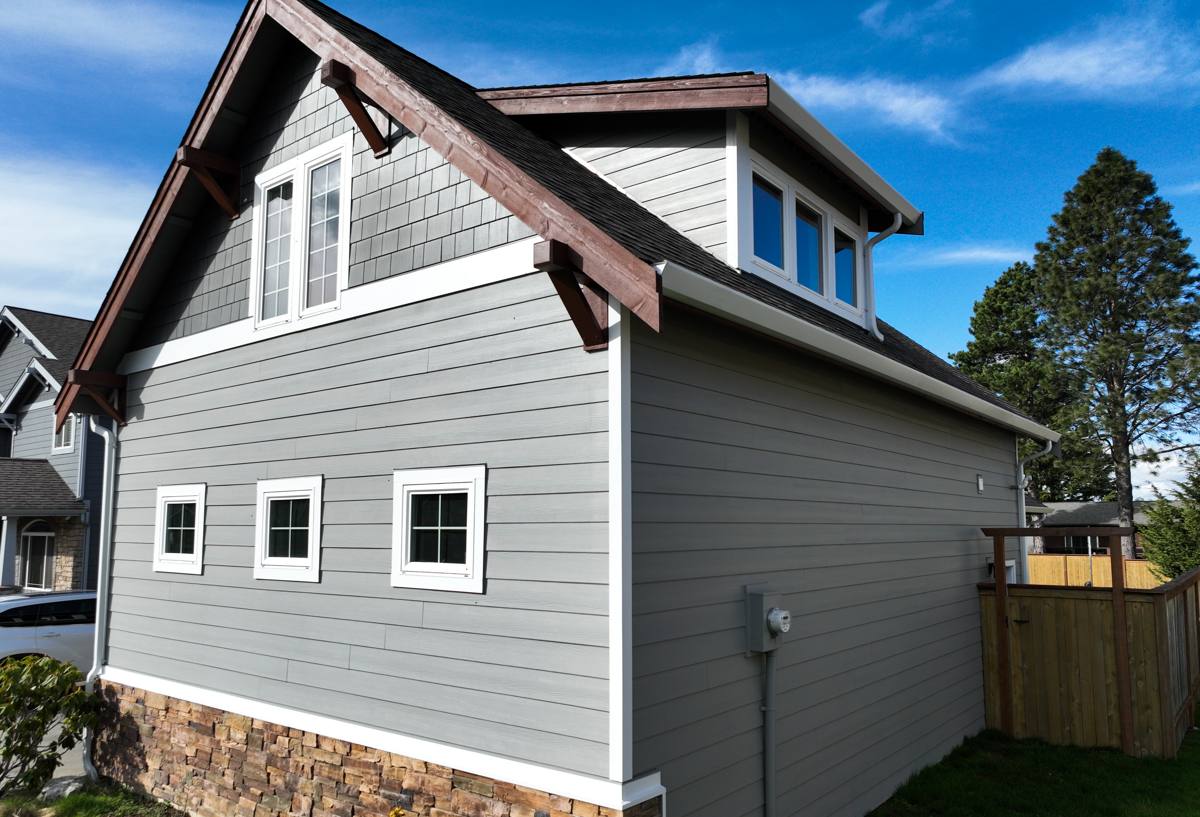
Why We Install Only James Hardie Fiber Cement
We made a decision early on to standardize on one siding system rather than offer a menu of products with different failure modes. James Hardie fiber cement is what we put on homes, and it's the only siding brand we install. That's not a marketing position — it's a practical one, built around what actually holds up in a climate like this one.
Fiber cement is a mix of cement, sand, and cellulose fiber, which makes it non-combustible and dimensionally stable in a way that wood-based and foam-core products aren't. It doesn't absorb water the way engineered wood siding can, and it doesn't rely on a sealed edge to keep moisture out the way vinyl relies on a lapped, unglued installation. James Hardie also makes an HZ5 product line engineered specifically for climate zones like ours — cold, wet, and cycling through freeze-thaw more winters than not.
What This Means in Practice
- ColorPlus factory-applied finish, baked on rather than field-painted, holds color and resists fading and chipping better than most site-applied paint jobs
- Fiber cement doesn't swell, rot, or delaminate the way wood-based products can when moisture gets behind them
- Non-combustible material, which matters for insurance conversations and general peace of mind
- A manufacturer warranty structure that's transferable, which protects resale value if you sell the home
Why We Don't Install LP SmartSide, Vinyl, or Cedar
Homeowners in Lynden often ask us directly why we don't offer the products other contractors sell, so we'll be straightforward about it.
LP SmartSide and Engineered Wood
LP SmartSide is a legitimate product with real strengths — it's lighter than fiber cement, easier to cut, and performs well in a lot of climates. Its core is still wood strand treated with resin and zinc borate, which means its long-term performance depends heavily on edges and cut ends staying sealed. In a climate with as much sustained moisture exposure as Whatcom County gets, any gap in that sealing — at a butt joint, around a penetration, at the bottom kick-out — becomes the spot where moisture gets in and doesn't leave quickly. We'd rather not build a warranty conversation around field-sealing diligence.
Vinyl Siding
Vinyl is inexpensive and low-maintenance in the sense that it never needs painting, but it's not sealed to the wall — it's designed to hang loose and expand and contract with temperature. That gap behind vinyl is exactly where moisture, insects, and eventually mold can sit unnoticed for years. Vinyl also becomes brittle with age and UV exposure, and it can't match the factory-baked color depth or the ability to hold up architectural detail that fiber cement offers.
Cedar and Primed Spruce
Cedar has real appeal — it's a beautiful, traditional Pacific Northwest material. But real wood siding in a climate this wet requires an ongoing maintenance commitment: re-staining or re-painting on a cycle, careful caulking, and vigilance about moss and mildew that most homeowners don't want to sign up for indefinitely. Primed spruce carries similar exposure risk with less of cedar's natural rot resistance. We'd rather install something that doesn't ask a homeowner to maintain it that closely just to avoid rot.
Allura and Cemplank
These are also fiber cement products, and fiber cement as a category is sound. Our reason for standardizing on James Hardie specifically comes down to the depth of their climate-engineered product lines, the strength and transferability of their warranty, and consistency of the ColorPlus finish system — factors that matter over a 30-plus year siding life, not just at installation.
How Our Exterior Services Work Together in Lynden
Siding rarely fails in isolation. The same rain and moisture load that wears on siding also affects roofing, windows, and any exterior decking, so we look at the whole envelope of a home rather than treating each trade as a separate project.
| Service | What We Check on a Lynden Home |
|---|---|
| Siding | Moisture behind existing cladding, moss/algae staining, trim condition, flashing at windows and doors |
| Roofing | Moss growth, valley and flashing condition, gutter function feeding into siding drainage |
| Windows | Seal failure, condensation between panes, flashing integration with new or existing siding |
| Decks | Ledger board attachment and flashing, fastener corrosion, board spacing for drainage |
When we're re-siding a home, we're also looking at how the roofline sheds water onto the walls below, whether window flashing is integrated correctly with the new siding, and whether a deck ledger is contributing moisture to a nearby wall. Fixing siding without addressing a roof that's dumping water in the wrong spot just moves the problem, it doesn't solve it.
What Correct Installation Looks Like
James Hardie siding performs the way it's designed to when it's installed to the manufacturer's specification — and it underperforms when it isn't. This is where a lot of the difference between a good siding job and a mediocre one actually lives, more than in the product choice itself.
- Proper starter strip and flashing at the foundation line, so water sheds away from the wood framing behind it
- Correct fastener spacing and type — Hardie is specific about nailing patterns, and shortcuts here affect wind resistance and panel integrity
- A drainage plane (weather-resistant barrier plus rainscreen or furring where appropriate) behind the siding, especially important in a climate where the wall assembly stays damp for extended stretches
- Correctly sized and caulked joints at window and door penetrations, the single most common point of water intrusion on any siding job
- Proper clearance at the bottom edge so panels aren't sitting in standing water or buried in landscaping mulch
We install to spec because the warranty and the performance both depend on it. A product installed loosely to spec voids protections the homeowner is counting on.
Moss, Algae, and Shade: The Lynden-Specific Problem
Because much of Whatcom County has tree cover and long wet seasons, north- and east-facing walls — the sides that get the least direct sun — are where we see the most moss and algae staining on siding, regardless of brand. James Hardie's factory finish resists staining better than raw wood or unfinished materials, and its non-porous surface makes moss and algae easier to clean off without damaging the material underneath. It's not immune to organic growth in shaded, damp spots, but it doesn't provide the porous surface that mold and mildew need to really take hold the way wood-based sidings can.
Simple Homeowner Maintenance Checklist
- Rinse siding annually, focusing on shaded north/east walls where moss accumulates
- Keep gutters clear so overflow doesn't run down the wall face
- Trim back vegetation and hedges that keep siding in constant shade and moisture
- Check caulking at windows, doors, and trim joints every year or two and re-caulk as needed
- Look at the bottom few inches of siding after heavy rain seasons for staining or softness
Cost Factors for a Lynden Siding Project
Every home is different, but the factors that move a siding project's cost are consistent. We'll always give you specifics after walking your property, but here's what generally drives the number.
| Factor | Why It Matters |
|---|---|
| Home size and wall complexity | More corners, gables, and dormers mean more cutting, flashing, and labor time |
| Existing siding removal | Tear-off and disposal of old siding adds labor and material costs |
| Underlying sheathing condition | Rot or moisture damage found during tear-off may need repair before new siding goes on |
| Siding profile and finish | Lap width, shingle-style panels, and trim details affect material and install cost |
| Access and site conditions | Tree cover, slope, and tight lot lines in some Lynden neighborhoods affect scaffolding and staging |
Why a Local Crew Matters Here
A crew that works this region regularly knows what to expect before they even start a tear-off: where moisture tends to have gotten into older homes, which wall orientations need extra attention to moss and staining, and how the shoulder-season rain windows affect scheduling. That local knowledge shows up in small decisions throughout a project — how a flashing detail gets handled, when to flag rot that needs addressing before new siding goes up, how a job gets sequenced around the wetter months. It's the difference between a crew that's installing a product and a crew that's building an exterior meant to hold up in this specific place.
We handle siding, roofing, windows, and decks for homes throughout the Bellingham and Lynden area, and we bring the same standard — James Hardie fiber cement, installed to spec — to every siding project we take on.
Get a Free, No-Pressure Estimate
If your Lynden home's siding is showing its age, or you're planning ahead before it becomes an urgent repair, we're glad to come take a look. There's no cost and no pressure — just a straightforward assessment of what your exterior needs and what it would take to get it there with James Hardie siding built for Whatcom County's climate.