 Bellingham
 Ferndale's Exterior Climate: Salt, Rain, and Moss
Ferndale sits close enough to the water and to Whatcom County's marine air that homes here take a different kind of beating than houses further inland. It's not dramatic weather — no hail, no ice storms to speak of — but it's relentless. Salt-tinged air, long stretches of driving rain, and short, low-angle winter sun combine to create conditions that slowly wear down the wrong exterior materials while barely touching the right ones. After years of working on homes throughout Whatcom County, we've learned that Ferndale's exterior problems are rarely sudden. They build for a decade, hidden under paint or behind trim, until a homeowner notices soft siding, curling shingles, or a green haze creeping up the north wall.
Marine air and salt exposure
Ferndale's location, with open water and tidal influence nearby, means many homes get a steady dose of salt-laden air, especially on days with wind off the water. Salt is corrosive to fasteners, hard on paint film, and accelerates the breakdown of materials that weren't engineered to handle it. Over time, salt air pulls moisture into porous or poorly sealed exterior products, and that moisture is what actually does the damage — swelling wood fiber, lifting paint, and corroding uncoated metal.
Driving rain and wind-driven moisture
Whatcom County doesn't get the heaviest rainfall totals in Washington, but Ferndale's open exposure means rain often arrives sideways rather than straight down. Wind-driven rain finds every gap in flashing, every hairline crack in caulk, and every seam where two materials meet. Siding and trim that would perform fine in a sheltered inland yard can fail years early here simply because water gets pushed into places it was never supposed to reach.
Moss and the long shade season
Between the rain, the marine humidity, and the shade cast by mature Douglas fir and cedar trees common to this part of Whatcom County, moss and algae have ideal growing conditions for much of the year. Moss on a roof holds moisture against shingles far longer than open sky ever would. Algae streaking on north-facing siding is mostly cosmetic, but it's also a sign that a surface is staying damp longer than it should — and damp-longer is exactly the condition that shortens the life of the wrong siding material.
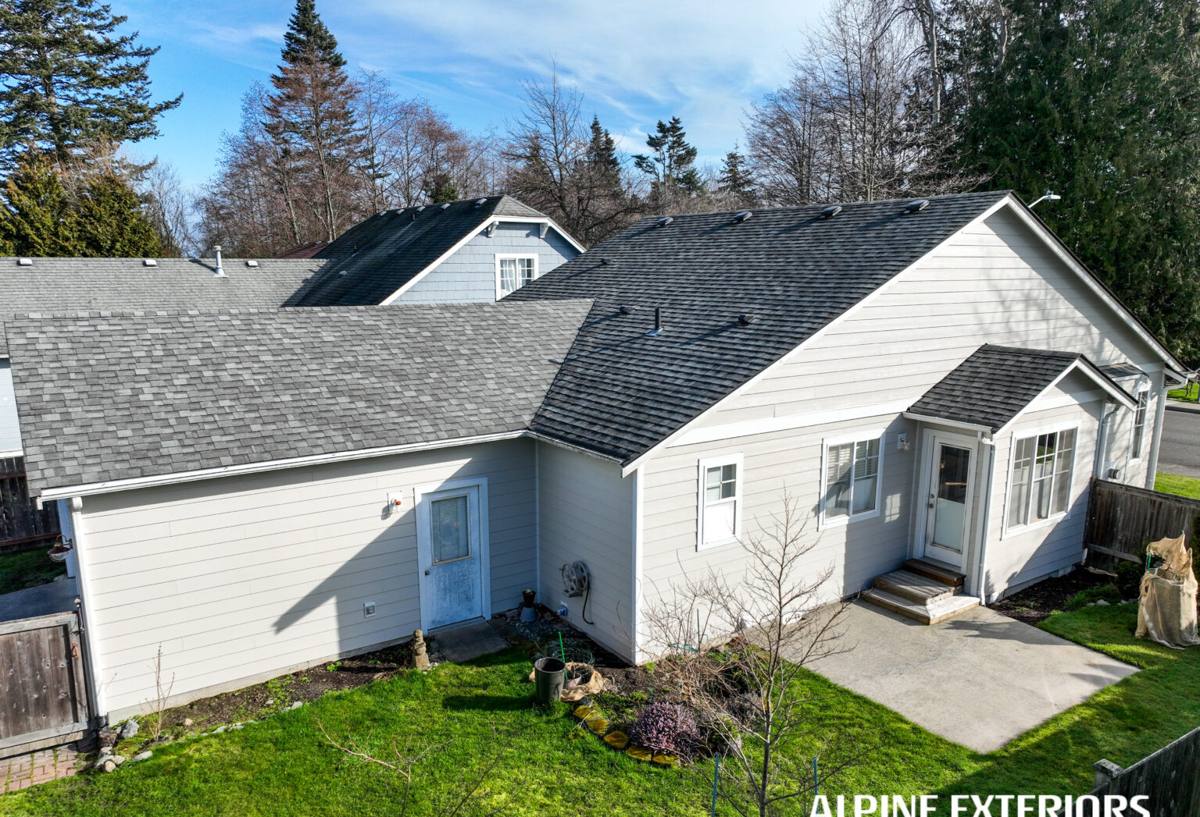
What This Means for Siding, Roofing, Windows, and Decks
Every exterior system on a Ferndale home is fighting the same three things: salt air, driving rain, and prolonged dampness from shade and moss. Siding takes the brunt of it because it's the largest surface area on the house. Roofing deals with moss directly and needs venting and moss-resistant materials. Windows need flashing and sealant details that account for wind-driven rain, not just vertical rainfall. Decks, especially those without much cover, face repeated wet-dry cycling that loosens fasteners and opens joints in lesser materials over a handful of seasons.
We work on all four — siding, roofing, windows, and decks — because they're interconnected. A roof that sheds water poorly will stain and saturate the siding below it. A window with failed flashing will rot the wall cavity around it regardless of how good the siding is. Treating the exterior as one system, rather than four unrelated projects, is how you actually solve Ferndale's climate problems instead of patching them one at a time.
Why We Install Only James Hardie Fiber Cement Siding
We made a deliberate decision to install James Hardie fiber cement exclusively, and we don't install vinyl, LP SmartSide, Cemplank, Allura, primed spruce, or cedar. That's not a marketing position — it's a standard we hold because of what we've seen play out on real homes in this exact climate.
What other products get right
To be fair to the alternatives: vinyl is inexpensive and low-maintenance in mild climates. LP SmartSide is a genuine engineered wood product with real strengths in dry, inland regions. Cedar has a natural look that some homeowners love and will pay a premium for. None of these products are junk. They're simply not what we'd choose to put on a home that sits in salt air with a long wet season and heavy shade.
Why we don't install them here
Vinyl siding can warp and distort when temperatures swing, and its seams and J-channels give wind-driven rain more entry points than a properly lapped fiber cement installation. It also can't be painted a dark color without risking heat-related warping, which limits design options homeowners in the Pacific Northwest often want. LP SmartSide and other engineered wood products are wood-based, meaning any sustained moisture intrusion — through a caulk failure, a poor flashing detail, or years of driving rain finding a seam — can lead to swelling and, eventually, rot at the edges. Cedar and primed spruce are natural wood; they look great fresh but demand a repainting and recaulking schedule that most homeowners underestimate, and in a moss-prone, shaded climate they're fighting organic growth on their own surface constantly. Cemplank and Allura are fiber cement competitors to Hardie, and while the category itself is sound, we've standardized on one manufacturer so our crews install one system to spec, every time, rather than switching techniques and details between brands.
James Hardie Product Lines and ColorPlus Finish
James Hardie fiber cement is non-combustible, dimensionally stable, and manufactured with region-specific engineering — the HardieZone system accounts for the difference between a dry inland climate and a wet coastal one. Whatcom County falls in the HZ10 zone, meaning the boards specified for this area are formulated for consistent moisture exposure rather than freeze-thaw cycling.
ColorPlus finish is baked on at the factory under controlled conditions, rather than field-painted on site. That matters directly for Ferndale's salt air and rain: a factory finish resists fading and chipping far better than field-applied paint, and it removes the recurring repaint cycle that wood and primed products require. Hardie's product lines — lap siding, panel siding, shingle-style siding, and trim — let us match a wide range of architectural styles while keeping the same underlying material performance across the whole exterior.
Roofing, Windows, and Decks: The Rest of the Envelope
Siding is only part of the picture. On the roofing side, we pay close attention to ventilation and moss-resistant material choices, since moss retention is one of the more predictable problems on shaded Ferndale lots. On windows, correct flashing and sealant integration around the siding is often what determines whether wind-driven rain stays outside the wall or finds its way in — this is an installation detail as much as a product choice. On decks, material selection and proper fastener choice matter more here than in drier climates, since repeated wet-dry cycling is harder on standard hardware and lower-grade lumber over time.
Comparing Siding Options for a Climate Like Ferndale's
| Factor | Vinyl | Engineered Wood (LP SmartSide) | Cedar / Primed Spruce | James Hardie Fiber Cement |
|---|---|---|---|---|
| Moisture tolerance | Moderate; seams vulnerable | Wood-based; sensitive to sustained moisture | Natural wood; needs ongoing sealing | Engineered for coastal/wet exposure |
| Salt air performance | Can become brittle over time | Coatings wear, exposing wood | Requires frequent maintenance | Non-combustible, stable material |
| Moss/algae resistance | Cosmetic staining only | Organic growth on damp surfaces | Prone to growth without upkeep | Factory finish resists staining longer |
| Repaint/refinish cycle | Rarely painted; limited color change | Every 5-10 years typically | Every 3-7 years typically | ColorPlus factory finish, longer intervals |
| Typical warranty structure | Varies by manufacturer | Varies by manufacturer | Largely maintenance-dependent | Strong transferable manufacturer warranty |
This table reflects general product characteristics, not a claim that any of these materials will fail on a given home — installation quality, maintenance habits, and site conditions all matter. It's simply why, given Ferndale's specific mix of salt air, rain, and shade, we've chosen to build our business around one material rather than offer all of them.
What Drives Cost on a Ferndale Exterior Project
Every project is different, but a few factors consistently move the price on siding, roofing, window, and deck work in this area:
- Extent of any existing moisture damage or rot that needs to be addressed before new material goes on
- House size, wall complexity, and the amount of trim and detail work involved
- Product line and finish selected (standard lap siding versus shingle-style or panel systems)
- Accessibility of the site, including tree cover, slope, and how much scaffolding or staging is required
- Whether roofing, windows, or decking are being addressed as part of the same project versus siding alone
We give straightforward, written estimates so homeowners can see exactly what's driving the number, rather than a single lump figure.
A Maintenance Checklist for Ferndale Homeowners
Whatever siding a home currently has, a few habits go a long way in this climate:
- Walk the exterior once a year, ideally after the wettest months, and look for soft spots, peeling paint, or dark staining
- Keep gutters clear so water isn't overflowing directly onto siding or trim below
- Trim back tree branches and vegetation that keep walls in constant shade and dampness
- Check caulking around windows, doors, and trim joints annually — this is where wind-driven rain gets in first
- Address any moss buildup on roofing promptly, since it holds moisture against the surface far longer than an open roof
Why a Local Crew Matters
A crew that works throughout Whatcom County day in and day out knows which details actually matter here — how deep to set flashing given the wind direction, which wall orientations take the worst of the weather, and where moss problems tend to start. That local knowledge shows up in the small installation decisions that don't appear on a spec sheet but make the difference between siding that lasts and siding that needs attention again in five years. It also means a real person answering the phone if a question comes up after the job is done, not a call center in another state.
If you're weighing a siding, roofing, window, or deck project on a Ferndale home, we're glad to take a look and talk through what we're seeing and what we'd recommend. Reach out for a free, no-pressure estimate using the form below.