 Bellingham
 Why Ferndale Siding Wears Differently Than Siding Inland
Ferndale sits close enough to the water and open farmland that its homes take on a specific combination of stresses most siding materials weren't designed to handle all at once. There's salt-laden air drifting in off the Strait of Georgia and Bellingham Bay, long stretches of driving rain that comes in sideways during winter storms, and a moss and algae season that, in Whatcom County, can run nine months of the year on a shaded north wall. Individually, most siding products can shrug off one of these. Together, over years, they find every weak point in a wall system.
That's the context we bring to every repair call in Ferndale. A crack that looks cosmetic in July can be a moisture pathway by the following spring. A little green film at the base of a wall isn't just an eyesore — it's a sign the siding is staying wet longer than it should. Repairing siding correctly here means understanding not just what's damaged, but why it failed in this particular climate.
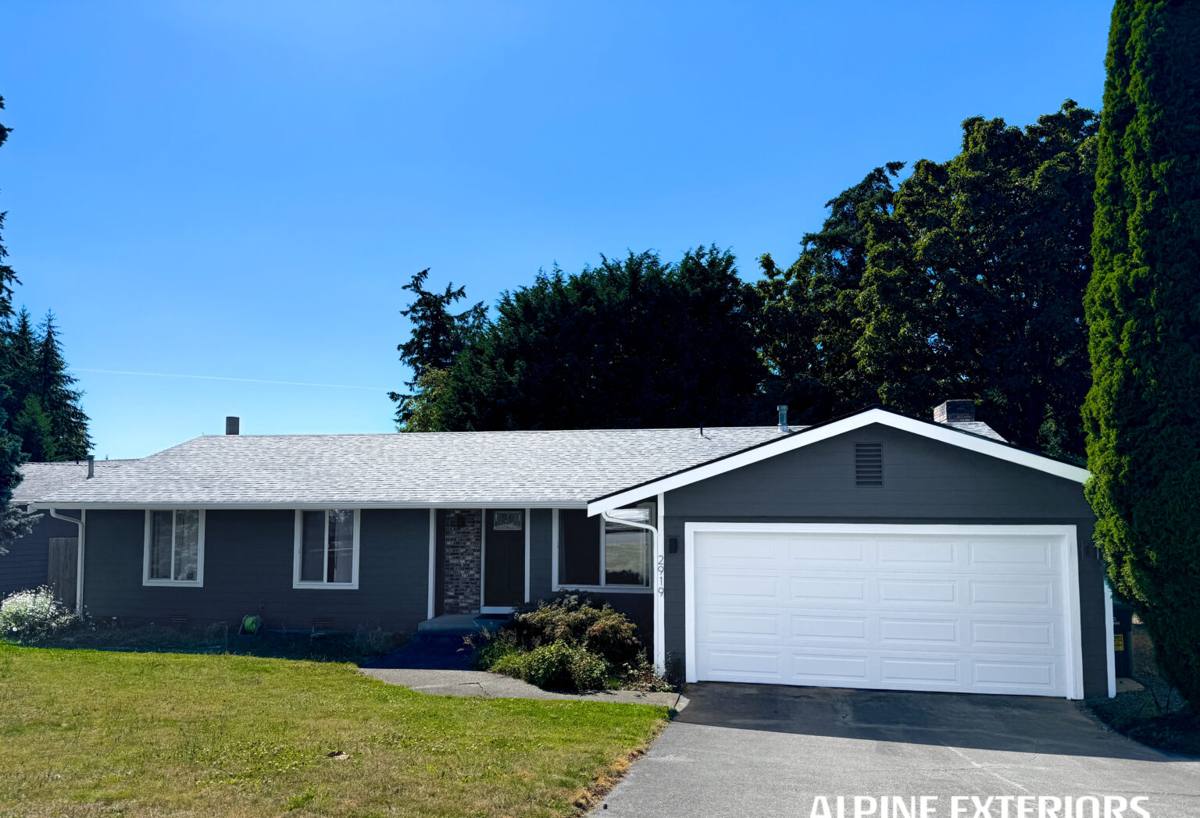
Signs Your Siding Needs Repair Now, Not Later
Siding damage rarely announces itself loudly. It shows up as small details that are easy to write off for another season — until the deferred maintenance turns into a much bigger job. Here's what we tell Ferndale homeowners to watch for:
- Cracked, split, or bowed boards, especially near corners and window trim
- Soft or spongy spots when you press on the siding by hand
- Persistent moss, algae, or black staining that comes back within weeks of cleaning
- Paint that's peeling, bubbling, or failing faster than it should for its age
- Gaps opening up at seams, butt joints, or where trim meets siding
- Visible daylight or drafts felt from inside near exterior walls
- Rust streaks from fasteners, or fastener heads backing out of the surface
- A musty smell in an interior room that shares a wall with a damaged section
Any one of these on its own might just need a straightforward patch. Several together, especially clustered on the same wall, usually means water has been getting behind the siding for a while and the repair needs to start with what's underneath it, not just what's visible.
Where Damage Shows Up First on Ferndale Homes
We see a consistent pattern on repair calls in this area. North- and west-facing walls, which catch the brunt of driving rain and stay shaded longest, are usually first to show moss growth and paint failure. Lower courses near grade and areas around downspouts take the worst water exposure. Trim boards around windows and doors — where two materials meet and caulk is doing a lot of the work — are almost always where we find the earliest signs of moisture intrusion, well before the field of the siding itself looks compromised.
What a Correct Siding Repair Actually Involves
A repair that just covers the visible problem without addressing its cause tends to fail again within a year or two — sometimes worse than before, because now there's trapped moisture behind a fresh patch. A repair done right follows a sequence:
- Diagnose before you touch anything. We remove the damaged section and check what's behind it — house wrap, flashing, sheathing — before deciding on a repair plan. If the water intrusion has reached the sheathing, that gets addressed first.
- Check the moisture path, not just the symptom. A cracked board is the symptom. The cause might be a failed caulk joint above it, a missing kick-out flashing, or a downspout dumping water directly onto that section. Fixing the board without fixing the path just buys time.
- Match the material and profile. Replacement boards need to match the existing reveal, thickness, and texture so the repair doesn't stand out as a patch. This matters even more on ColorPlus-finished fiber cement, where color consistency depends on using the right product line.
- Rebuild the water management, not just the surface. Correct flashing, properly lapped house wrap, and the right gap at the bottom of the siding are what keep the next storm from causing the same damage again.
- Finish to spec. Fasteners set at the correct depth, caulk used only where it belongs (not as a substitute for proper flashing), and paint or factory finish matched cleanly at the seams.
Repair vs. Replacement: How We Decide
Not every damaged wall needs full replacement, and not every repair is worth doing instead of replacing. We walk Ferndale homeowners through the actual trade-offs rather than defaulting to the bigger job. Here's generally how the decision breaks down:
| Factor | Favors Repair | Favors Replacement |
|---|---|---|
| Extent of damage | Isolated to one or two walls or sections | Spread across most of the exterior |
| Underlying moisture | Sheathing and wrap are still sound | Rot has reached framing or is widespread |
| Age of siding | Siding is well within its expected service life | Siding is old, brittle, or a discontinued product |
| Material match | Matching boards/profile are still available | Product is obsolete or mismatched to what's needed |
| Root cause | Cause is identifiable and fixable locally | Cause is systemic (wall assembly, grading, ventilation) |
When the damage is contained and the wall assembly underneath is sound, a focused repair is the honest recommendation — there's no reason to sell a Ferndale homeowner a full re-side when a section replacement solves the problem. When the damage points to a bigger, systemic moisture issue, we say so plainly and explain why patching would just be a short-term fix.
Why We Repair and Replace With James Hardie Fiber Cement Only
When a repair calls for new boards, or when a section needs to be replaced rather than patched, we use James Hardie fiber cement exclusively. It's not the only siding product on the market, but it's the one we've standardized on because it holds up to exactly the conditions Ferndale deals with: it's non-combustible, it doesn't feed moss and algae growth the way wood-based products can, and its HZ5 product line is engineered for the kind of wet, moderate Pacific Northwest climate Whatcom County sits in. The ColorPlus factory finish also means a repaired section can be color-matched with far more consistency than field-painted alternatives, so the patch doesn't stand out five years later.
We don't install vinyl, LP SmartSide, or primed wood siding, even for repair work, because we don't want to warranty a fix with a product we don't believe holds up as well in this climate. If your existing siding is a different material, we'll still assess and repair it honestly — but if the conversation moves toward replacement, Hardie is what we'll recommend and what we'll install.
Our Repair Process, Start to Finish
We keep the process straightforward and try not to make more of a mess than the repair requires:
- On-site inspection. We look at the damaged area and the walls around it, and check for moisture behind the surface, not just what's visible from the ground.
- Honest scope and estimate. You get a clear explanation of what's actually wrong, what a repair involves, and what it costs — including whether repair or partial replacement is the better call.
- Scheduling around Whatcom County weather. Repair work needs a reasonably dry window, so we plan around the forecast rather than rushing a patch into a wet wall.
- The repair itself. Removal of damaged material, correction of the underlying cause, installation of matched replacement boards, and proper flashing and sealing.
- Finish and cleanup. Paint or finish matched as closely as possible, site cleaned of debris and old material.
Why It Matters to Hire a Crew That Already Works in Ferndale
Siding repair looks straightforward from the outside — pull a board, put in a new one — but the diagnosis is where the real skill is, and that diagnosis is shaped by knowing the local conditions. A crew that regularly works in Ferndale and the surrounding parts of Whatcom County has already seen how salt air corrodes certain fasteners faster than expected, which wall orientations hold moisture longest given the local rain patterns, and how aggressively moss establishes itself on shaded siding here compared to drier parts of the state. That local pattern recognition is what keeps a repair from becoming a callback.
It also matters for something more practical: availability. A contractor based nearby can respond faster when a storm damages siding or when a small problem needs to be looked at before it grows, rather than scheduling around a long drive from out of the area.
Maintaining Siding After a Repair
A correct repair should hold up for years, but a little regular attention keeps it — and the rest of the siding — from needing the same fix again:
- Rinse moss and algae off shaded walls before it establishes a thick mat, rather than after
- Keep gutters and downspouts clear so water isn't dumping directly onto a wall
- Trim back vegetation that keeps siding shaded and damp longer than it needs to be
- Check caulk joints around windows and trim annually, and recaulk before they visibly fail
- Walk the exterior once a year, especially after a hard winter, looking for the early signs listed above
If you're seeing damage, staining, or soft spots on your Ferndale home's siding, we're happy to take a look and give you a straightforward read on what's going on and what it would take to fix it properly. Reach out for a free, no-pressure estimate using the form below.