 Bellingham
 Sehome's Exterior Climate, in Plain Terms
Sehome sits close to Bellingham Bay, wrapped around Sehome Hill and its tree cover, which means homes here deal with a specific combination of exposures: salt-tinged marine air rolling in off the water, long stretches of driving rain through fall and winter, and enough shade and humidity from the surrounding trees to keep moss and algae in business most of the year. None of that is unique to one street or one house style in the neighborhood — it's the baseline for exterior materials anywhere in this part of Whatcom County. What changes from house to house is how well the siding, trim, roofing, and flashing were built to handle it.
We work on homes throughout Bellingham, and Sehome's mix of older bungalows, mid-century houses, and newer infill construction gives us a good cross-section of how different exterior materials age under the same weather. The short version: material choice and installation quality matter more here than in a drier, more sheltered inland climate, because the margin for error is smaller.
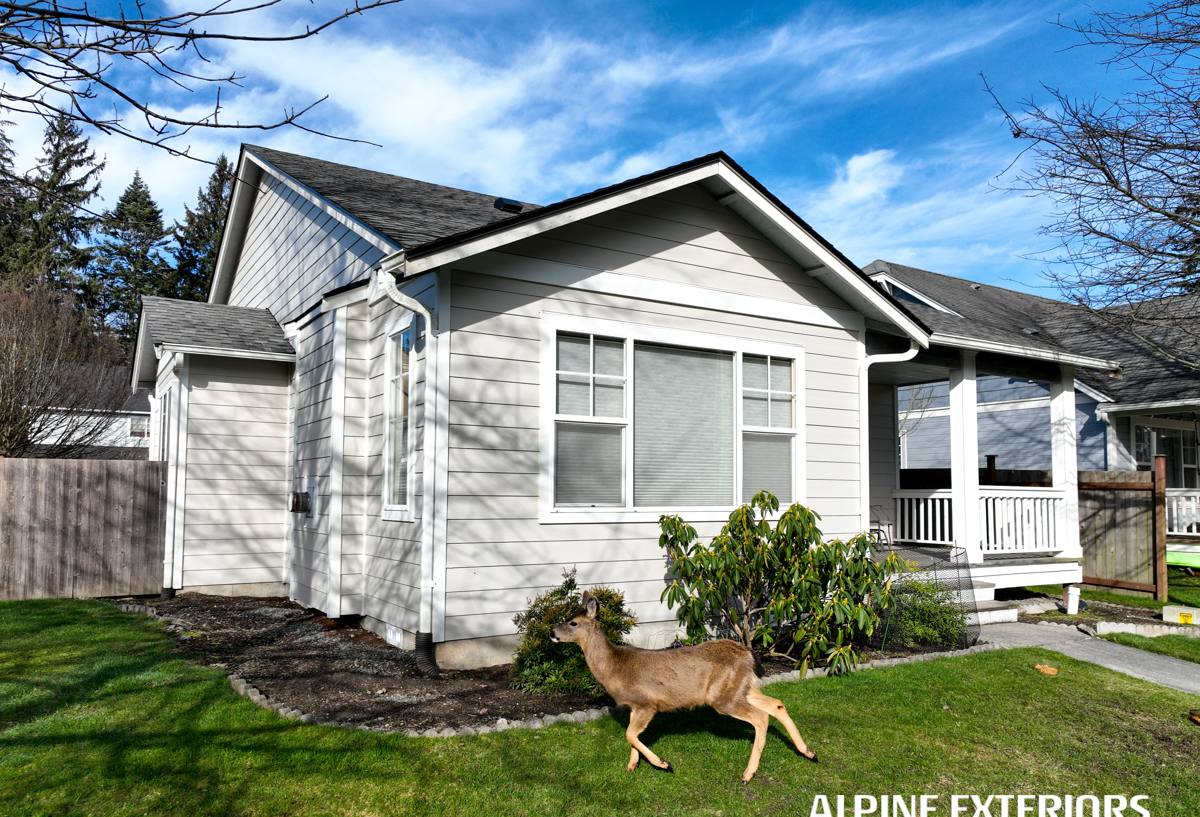
What Marine Exposure Actually Does to a House Over Time
It helps to understand the mechanism, not just the symptom. A few things are happening at once on a Sehome exterior:
- Moisture cycling: siding and trim get wet from rain, partially dry between storms, then get wet again — repeatedly, for months. Materials that absorb water during that cycle (rather than shedding it) swell, and swelling is what eventually cracks paint, opens seams, and rots wood fiber.
- Shade and airflow: tree-lined lots dry out slower after a storm. Slower drying means more time for moss, algae, and mildew to establish on siding, trim, and roofing.
- Salt-influenced air: proximity to the bay adds a mild corrosive element to the mix, which mostly shows up in fasteners, flashing, and metal trim rather than the siding panel itself — but it's one more reason material and hardware selection matters.
- Wind-driven rain: Bellingham's storms don't just fall straight down; they get pushed sideways into wall assemblies, which puts real pressure on caulking, seams, and butt joints that a calmer climate wouldn't test as hard.
Individually, none of these is dramatic. Compounded over ten or fifteen Bellingham winters, they're exactly what separates a house that still looks sharp from one that's chalky, moss-streaked, and soft at the bottom courses.
Why We Install Only James Hardie Fiber Cement
We get asked fairly often why we don't offer vinyl, LP SmartSide, or other fiber cement brands alongside Hardie. The honest answer is that we've chosen to specialize rather than stock every option, and for a climate like Sehome's, fiber cement — specifically James Hardie's — is the product we're comfortable standing behind long-term.
Fiber cement is cement, sand, and cellulose fiber. It doesn't absorb and swell the way engineered wood products can, and it doesn't expand and contract with temperature the way vinyl does, which matters when a wall is going through repeated wet-dry cycles for half the year. James Hardie also builds region-specific product engineering into its lineup — its HZ5 formulation is designed for climates with more moisture exposure, which the Pacific Northwest qualifies for. That's a meaningful distinction from a generic, one-size-fits-all siding product.
The factory-applied ColorPlus finish is the other piece. It's baked on and warrantied against fading and peeling for a set number of years, which matters in a shaded, damp neighborhood where repainting siding is an unpleasant, recurring chore. We're not going to tell you Hardie needs zero maintenance — no siding does, and the trim, caulking, and flashing around any product still need periodic attention — but the field of options we'd need to repaint or patch shrinks considerably with Hardie compared to primed wood or engineered wood siding.
We also won't install vinyl on a marine-climate home as a matter of standard practice. It's inexpensive and low-maintenance in the sense that it doesn't need repainting, but it has real limits: it can warp or crack in temperature swings, seams are visible rather than integrated, and it doesn't hold up as a fire-resistant or long-term structural cladding the way fiber cement does. For a Sehome home that's going to sit through a lot of wet, mild-to-cold cycles, we think fiber cement is the better long-term investment, and we'd rather be straightforward about that than sell a product we don't fully trust for the climate.
What "Climate-Engineered" Actually Means
James Hardie doesn't sell one plank nationwide. The company engineers product lines for different climate zones — HZ5 for colder, wetter regions like ours, HZ10 for hot-humid and coastal Southeast climates. That distinction shows up in the moisture management and application details baked into the product, not just marketing language. When we quote a Sehome job, we're specifying the version of the product actually built for this climate, not a generic national default.
It's Not Just Siding: Roofing, Windows, and Decks Face the Same Climate
We do full exteriors — siding, roofing, windows, and decks — because on a house like the ones common in Sehome, those systems are interdependent. Moss that builds up on a north-facing roof slope is the same moisture and shade problem showing up on the siding below it. A window that isn't properly flashed lets wind-driven rain track down behind the wall assembly, which can damage siding and sheathing from the inside out long before it's visible from the street. A deck built without attention to ledger flashing and end-grain sealing will rot at the connection points first, exactly where it meets the house.
When we look at a Sehome property, we're looking at the whole envelope, not just the wall covering. That's partly why re-siding is often a good moment to also address roofing or window flashing issues — it's far cheaper to fix them together than to open the wall assembly back up a few years later because a separate problem was never addressed.
What Correct Installation Looks Like Here
Fiber cement siding performs the way it's rated to perform only when it's installed correctly, and a marine climate leaves less room for shortcuts. On every Sehome-area job, the details that matter most are:
- Proper rain-screen gap or drainage plane behind the siding, so incidental moisture has somewhere to go instead of sitting against the wall sheathing.
- Correct flashing at every horizontal joint, window, and door — this is where the majority of long-term moisture problems actually originate, not the siding panels themselves.
- Manufacturer-specified fasteners and nailing patterns, since under-fastened or over-driven fasteners are one of the most common causes of premature failure on fiber cement.
- Factory-mitered or properly sealed butt joints, since a caulk-only seam is the first thing wind-driven rain will find and exploit.
- Adequate clearance between the bottom of the siding and grade, decks, or roof lines, so splashback and standing moisture don't sit against the material.
None of this is exotic — it's standard best practice for fiber cement installation — but it's also exactly the kind of detail that gets skipped when a crew is unfamiliar with the product or moving fast. In a climate that tests every seam and joint the way Bellingham's does, installation quality is arguably as important as the material choice itself.
Cost Factors: What Actually Drives the Price on a Sehome Job
| Factor | Why It Matters Here |
|---|---|
| Home size and wall complexity | More corners, gables, and dormers mean more cuts, flashing details, and labor time |
| Existing siding removal and sheathing condition | Moisture damage under old siding is common in shaded, marine-exposed homes and may need repair before new siding goes on |
| Siding profile and ColorPlus color selection | Lap width, shingle-style panels, and factory colors vary in material cost |
| Trim and accessory scope | Corner boards, window trim, and fascia work add labor but improve long-term water management |
| Access and site conditions | Tree-lined, sloped, or tightly spaced lots common in older Bellingham neighborhoods can affect staging and labor time |
We won't quote a number without seeing the house, but these are the variables that move a bid up or down more than anything else. A detailed, itemized estimate is the only way to know what a specific Sehome home actually needs.
Why a Local Crew Matters
A contractor who works Whatcom County regularly has already seen how marine exposure, tree cover, and driving rain interact with different house styles and ages around Bellingham — including the kind of moisture patterns that show up around Sehome's shadier, tree-lined lots. That familiarity shows up in small but real ways: knowing where moisture tends to collect on a given roof pitch, understanding the local permitting process, and having a realistic sense of how long a project takes given our weather windows, rather than working off a generalized national playbook.
It also means we're not disappearing after the job is done. Warranty work, follow-up questions, and normal wear-and-tear maintenance are a lot more straightforward with a crew that's still local and reachable, rather than a traveling outfit that moved on to the next region.
A Simple Checklist Before You Commit to an Exterior Project
- Ask what siding material is being proposed and why it's suited to a marine, wet-winter climate — not just what's cheapest to install.
- Confirm whether the quote includes flashing, rain-screen/drainage details, and trim work, or just the siding panels themselves.
- Ask to see the manufacturer's climate-specific product line being used, if fiber cement is proposed.
- Get the warranty terms in writing — both the manufacturer's product warranty and the contractor's workmanship warranty.
- Check that the contractor is licensed and insured to work in Washington, and ask how long they've worked in this specific region.
- If your roof, windows, or deck haven't been inspected recently, ask whether they should be addressed at the same time as siding.
Getting Started
If you're noticing moss buildup, chalky or peeling paint, soft spots near the bottom of your walls, or you're just planning ahead for a home in Sehome's marine climate, we're happy to take a look and walk you through what we're seeing — no pressure, no obligation. Request a free estimate below and we'll schedule a time to assess your home's exterior in person.