 Bellingham
 Siding Built for Where You Actually Live
Puget sits close enough to Bellingham Bay that the weather here isn't quite the same as siding weather ten miles inland. Homes in this part of Whatcom County deal with a combination most manufacturers' product literature never quite accounts for: salt-laced air rolling off the water, driving rain that comes in sideways more often than straight down, and a moss season that can run eight or nine months out of the year in the shadier lots. None of that is exotic or unusual for this corner of the Pacific Northwest, but it's a real load on exterior materials, and it shows up fastest on siding, trim, and roofing that wasn't specified for it.
We're a local exterior contractor, not a national franchise reading from a script. When we talk about Puget's climate, we're talking about the same weather hitting our own trucks, tools, and job sites every week. That matters when you're choosing a contractor, and it matters even more when you're choosing what material actually goes on the wall.
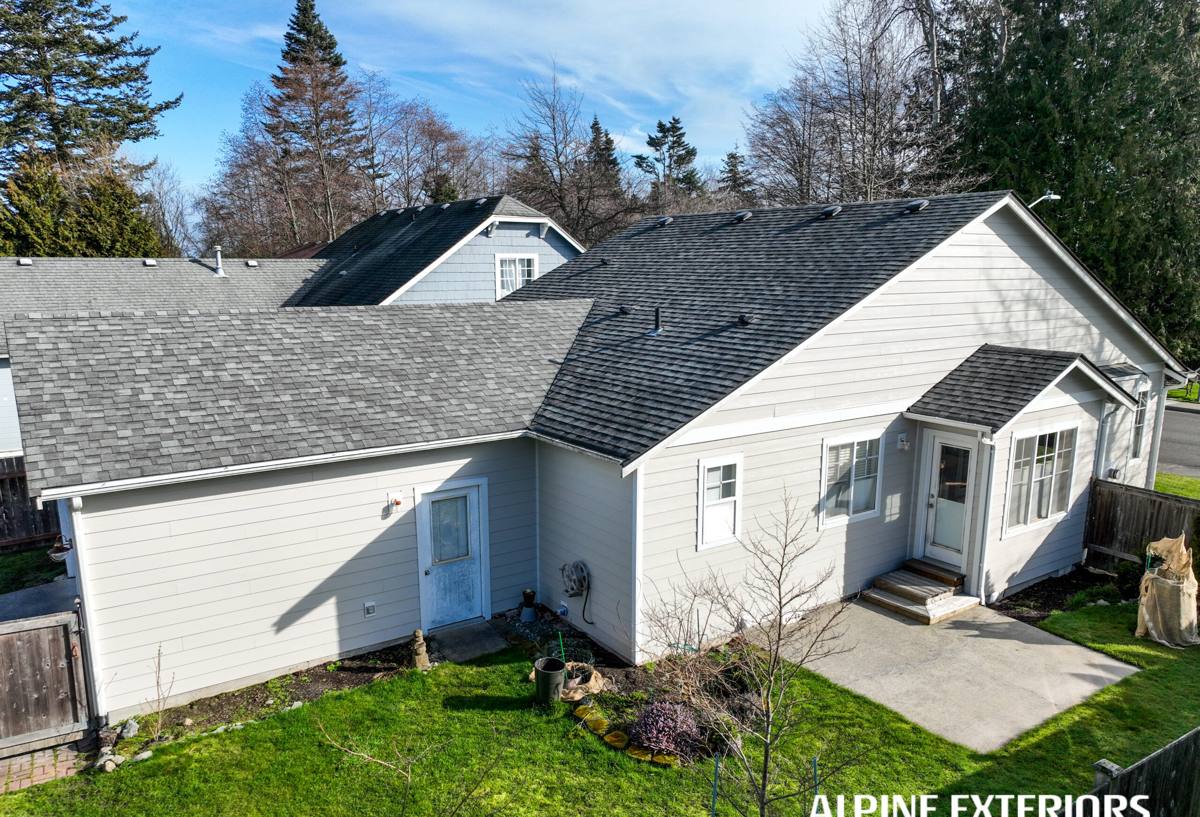
What Salt Air, Rain, and Moss Actually Do to a House
Salt Air
Proximity to Bellingham Bay means airborne salt is a constant, low-grade presence, not an occasional event. Salt is hygroscopic — it pulls moisture out of the air and holds it against whatever surface it lands on. Over years, that means fasteners corrode faster, paint film breaks down sooner, and any material with even a small amount of expansion-and-contraction movement gets stressed more than it would inland. Metal trim, uncoated fasteners, and lower-grade paint systems all show wear here before they would in Sumas or Deming.
Driving Rain
Wind off the water pushes rain sideways into wall assemblies, not just down onto roofs. That matters because a lot of siding failure isn't about the rain that falls — it's about the rain that gets driven behind lap joints, around window trim, and into seams that were never meant to be wet. A siding system's water-management detailing (how it sheds and drains, not just how it looks) is the difference between a wall that stays dry behind the cladding and one that's slowly rotting the sheathing nobody sees until there's a soft spot.
Moss and Sustained Moisture
Long, mild, wet stretches are ideal moss and algae conditions, especially on north- and west-facing walls that don't get much sun to dry out between storms. Moss itself isn't just cosmetic — it holds moisture against the surface underneath it, and on materials that aren't dimensionally stable or that swell when wet, that sustained dampness accelerates rot, delamination, and paint failure.
Why We Install Only James Hardie Fiber Cement
We get asked fairly often why we don't offer vinyl, LP SmartSide, cedar, primed spruce, or other fiber cement brands like Allura or Cemplank. It's not that every one of those products is without merit — some have real advantages in the right application. It's that we've made a professional decision to standardize on one product system we can install to spec, warranty with confidence, and stand behind for the long haul in exactly the conditions Puget homes face.
- Vinyl expands and contracts significantly with temperature swings, and in driving rain it relies heavily on correct lap and flashing details to keep water out from behind it — done wrong, it traps moisture rather than shedding it.
- Wood-based siding (cedar, primed spruce, engineered wood like LP SmartSide) is organic material. Even with resin treatments and factory coatings, sustained moisture and a long moss season put real pressure on paint film and edge sealing, and any breach becomes an entry point for rot.
- Other fiber cement brands are chemically similar to Hardie in the broad strokes, but we've standardized on one manufacturer so our crews install one system with total familiarity, one factory finish warranty applies consistently, and we're not troubleshooting three different flashing and fastening specs across jobs.
James Hardie's fiber cement is non-combustible, dimensionally stable across wet and dry cycles, and comes with a factory-applied ColorPlus finish that's baked on under controlled conditions rather than field-applied — which matters a great deal in an area where field-painted surfaces get less sun and more damp time to cure properly. It doesn't rot, and salt air doesn't degrade the cement substrate the way it does bare wood or lower-grade coatings.
Choosing the Right Hardie Product Line
Hardie makes several product lines engineered for different climate zones, and for the Pacific Northwest that means specifying their HZ10 formulation, built for wet, moderate-temperature climates rather than freeze-heavy or high-heat regions. Within that, homeowners are usually choosing between a few profiles:
| Product | Look | Best For |
|---|---|---|
| HardiePlank Lap Siding | Traditional horizontal lap, smooth or cedar-textured | Most homes; the standard workhorse profile |
| HardiePanel Vertical Siding | Vertical panels, often with battens | Modern styling, accent walls, gable ends |
| HardieShingle | Staggered or straight-edge shingle look | Craftsman and cottage-style homes |
| HardieTrim | Smooth trim boards | Window, corner, and fascia detailing |
Color selection matters too. ColorPlus finishes come pre-matched to trim and accessory colors, which keeps a driving-rain climate from creating the mismatched, weathered look that happens when field-painted trim ages at a different rate than factory-finished siding.
How We Detail Installation for This Climate
Fiber cement is only as good as its installation. In a wind-driven-rain environment, the details around water management are where a job either performs for thirty years or starts causing problems in five.
Water Management First
We flash window and door openings before siding goes on, use proper weather-resistant barriers behind the cladding, and maintain correct clearances at the ground, roofline, and deck ledger connections so water has somewhere to go besides into the wall assembly.
Fastening and Gaps
Hardie specifies exact nailing patterns, fastener types, and expansion gaps at butt joints and trim intersections. Skipping these — a common shortcut on rushed jobs — is how caulked joints crack and water finds its way behind the boards within a few winters.
Coastal-Grade Fasteners
Given the salt air here, we use corrosion-resistant fastener types appropriate for coastal-adjacent conditions rather than standard interior-grade hardware, so the fasteners don't become the weak point in an otherwise durable wall system.
More Than Siding: A Full Exterior Approach
Siding doesn't work in isolation. We also handle roofing, windows, and decks, because in a climate like this, the exterior envelope has to function as one connected system.
Roofing
A roof shedding water properly protects everything below it, including your new siding. Moss on a roof edge that isn't managed will eventually shed spores and moisture onto the wall beneath it.
Windows
Window flashing integrates directly with siding water management. Replacing windows and siding together lets us tie the flashing details into one continuous water path instead of patching around an existing, potentially failing detail.
Decks
Deck ledger boards are a notorious point of hidden rot when they're not flashed correctly against the house — and they sit right at the wall assembly Hardie siding is protecting. We treat that intersection carefully.
What to Look for in a Local Contractor
Puget homeowners have options, and it's worth being deliberate about who you hire, especially for a job that's supposed to last decades.
- Ask whether the crew is factory-trained on the specific product they're installing, not just "familiar with siding" in general
- Confirm who is responsible for a warranty claim — the manufacturer, the contractor, or both — and get it in writing
- Ask how they detail flashing at windows, corners, and the base of the wall, not just what siding brand they use
- Check that fastener and coating specs are appropriate for a coastal-adjacent, high-rainfall climate
- Get a written scope that names the specific product line, profile, and color system, not just "Hardie siding"
- Ask how they handle moss and organic growth removal on the existing structure before new siding goes on
Cost Factors for a Puget Siding Project
Every home is different, but the same handful of factors drive most of the cost variation we see on local jobs:
| Factor | Why It Matters |
|---|---|
| Home size and wall complexity | More corners, gables, and dormers mean more cutting, trim, and labor time |
| Existing siding removal | Tear-off and disposal of old material adds time versus a bare-sheathing situation |
| Sheathing and moisture repair | Hidden rot found once old siding comes off can add scope, especially near decks and windows |
| Product line and profile | Lap versus shingle versus vertical panel carries different material and labor costs |
| Trim and accessory scope | Full trim replacement versus reusing sound existing trim changes the total |
We won't know your real number until we've looked at your walls, but we'll always walk you through what's driving the estimate rather than handing you a flat figure with no explanation.
Maintaining Hardie Siding in a Wet Climate
Fiber cement is low-maintenance compared to wood, but "low-maintenance" isn't "no-maintenance," especially with a moss season this long. A periodic gentle rinse to keep organic growth from establishing on north-facing walls, keeping gutters clear so water isn't sheeting down the siding face, and an occasional check of caulked joints and trim intersections will keep the system performing the way it's designed to for the long run. Because the color is factory-applied, you're not signing up for a repaint cycle the way you would with field-finished wood.
Let's Take a Look at Your Home
If you're in Puget and dealing with siding that's showing its age — moss buildup, paint that won't hold, soft spots near trim or deck connections — we're happy to come take a look. We'll give you an honest read on what's actually going on with your walls, what it would take to fix it right, and a straightforward estimate with no pressure attached.