 Bellingham
 Happy Valley's Exterior Homes Work Harder Than Most People Realize
Happy Valley sits close enough to Bellingham Bay and the surrounding tree cover that its houses take on a specific kind of weather load year-round. It's not dramatic weather — no hurricanes, no hailstorms — but it's relentless in a quieter way. Salt-tinged air drifts in off the water, driving rain comes sideways during winter storms, and a heavy tree canopy in parts of the neighborhood keeps siding and roofing damp longer than homes out in the open. None of that is unique to one street or one block. It's the character of this part of Whatcom County, and it shows up in how exteriors age here compared to drier inland regions.
We've worked on homes throughout Bellingham long enough to know that "good enough for most of the country" siding, windows, and roofing often aren't good enough for a Happy Valley lot. This page walks through what that means in practical terms, and how we approach siding, roofing, window, and deck work for homes in this neighborhood.
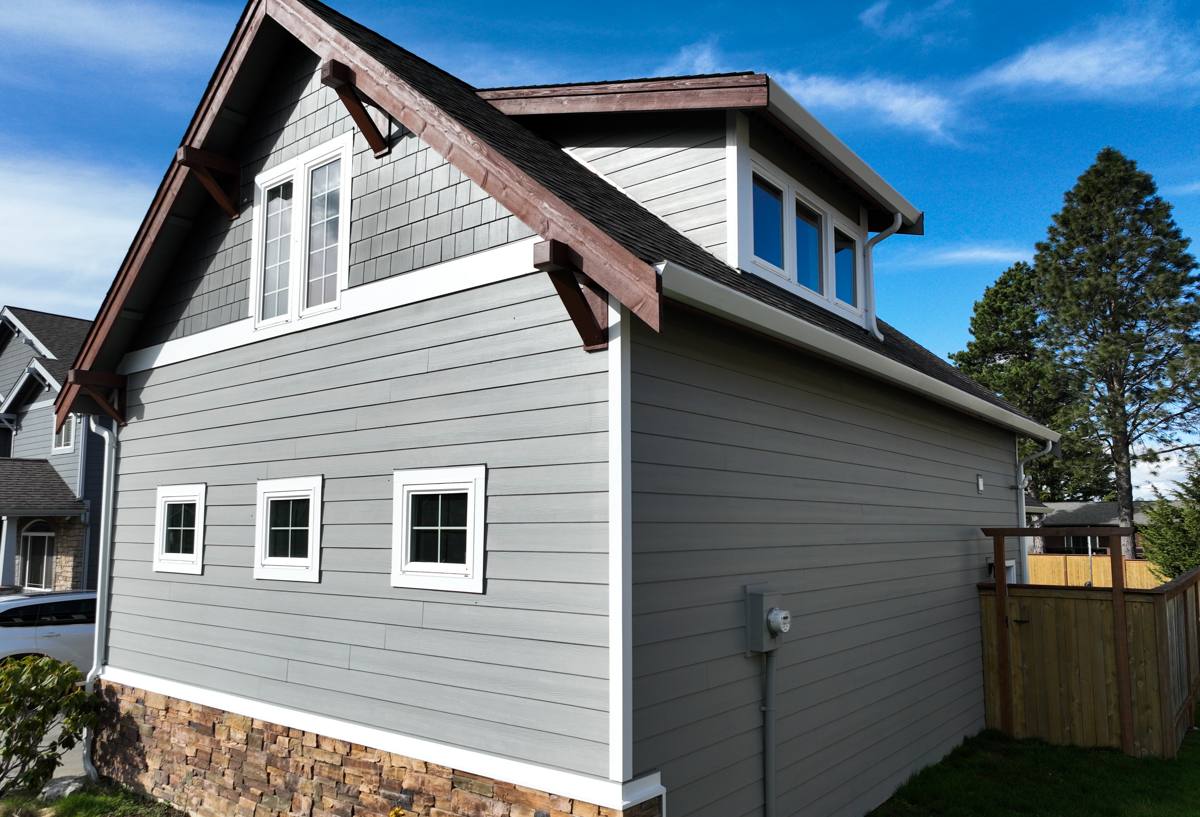
Salt Air: The Slow, Underrated Threat
Bellingham isn't oceanfront in the way a lot of coastal towns are, but proximity to the bay still puts a measurable amount of salt-laden moisture into the air, especially on windier days. Salt air doesn't rot wood the way standing water does — instead, it works on fasteners, metal flashing, and painted or coated surfaces over time. Paint that would hold up for a decade in a dry inland climate can start chalking, fading, or lifting years sooner here.
Where it shows up first
- Fastener heads and metal trim corroding faster than expected
- Paint and caulk failing prematurely on south- and west-facing walls
- Window hardware and screen frames pitting or stiffening over a decade or two
- Faster fade on lower-quality factory finishes versus baked-on coatings
The fix isn't dramatic — it's material selection. Corrosion-resistant fasteners, quality flashing details, and a factory-applied finish that's engineered to resist UV and moisture cycling all matter more here than they would in a landlocked climate.
Driving Rain and Wind-Driven Moisture
Whatcom County gets a lot of rain, but the bigger issue for siding isn't total rainfall — it's how often that rain arrives sideways. Wind off the water pushes moisture into seams, laps, and butt joints that would stay dry in a calmer climate. Over years, that repeated wetting is what causes swelling, delamination, or rot in siding products that weren't built to shed water aggressively.
This is one of the biggest reasons installation quality matters as much as material choice. Even a good siding product installed with tight caulking instead of proper flashing, or without correct clearances at the ground and roofline, will eventually let water in in a climate like this one. We pay close attention to water management details — starter strips, kick-out flashing, window and door head flashing, and proper gaps — because in Happy Valley, those details get tested constantly.
The Long Moss Season
Between fall and spring, shaded and north-facing exteriors in Happy Valley can stay damp for weeks at a stretch, especially under mature trees. That's exactly the environment moss and algae need to take hold on roofing, siding, and decking. Once moss establishes itself on a roof or wall, it holds moisture against the surface underneath it, which accelerates whatever decay process is already underway.
What helps homes here resist moss buildup
- Roofing materials and installation details that promote drainage and airflow
- Siding that doesn't absorb and hold moisture the way untreated wood does
- Trimming back tree cover where it's shading and dampening walls unnecessarily
- Periodic gentle cleaning rather than pressure-washing that can force water behind siding
Moss removal itself is routine maintenance. The bigger question is whether the material underneath is the kind that degrades when it stays damp, or the kind that doesn't care.
Why We Install Only James Hardie Fiber Cement Siding
We made a deliberate decision to install one siding system — James Hardie fiber cement — rather than offering a menu of vinyl, engineered wood, or other fiber cement brands. In a climate like Bellingham's, that decision comes down to how materials actually perform over decades, not just how they look at installation.
Non-combustible and dimensionally stable
Fiber cement doesn't expand and contract with moisture the way wood-based products do, and it's non-combustible, which matters for both insurance considerations and long-term peace of mind. It holds paint lines and caulk joints better over time because the material itself isn't moving underneath them.
Climate-engineered product lines
Hardie manufactures different formulations (HZ5 and HZ10 zones) specifically calibrated for regional moisture and freeze-thaw conditions. That's a meaningfully different approach than a one-size-fits-all product, and it's relevant in a Pacific Northwest climate that stays wet for most of the year.
ColorPlus factory finish
Rather than relying on field-applied paint, Hardie's ColorPlus finish is baked on at the factory under controlled conditions, which produces better UV and fade resistance than most site-applied paint jobs — a real advantage against the salt air and sun exposure Happy Valley homes see.
Warranty backing
Hardie's product warranty is transferable and backed by a large, established manufacturer, which matters if you sell the home before the warranty period ends. It's a meaningfully different guarantee than what smaller or newer product lines can offer.
We don't install LP SmartSide, vinyl, Cemplank, Allura, or primed wood siding — not because those products have no merit, but because we've chosen to stand behind one system we trust completely for this climate, rather than installing several products with different long-term track records.
Siding Doesn't Work Alone: Roofing, Windows, and Decks
A home's exterior is a system. Siding can be installed perfectly and still underperform if the roof above it is shedding water onto walls it shouldn't, or if window flashing is directing moisture behind the cladding instead of away from it. That's why we handle roofing, windows, and decks alongside siding rather than treating them as separate trades.
Roofing
Roof condition directly affects how much moisture reaches your siding at the eaves and gable ends. A roof shedding water properly, with clean gutters and correct flashing, takes real pressure off the walls below it.
Windows
Window replacement is one of the most common triggers for a full siding project, since old flashing and trim are exposed once windows come out. Doing both at once means the flashing details get done right the first time, instead of patched around old siding.
Decks
Decks in this climate face the same driving rain and moss exposure as siding and roofing, and deck ledger connections to the house are a common point of hidden water damage if not flashed correctly.
Why a Local Crew Matters in Happy Valley
A crew that works Whatcom County regularly knows which details actually matter here versus what's fine in a drier climate. That includes how far to hold siding off grade and roof lines, how aggressive to be with flashing at penetrations, and what maintenance schedule realistically fits a home that spends half the year under cloud cover and moisture. It also means being reachable for questions after the job is done, not just during the sale.
Comparing Siding Approaches for This Climate
| Factor | James Hardie Fiber Cement | Vinyl | Engineered Wood (e.g. LP SmartSide) |
|---|---|---|---|
| Moisture behavior | Dimensionally stable, doesn't swell or rot | Doesn't rot, but can warp or crack with temperature swings | Wood-based core; vulnerable if moisture reaches the substrate |
| Fire resistance | Non-combustible | Can melt or deform under heat | Combustible, wood-based |
| Finish durability | Factory-baked ColorPlus finish | Color molded through, but can fade and chalk | Requires field-applied paint and maintenance |
| Typical lifespan with proper install | Multiple decades | Multiple decades, but seams and fasteners degrade | Shorter if moisture management isn't precise |
| Warranty structure | Long-term, transferable manufacturer warranty | Varies widely by manufacturer and grade | Varies; often shorter than fiber cement |
This isn't a claim that other products can't perform — it's why, after years of exterior work in this climate, we standardized on one system we're confident in rather than installing several with different risk profiles.
What to Expect When You Work With Us
- An on-site walkthrough to assess current siding, roofing, window, and deck condition
- Honest feedback on what actually needs replacement versus what can be maintained
- A clear, written estimate with no pressure to sign on the spot
- Attention to water management details — flashing, clearances, and drainage — not just surface appearance
- A realistic timeline that accounts for Bellingham's weather windows
If your Happy Valley home is showing early signs of the wear this climate causes — moss creeping across a wall, paint failing faster than it should, siding that feels soft or delaminated near the ground — it's worth getting ahead of it before a small repair becomes a full replacement. We're happy to come take a look, tell you honestly what we see, and put together a free, no-pressure estimate for siding, roofing, window, or deck work using the form below.