 Bellingham
 Siding Fails From the Inside Out
When a homeowner in Bellingham calls about siding trouble, the visible problem is almost never the whole story. Peeling paint, dark streaking, soft spots near the bottom edge, or panels that look warped are symptoms. The actual damage is usually happening on the backside of the siding and inside the wall assembly, where nobody sees it until it's advanced enough to show through.
Siding's real job isn't just to look good. It's the first layer of a water-management system that includes a weather-resistive barrier, flashing at every penetration and transition, and a drainage plane that lets any water that does get past the siding find its way back out. When that system is compromised, water gets trapped against the sheathing and framing, and the siding on the outside can look fine for years while rot, mold, and structural damage build up behind it.
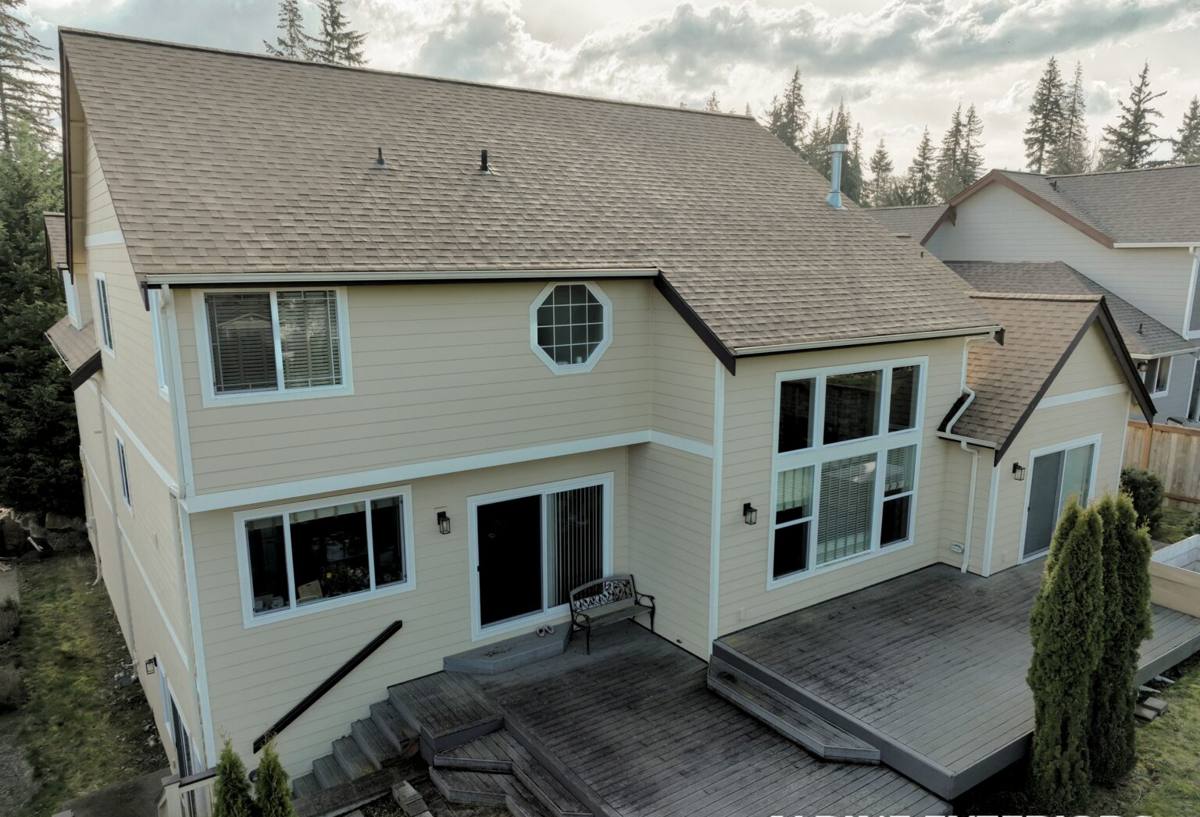
How Moisture Actually Gets Behind Siding
There are a handful of common entry points, and in our experience they account for the vast majority of moisture problems we find once we pull siding off a wall:
- Missing or reversed flashing above windows, doors, and horizontal trim boards — water runs down the wall and gets funneled straight into the sheathing instead of out and away from it.
- Caulk used as a substitute for flashing. Caulk is a maintenance item, not a permanent seal. Once it cracks or shrinks, water has a direct path in.
- Butt joints and seams that weren't properly lapped, back-primed, or sealed at the time of install.
- Siding installed tight to the ground, a deck, or a roofline with no clearance, so it wicks moisture continuously instead of drying out between rain events.
- Fasteners driven wrong — overdriven nails crack the material or crush the drainage gap; underdriven or misplaced fasteners leave gaps that pull water in.
- No weather-resistive barrier, or a torn/improperly lapped one underneath the siding itself.
None of these are visible from the curb. They're all things that either show up in the installation details or get discovered when a wall is opened up for repair.
The Water-Resistive Barrier and Drainage Plane Matter More Than the Siding Itself
It surprises a lot of homeowners, but the siding material is actually the second line of defense. The weather-resistive barrier (WRB) wrapped around the sheathing, combined with correctly lapped flashing and a drainage gap behind the siding, is what determines whether incidental water — and on the coast, there's always some — makes it into the wall cavity or drains harmlessly back out.
A well-built wall assumes water will occasionally get behind the siding. It's designed to handle that and dry out. A poorly built one relies on the siding surface staying perfectly sealed forever, which no siding product actually does. This is why two homes with the same siding material can have completely different moisture histories — the difference is almost always in the assembly behind the panels, not the panels themselves.
Where Bellingham Homes Are Especially Exposed
Whatcom County's climate puts extra demand on this system. Driving rain off the Strait of Georgia and Bellingham Bay hits walls at an angle, not straight down, which pushes water into laps, seams, and trim joints that a drier climate's siding might never test. Salt air along the coastal parts of the county accelerates corrosion on fasteners and metal flashing, which shortens the life of exactly the components that keep water out. And the long stretch of damp, low-sun months that feeds moss growth on roofs and siding also means less drying time between rain events — a wall that gets wet in October may not fully dry out until spring.
Signs Moisture Is Already Behind Your Siding
By the time moisture damage is visible from outside, it's typically been developing for a while. Common warning signs, roughly in order of how early they tend to appear:
| Sign | What it usually means |
|---|---|
| Paint bubbling, peeling, or alligatoring in one area | Moisture pushing out through the finish from behind |
| Dark staining or streaking below seams or trim | Water finding a path around failed flashing or caulk |
| Soft, spongy, or bulging siding when pressed | Sheathing or the siding itself has absorbed water and is breaking down |
| Musty smell in an adjacent interior room | Mold growth inside the wall cavity |
| Visible gaps, cracks, or separation at panel joints | Direct entry points that have likely been active for some time |
| Interior drywall staining or trim warping on an exterior wall | Advanced moisture intrusion that has reached the interior side of the wall |
Any one of these on its own is worth a look. Several together usually means it's time to open up a section of wall and see what's actually happening, rather than patching the visible symptom.
Why Some Siding Materials Handle This Better Than Others
The siding material doesn't replace a good drainage assembly, but it does affect how forgiving the wall is when water inevitably gets behind it, and how the material itself responds to repeated wetting.
| Material | Behavior when wet | Longer-term risk |
|---|---|---|
| Primed spruce / cedar lap | Absorbs moisture readily; swells and can cup or split | Rot at butt joints and lower courses without diligent repainting |
| Engineered wood (LP-type) | Resists moisture better than raw wood but the wood-strand core can still swell if the factory edge seal is compromised | Edge and bottom-edge deterioration if not maintained per spec |
| Vinyl | Doesn't absorb water itself, but relies entirely on the assembly behind it since it's not a sealed water barrier — and it moves a lot with temperature | Hides moisture problems longer because the vinyl itself won't show staining |
| Fiber cement (James Hardie) | Dimensionally stable, doesn't swell or rot, factory-cured to resist moisture absorption into the panel itself | Failure risk shifts almost entirely to installation quality, not the material |
This is the honest, practical reason fiber cement holds up better in a climate like ours: it removes the material itself as a point of failure. Wood-based products can perform well for years, but they depend on paint film integrity and diligent maintenance to keep water out of an absorbent substrate. In a county with this much sustained dampness and driving rain, that maintenance window closes faster than in drier regions.
What Correct Installation Actually Involves
Since the assembly behind the siding matters as much as the siding itself, installation quality is where most long-term moisture problems are actually decided. A correct install includes:
- A continuous, properly lapped weather-resistive barrier with no tears or gaps
- Head, kickout, and step flashing installed to shed water outward at every window, door, roofline, and deck ledger
- Proper clearance between siding and grade, roofing, decks, and other horizontal surfaces (typically 6 inches or more from soil, 1-2 inches from roof lines)
- A drainage gap or rainscreen behind the siding so incidental moisture can escape rather than pool
- Fasteners set to manufacturer spec — not overdriven, not underdriven, correct type for the substrate
- Caulk used only where specified, not as a substitute for flashing
- Butt joints and seams treated per the manufacturer's published installation instructions, not general contractor habit
These details rarely show up in a bid comparison because they're invisible once the job is done. They're also exactly what separates a wall that dries out fine for forty years from one that's rotting behind the paint in eight.
Repair, or Time to Replace?
Not every moisture issue means a full re-side. A localized failure — one bad flashing detail, one section of rotted trim — can often be repaired if it's caught early and the surrounding sheathing is still sound. The deciding factors are usually:
- How much of the wall area shows active moisture damage versus a single isolated spot
- Whether the sheathing underneath is still structurally sound or has started to delaminate/soften
- The age and condition of the siding material overall — patching a 25-year-old wood siding job that's failing broadly is often just delaying a full replacement
- Whether the underlying WRB and flashing system needs to be redone anyway, in which case replacing the siding at the same time is more cost-effective than doing it twice
We'll always tell a homeowner honestly when a targeted repair makes sense versus when it's throwing money at a wall that needs to come apart and be rebuilt correctly.
Why We Only Install James Hardie
We standardized on James Hardie fiber cement because it removes the biggest variable in long-term siding performance: the material's own reaction to moisture. It doesn't absorb water into an organic substrate, doesn't swell or rot, and it's engineered with HZ5 product lines specifically for climates that see sustained damp weather like ours. Combined with a correctly built drainage assembly — which we treat as non-negotiable on every job — it gives Bellingham homeowners a wall system where water intrusion is far less likely to turn into structural damage even if the assembly is tested by a hard winter of driving rain off the water.
The factory-applied ColorPlus finish also matters here specifically: it's cured and warrantied against the peeling and cracking that lets moisture behind field-painted siding in the first place, which is one of the more common failure points we see on older homes throughout Whatcom County.
Get a Straight Answer About Your Siding
If you're seeing any of the warning signs above, or you just want a professional look at how your walls are draining before a problem develops, we're happy to come take a look. We'll give you a clear, honest read on what's going on and a free, no-pressure estimate — no upsell, just what we'd actually recommend for your home.