 Bellingham
 Roofing in Ferndale Isn't the Same Job as Roofing Somewhere Dry
Ferndale sits close enough to the water and low enough in the valley that its roofs deal with a specific combination of stresses: salt-laden air moving in off Bellingham Bay and the Strait, long stretches of driving rain that comes in sideways more often than straight down, and a moss season that can run most of the year on shaded, north-facing slopes. None of these things alone is unusual for Western Washington. Together, on the same roof, year after year, they wear out the weak points in a shingle roof faster than most homeowners expect.
An asphalt shingle roof that's installed correctly for this climate will outlast one that was installed to a generic spec sheet by years, not months. The difference usually isn't the shingle brand — it's the flashing, the underlayment, the ventilation, and the small decisions made on install day that either shed water and moss or slowly let them win.
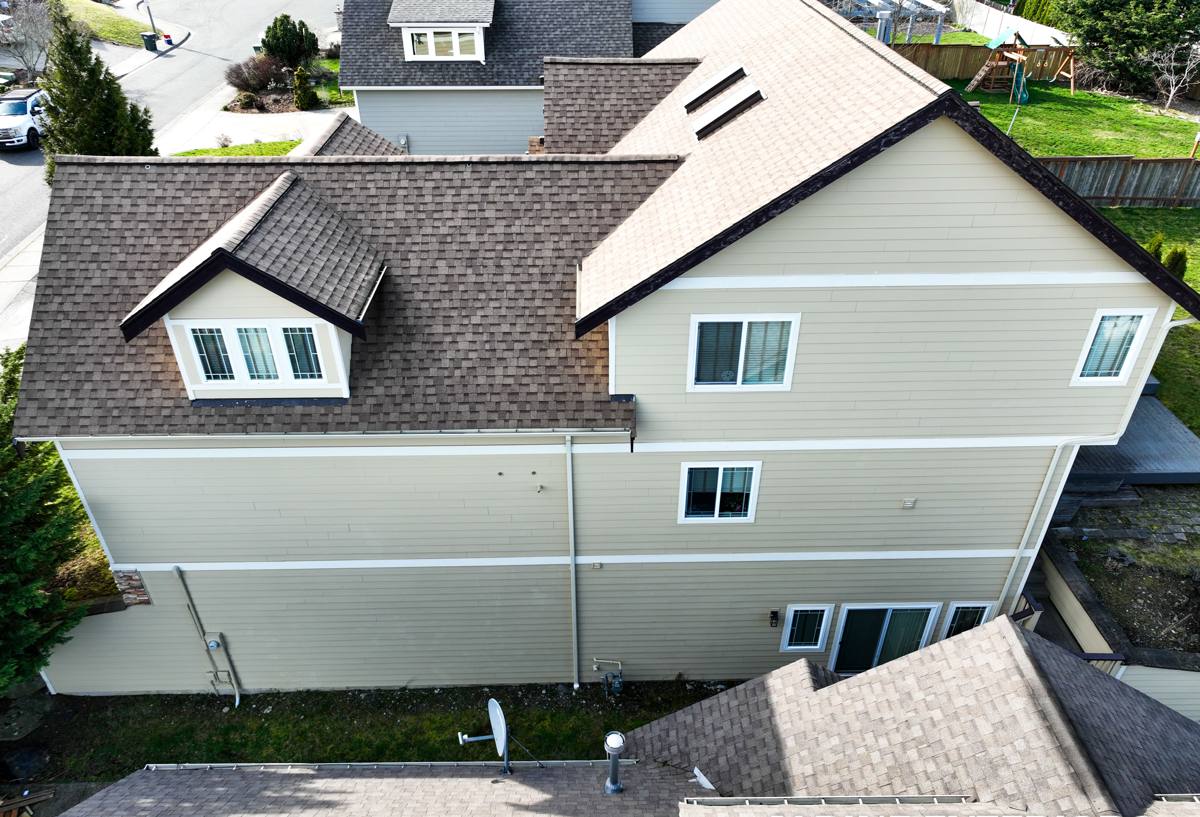
What Ferndale's Climate Actually Does to a Roof
Salt Air and Corrosion
Homes closer to the water take on airborne salt that settles on roofing hardware over time. Exposed or lower-grade fasteners, drip edge, and flashing corrode faster in this environment than they would further inland. It's a slow process, so it's easy to miss until a rusted nail head telegraphs through a shingle or a flashing seam starts leaking at a joint that used to be watertight.
Driving Rain and Wind-Driven Water
Rain that comes in at an angle doesn't just run down the roof plane — it gets pushed sideways and upward under shingle edges, into valleys, and around penetrations like vent pipes and chimneys. A roof built for straight-down rain can perform fine for years and then fail during the first real wind-driven storm, because the parts that matter in that scenario — underlayment laps, valley construction, fastener count — were never tested until then.
Moss Season
Shaded, north- and east-facing roof slopes in and around Ferndale can stay damp for weeks at a stretch, which is exactly what moss needs to establish. Moss doesn't just look bad — it holds moisture against the shingle surface, lifts shingle edges as it grows, and works its way into laps and nail lines. Left long enough, it shortens the life of an otherwise sound roof by years.
What a Correct Asphalt Shingle Roof Involves
A shingle roof is a system, not a single product. Every layer has to do its job for the roof to actually perform in this climate.
- Deck inspection and repair — any soft, delaminated, or water-damaged sheathing gets replaced before anything new goes down, not covered over.
- Ice and water shield at eaves, valleys, and around penetrations — the self-adhering membrane that backs up the shingles where wind-driven rain and ice damming are most likely to force water backward.
- Synthetic underlayment across the full roof deck as the secondary water barrier beneath the shingles.
- Properly lapped, corrosion-resistant flashing at valleys, chimneys, skylights, walls, and any roof-to-wall transition — this is where most leaks actually start.
- Correct nailing pattern — the right number and placement of fasteners for the shingle's wind rating, not just enough to hold it down.
- Balanced attic ventilation — intake at the eaves and exhaust at the ridge, sized to the attic, so heat and moisture don't get trapped under the deck.
Shingle Class Matters More Than It Seems
Not every asphalt shingle is built the same, and the difference shows up over time, not on day one.
| Shingle Type | Typical Lifespan | Wind Rating | Best Fit |
|---|---|---|---|
| 3-Tab | 15-20 years | Lower | Budget-conscious projects, simple roof lines |
| Architectural / Dimensional | 25-30+ years | Higher | Most Ferndale homes — better wind and moisture resistance |
| Impact-Rated / Premium | 30+ years | Highest | Exposed sites, homeowners prioritizing longevity |
We steer most Ferndale homeowners toward architectural shingles with algae-resistant (AR) granules. The AR treatment doesn't make moss impossible, but it measurably slows the growth that this area's damp, shaded roof slopes invite, and the heavier profile handles wind-driven rain better than a 3-tab shingle does.
How We Approach a Ferndale Roofing Job
1. Inspection First
Before we talk materials, we get on the roof. We're checking deck condition, existing flashing, ventilation, and how the current roof has actually held up against this specific climate — not just its age. That tells us honestly whether a repair, a partial replacement, or a full tear-off is the right call.
2. Tear-Off, Not Overlay
We don't install new shingles over old ones. An overlay hides deck problems instead of fixing them, and it traps moisture between layers — exactly the wrong move in a climate that already gives moss and rot every advantage. A full tear-off lets us see the deck, fix what's underneath, and start the new system clean.
3. Materials Suited to the Site
We factor in how exposed the roof is to wind and rain, how shaded it is, and how close it sits to the water when we recommend shingle class, underlayment type, and flashing hardware — not just the cheapest spec that meets code.
4. Install Day
Deck repair, ice and water shield, underlayment, flashing, then shingles, done in that order with attention to the details that don't show up in a drive-by look at a finished roof — proper nailing, tight valley work, sealed penetrations.
5. Cleanup and Walk-Through
Full site cleanup, magnetic sweep for stray fasteners, and a walk-through where we show you the finished work and explain what maintenance, if any, it'll need going forward.
Repair, Partial Replacement, or Full Roof?
Not every roofing problem in Ferndale means a full replacement. The right call depends on a few honest factors.
| Factor | Leans Toward Repair | Leans Toward Replacement |
|---|---|---|
| Roof age | Under 12-15 years | Approaching or past shingle's rated life |
| Extent of damage | Localized — one slope, one flashing point | Widespread granule loss, curling, multiple leaks |
| Deck condition | Solid, no soft spots | Soft decking or signs of rot found |
| Moss/algae staining | Surface only, treatable | Heavy, long-term growth affecting shingle integrity |
| Ventilation | Already balanced and adequate | Undersized or missing — needs correction anyway |
We'll tell you straight if a repair is the honest answer. A roof that's structurally sound doesn't need to be replaced just because it's aging — but we'll also tell you when a repair is just delaying a bigger bill.
Ventilation and Moss: The Two Things Most Roofs Get Wrong
Undersized or unbalanced attic ventilation is one of the most common issues we find on existing Ferndale roofs, and it's rarely visible from the ground. Poor ventilation traps heat and moisture under the deck, which accelerates shingle aging from underneath and creates the damp conditions moss thrives on from above. When we replace a roof, correcting ventilation is part of the job, not an upsell.
For moss specifically, the long-term fix is a combination of things: algae-resistant shingles, adequate ventilation so the deck dries out between rain events, and keeping gutters and valleys clear so water isn't sitting against the shingle edge. A one-time moss treatment helps in the short term, but it doesn't address why moss keeps coming back on a given slope.
Why a Crew That Already Works Ferndale Matters
Roofing crews that work all over Western Washington aren't wrong about roofing in general — but a crew that regularly works Ferndale and the surrounding Whatcom County communities knows things a generalist doesn't have to think about: which roof orientations in this specific area hold moss the longest, how much wind-driven rain exposure to plan for on an unshielded slope, and what Whatcom County permitting actually requires for a given scope of work. That familiarity shows up in fewer surprises mid-project and a roof that's built for the conditions it'll actually face, not a national average.
Keeping an Asphalt Shingle Roof Healthy Between Services
- Clear gutters and valleys of debris at least twice a year, more often under fir or cedar trees.
- Have moss treated before it spreads past a light surface haze — don't wait for visible clumps.
- Check attic ventilation isn't blocked by insulation or debris.
- Look for granules collecting in gutters — a sign of aging shingles worth having inspected.
- Get flashing around chimneys, skylights, and vents checked after major windstorms.
- Trim back branches that keep a roof slope shaded and damp longer than it needs to be.
Let's Take a Look at Your Roof
If you're dealing with moss buildup, a leak that shows up only in certain storms, or a roof that's simply getting old, we're happy to come take an honest look. No pressure, no upsell script — just a straight assessment of what your roof needs and what it doesn't. Use the form below to request a free estimate.