 Bellingham
 Why Ferndale Decks Wear Out Faster Than the Manual Says
Every deck board sold in the Pacific Northwest comes with a warranty written for average conditions. Ferndale doesn't have average conditions. Sitting close to Bellingham Bay and the Strait, homes here take on salt-laden air, long stretches of driving rain off the water, and a moss season that can run from October clear through April. That combination shortens the life of a deck faster than most manufacturers' literature accounts for, and it's the reason a deck that looks fine in Year 6 can have soft joists and failing fasteners underneath by Year 10.
We're not telling you this to scare you into a replacement you don't need. Plenty of Ferndale decks just need targeted repair. But when a deck has reached the point where the framing, ledger, or footings are compromised, patching the surface boards is a short-term fix that hides a longer-term problem. This page is about doing a full deck replacement correctly for a home in this specific climate — not a generic deck-building overview.
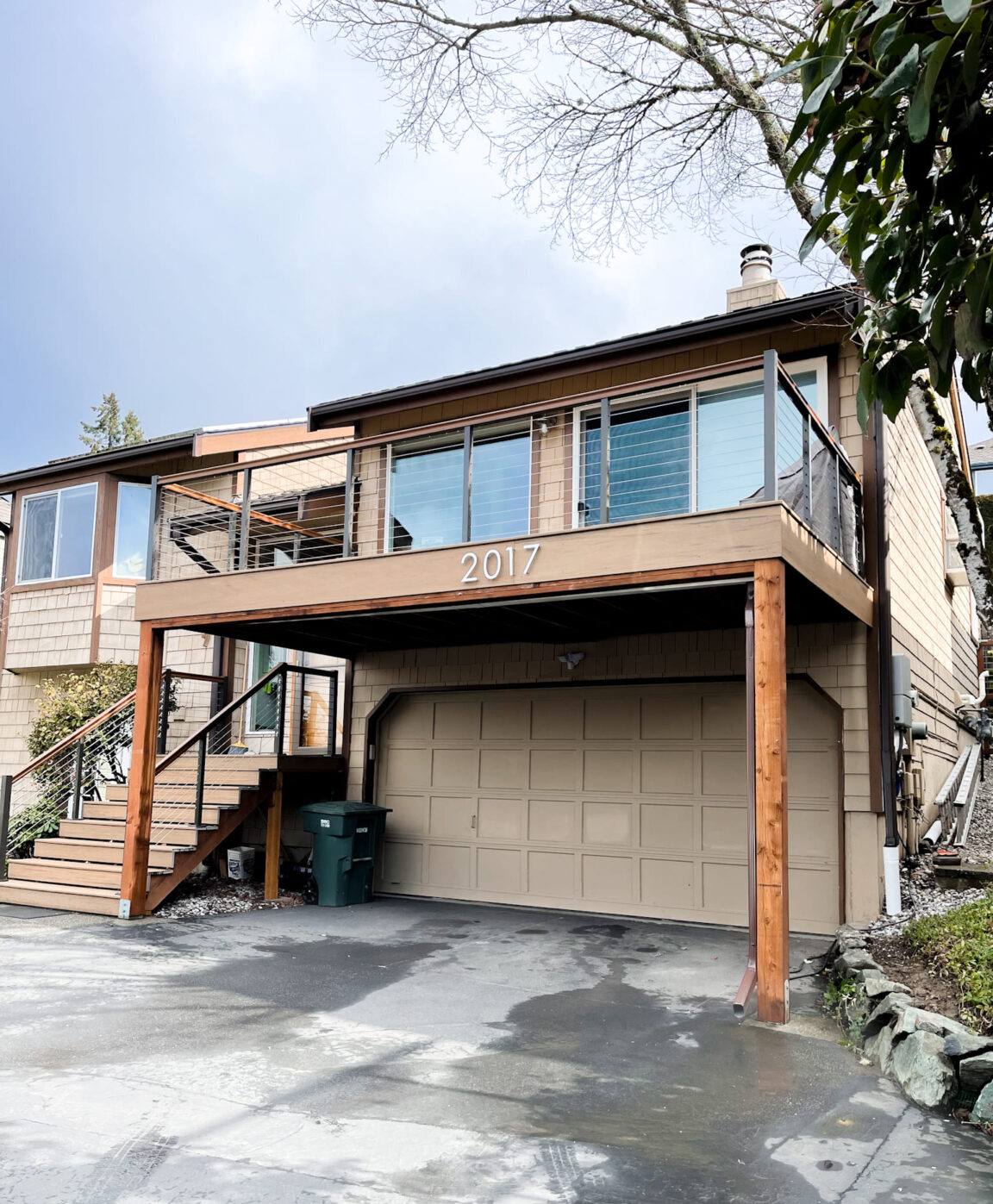
What Whatcom County Weather Actually Does to a Deck
Salt Air and Fastener Corrosion
Proximity to the water means airborne salt settles on every exterior surface, including deck hardware. Standard hot-dip galvanized fasteners can start corroding years earlier near the coast than they would further inland. Once a fastener corrodes, it loses grip strength long before it visibly fails, which is why decks near Bellingham Bay sometimes develop movement or squeaking in boards that still look structurally sound.
Driving Rain and Water Intrusion
Rain in this part of Whatcom County doesn't just fall straight down — wind off the water pushes it sideways into ledger boards, stair stringers, and any point where the deck meets the house. Over time, that horizontal moisture finds its way into end grain, fastener holes, and flashing gaps. The ledger board connection, where the deck attaches to the house, is the single most common point of hidden rot we find on Ferndale decks, because it's also the hardest spot for water to dry out.
Moss, Algae, and a Long Wet Season
A moss season that stretches most of the year means deck surfaces stay damp for extended periods, especially in shaded yards or under mature trees. Moss and algae hold moisture against the wood surface, which accelerates decay in untreated or under-maintained decking and creates a genuinely slick, dangerous walking surface — a real safety issue on stairs and ramps.
Signs a Ferndale Deck Needs Replacement, Not Repair
- Soft or spongy spots in the decking boards, especially near the house or at board ends
- Visible gaps, rust streaks, or pulled-through fasteners along the ledger board
- Stair stringers or posts that feel loose or flex under weight
- Persistent moss or dark staining that returns within weeks of cleaning
- Railing posts that wiggle at the base — often a sign the framing beneath has softened
- A deck built before current code that lacks proper ledger flashing or joist hangers
- More than one prior repair to the same section within a few years
If you're only seeing one or two of these, a repair may still make sense. If you're seeing several, or if the deck is original to an older Ferndale home, replacement is usually the more honest recommendation — and the more cost-effective one over a 10-15 year horizon.
What a Correct Deck Replacement Involves Here
Full Demo and a Real Look at What's Underneath
We don't just pull boards and reuse the frame. Every replacement starts with tearing off decking down to the substructure so we can actually see the ledger, joists, beams, and post bases. This is where a coastal Whatcom County deck often surprises homeowners — surface rot that looked minor can reveal a ledger board that's been wicking moisture for years.
Ledger Flashing Done Right
Given how much water intrusion at the house connection drives failure here, proper ledger flashing isn't optional. That means correctly lapped house wrap or building paper, flashing that directs water away from the ledger rather than behind it, and a gap or drainage path so trapped moisture has somewhere to go instead of sitting against the house sheathing.
Framing and Fasteners Matched to the Climate
For a home this close to salt air, we use fasteners and structural connectors rated for coastal exposure, not just standard-grade hardware. It costs a little more up front and it's the difference between hardware that lasts the life of the deck and hardware that's corroding again in five years.
Decking Material Selection
We'll walk you through real options — pressure-treated lumber, cedar, and composite decking — and tell you honestly where each one struggles in this climate, not just where it shines.
Comparing Decking Materials for Ferndale's Climate
| Material | Moisture Behavior | Moss/Algae Resistance | Maintenance | Typical Lifespan Here |
|---|---|---|---|---|
| Pressure-treated lumber | Good if sealed regularly; end grain is a weak point | Moderate — needs periodic cleaning | Annual cleaning, re-sealing every 2-3 years | 12-18 years with upkeep |
| Cedar | Naturally decay-resistant but softer, dents and checks over time | Moderate — greys and can host moss without upkeep | Cleaning plus stain/seal every 2-3 years | 15-20 years with upkeep |
| Composite decking | Doesn't absorb water or rot; core matters — some cores handle moisture better than others | Good — smoother, less porous surface, though still needs washing | Occasional washing, no sealing/staining | 20-30+ years, backed by manufacturer warranty |
There's no universally "right" choice — a lower-maintenance composite makes sense for a lot of Ferndale households given the wet season, but plenty of homeowners still prefer the look and feel of real wood and are willing to keep up with maintenance. We'll give you a straight cost and upkeep comparison for your specific deck, not a sales pitch toward whatever we happen to have on the truck.
Our Process, Start to Finish
- On-site assessment — we inspect the existing deck, ledger connection, and framing, and tell you honestly whether you're looking at repair or replacement
- Design and material walkthrough — size, layout, railing style, and decking material, with real pricing for each option
- Permitting — we handle the permit process where required so the new structure meets current code, including railing height and guard spacing
- Full demo — removal of the old deck down to (and including, if needed) framing and footings
- Framing and flashing — new ledger flashing, coastal-rated fasteners, and structural connections built for this climate
- Decking, railing, and stairs installed — with attention to drainage gaps and fastener patterns that shed water rather than trap it
- Final walkthrough — we go over care and maintenance specific to whichever material you chose
Why a Crew That Already Works Ferndale Matters
Deck framing details that work fine in a drier inland climate can be the wrong call three miles from the water. A crew that already builds and repairs decks across Whatcom County knows which ledger details actually keep water out here, which fastener grades hold up against salt air over the long run, and which decking products handle a near-year-round moss season without turning into a maintenance headache. That's not something you learn from a spec sheet — it's something you learn from seeing what fails on real decks in this area after five, ten, and fifteen years.
We also know the practical side of building here: working around Whatcom County's wet-season scheduling, sequencing demo and framing to minimize the days your structure is exposed to rain, and building in drainage details that a generic deck plan won't include.
What to Ask Before You Hire Anyone for This
- Will you inspect and, if needed, replace the ledger flashing — not just reattach the old boards?
- What fastener and hardware grade are you using, and is it rated for coastal exposure?
- Is a permit required for this project, and will you pull it?
- What does the warranty actually cover — labor, materials, or both?
- Can you show me the difference in maintenance between the material options for a place with our rain and moss?
If a contractor can't give you clear, specific answers to these — especially the ledger flashing question — that's worth noticing before you sign anything.
What This Typically Costs
Deck replacement pricing depends heavily on size, decking material, railing style, and how much of the substructure needs rebuilding versus reusing. A straightforward pressure-treated replacement on an existing footprint sits at the lower end of the range; a full rebuild with composite decking, custom railing, or a larger footprint runs higher. Rather than quote a number that won't reflect your actual deck, we'll give you a firm, itemized estimate after seeing the site — including whether we expect to find hidden framing damage once demo starts.
If your deck in Ferndale is showing any of the wear signs above, or you'd simply rather replace it right than keep patching it, we're happy to come take a look. The estimate is free, there's no pressure, and you'll get a straight answer about whether replacement is really what your deck needs — use the form below to get started.