 Bellingham
 Windows Built for Blaine's Coastline, Not a Generic Catalog Size
Blaine sits right where the Salish Sea meets the Canadian border, and that location shapes everything about how a window needs to perform here. Homes a few blocks from Drayton Harbor or Semiahmoo Bay take on salt-laden air almost year-round, while houses further inland still deal with the same driving rain and long gray winters as the rest of Whatcom County. Off-the-shelf window sizes and standard installation details don't always account for that combination, which is why we treat window work in Blaine as custom work — measured, specified, and installed for the specific house and its exposure, not just pulled from a builder-grade line because it's what's in stock.
"Custom" doesn't have to mean unusual shapes or high-end architecture, though we do that too. Most of our custom window jobs in Blaine are standard-looking replacement or new-construction windows that are sized, flashed, and finished specifically for that wall, that siding type, and that home's age. A lot of window failures we get called out to fix started as a "good enough" fit that never accounted for how much weather this stretch of coastline actually sees.
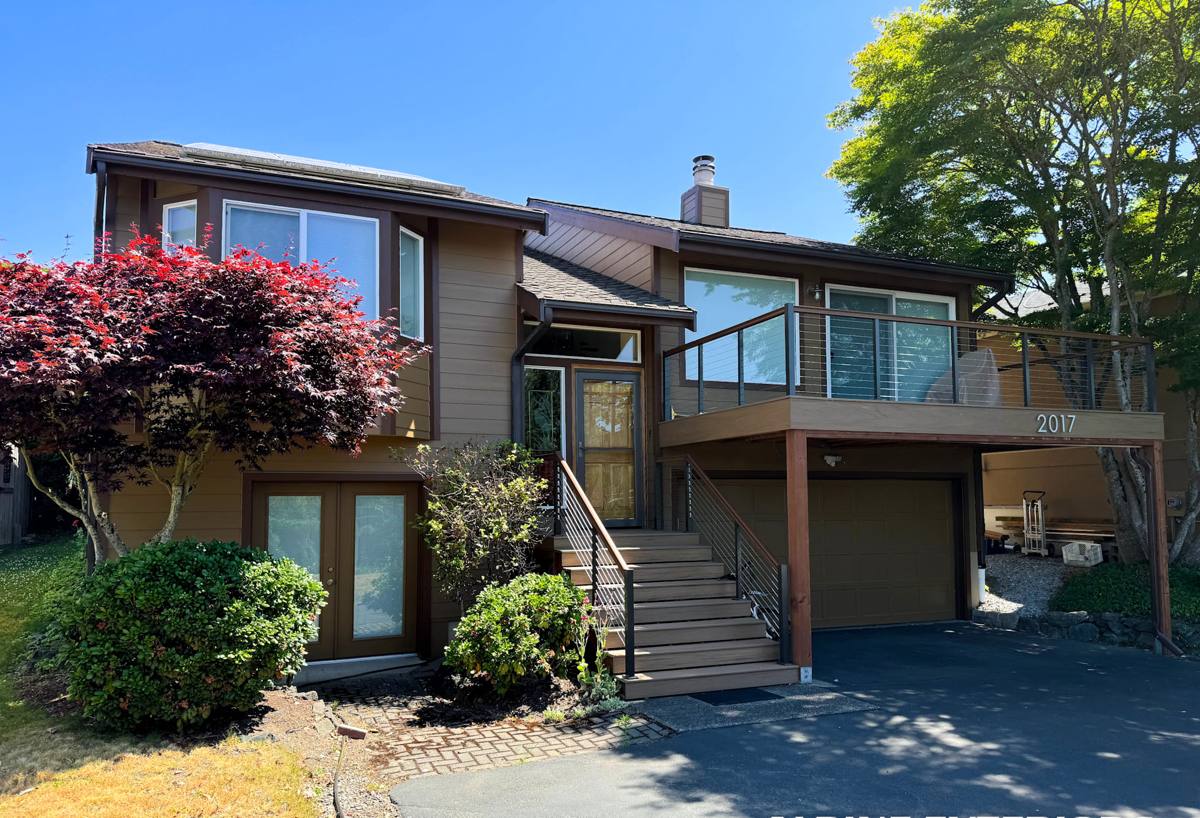
Why Blaine's Climate Is Harder on Windows Than It Looks
Blaine doesn't get hurricanes or extreme temperature swings, and that can lull homeowners into underestimating what the marine environment does to a window system over time. The real stressors here are slow and constant rather than dramatic:
- Salt air corrosion — homes near the water deal with airborne salt that accelerates corrosion on hardware, screws, and unprotected metal flashing far faster than an inland home would see.
- Driving rain — wind off the water pushes rain sideways into wall assemblies, which means flashing and sill details matter more here than in a sheltered location.
- Moss and organic growth — our long wet season keeps moss, algae, and mildew active on north- and shade-facing exposures for much of the year, and it will colonize any spot where water sits or drains poorly around a window frame.
- Condensation cycles — cool, humid air condenses readily on older, poorly insulated glass and frames, which over years contributes to wood rot and sash deterioration.
None of these show up as a sudden failure. They show up as a soft sill five years from now, a fogged double-pane unit, or streaking and staining nobody can quite explain. Good custom window work is largely about designing those problems out before they start.
What "Correct" Window Installation Actually Involves
Accurate Measurement and Sizing
We measure each opening individually — width, height, diagonal (to check square), and depth. Many Whatcom County homes, especially older ones near downtown Blaine or on older county lots, have openings that have shifted slightly over decades of settling. A custom-sized window accounts for that instead of forcing a stock size into an opening that isn't quite true.
Flashing and Water Management
This is the step that determines whether a window survives our climate long-term. Proper installation means integrating window flashing with the home's weather-resistive barrier in the correct shingle-lap order — sill pan first, then jambs, then head flashing lapped over the top — so any water that gets past the exterior surface drains back out instead of into the wall cavity. On a coastal, high-rain job like most of what we see in Blaine, we don't treat this as optional or skip it to save time.
Sealing and Insulation
Low-expansion foam or backer rod and sealant around the frame perimeter, plus proper caulking at the exterior trim line, closes off air and moisture paths without trapping water inside the assembly. Over-sealing in the wrong spot can be as harmful as under-sealing — it can trap moisture that has nowhere to drain.
Hardware and Fastener Selection
In a salt-air environment, fastener choice matters more than most homeowners realize. We use corrosion-resistant fasteners and hardware appropriate for coastal exposure rather than standard interior-grade screws, which can start rusting and staining trim within a few seasons this close to the water.
Choosing Window Materials for a Coastal Whatcom County Home
There's no single "best" window material — the right choice depends on the home's exposure, budget, and maintenance appetite. Here's how the common options actually compare for a Blaine property:
| Material | Coastal/Salt-Air Performance | Maintenance | Where It Fits Best |
|---|---|---|---|
| Vinyl | Won't corrode or rot; good moisture resistance | Low — occasional cleaning | Most homes; best value for full-house replacement |
| Fiberglass | Excellent — stable in wet/dry cycles, resists warping | Low | Homes with direct water exposure or wide temperature/humidity swings |
| Wood | Attractive but vulnerable without diligent upkeep | High — needs regular repainting/sealing | Historic or architecturally sensitive homes where original look matters |
| Wood-Clad (wood interior, metal/composite exterior) | Good if cladding and flashing are detailed correctly | Moderate | Homeowners wanting a wood interior look with less exterior upkeep |
| Aluminum | Prone to corrosion and condensation in salt air unless thermally broken | Moderate to high | Limited coastal use; we typically steer clients elsewhere here |
We generally steer Blaine homeowners toward vinyl or fiberglass for full replacements because both hold up well against salt air and constant moisture without the upkeep schedule that wood or bare aluminum demands. That's a maintenance and moisture-behavior call, not a knock on wood windows themselves — a well-maintained wood window can last decades, but "well-maintained" is a real, ongoing commitment on a property this close to open water.
Custom Windows vs. Standard Replacement: What's the Difference?
Homeowners often ask what makes a window job "custom" versus a standard swap-out. The honest answer is that it's a spectrum:
- Insert (pocket) replacement — a new window frame fits inside the existing frame. Faster and less invasive, but only appropriate when the existing frame is still sound and square.
- Full-frame replacement — the old window and frame are removed down to the rough opening, allowing us to inspect and fix any hidden rot or flashing problems before installing new. This is what we recommend whenever there's any sign of water intrusion, which is common on older homes near the water in Blaine.
- Custom-sized or custom-shaped units — openings that don't match stock dimensions, architectural features like bays or arched tops, or matching a specific sightline across a whole elevation.
Whichever category a project falls into, we treat the water-management details the same way — that part isn't optional based on budget.
Our Process, Start to Finish
- On-site assessment — we look at existing window condition, siding type, and any signs of past water intrusion around openings before recommending anything.
- Measurement and product selection — precise measurements and a material/style recommendation suited to that wall's exposure and the home's overall siding and trim.
- Removal and inspection — for full-frame jobs, we open the wall enough to check the sheathing and framing underneath for hidden moisture damage before it gets covered back up.
- Installation — sill pan, flashing integration, insulation, and sealing done in the correct order, with corrosion-resistant hardware.
- Exterior trim and finish — trim, caulking, and paint or cladding matched to the home so the new windows look original to the house, not bolted on.
- Final walkthrough — we check operation, sealing, and cleanup with the homeowner before calling the job done.
Signs Your Blaine Home's Windows Need Attention
A quick self-check before calling anyone:
- Fogging or moisture between panes of a double- or triple-glazed unit (a sign the seal has failed)
- Soft or discolored wood at the sill or bottom corners of the frame
- Difficulty opening, closing, or locking a window that used to operate smoothly
- Visible moss, algae, or persistent dark staining around the frame or below the sill
- Drafts or a noticeable temperature difference near the window on windy days
- Peeling paint or bubbling on interior or exterior trim near the frame
Any one of these can be a minor fix. Several together, especially combined with visible rot, usually mean it's time for full-frame replacement rather than a patch.
Why Hire a Crew That Already Works in Blaine
Window installation looks similar everywhere on paper, but the details that make it last change with the environment. A crew that mostly works drier inland climates may not default to the flashing sequence, fastener choice, or drainage detailing that a salt-air, high-rainfall town like Blaine actually needs. We work throughout Whatcom County, including Bellingham and the surrounding coastal communities, so we see the same salt exposure, wind-driven rain, and moss patterns repeatedly — and we build our installation standards around what actually holds up here, not around a generalized national spec sheet.
We also coordinate window work with the rest of the exterior — siding, trim, and flashing — so a window replacement doesn't become an isolated patch that fights with the surrounding wall assembly. That matters most on older Blaine homes where the siding and window openings have settled together over the years.
Permits, Timing, and What to Expect
Window replacement in Blaine may require a permit depending on the scope of work and whether it involves structural changes to the opening — we handle that conversation with the homeowner up front rather than leaving it as a surprise. Timing-wise, we recommend scheduling exterior window work outside the heaviest stretch of our wet season when possible, since dry working conditions make for a cleaner flashing and sealing job, though we do complete jobs year-round when a window has failed and can't wait.
If you're weighing a few windows versus a full-house replacement, cost and disruption both scale with full-frame work versus insert replacement, and with how many openings need attention. We'll walk the exterior with you, point out what we see, and give you a straightforward recommendation — not an upsell to the most expensive option by default.
Get a Free, No-Pressure Estimate
If your Blaine home has windows showing wear, drafts, or signs of water intrusion — or you're planning ahead for a full replacement — we're happy to take a look and give you a straightforward assessment. Fill out the form below for a free estimate with no obligation and no pressure.