 Bellingham
 Building a Deck That Actually Holds Up in Lynden
Lynden homeowners ask for a lot of the same things when they call about a new deck: something that looks good, doesn't turn into a maintenance chore, and won't be slick with moss by the second winter. That's a reasonable list, and it's also a harder list to deliver on than most people expect. A deck in Lynden isn't dealing with the same conditions as a deck in a dry climate. It's dealing with long stretches of standing moisture, driving rain that comes in sideways off the wind, and a moss season that can run from fall through spring. Add in the salt-tinged air that reaches inland from the Sound and Whatcom County's coastal exposure, and you've got a structure that needs to be built with drainage, ventilation, and material choice in mind from the first stake in the ground — not decided later as an afterthought.
We build and repair decks throughout the Bellingham area, and Lynden is a regular part of that work. The town's mix of older farmhouses, newer subdivisions, and acreage properties means we see everything from small entry decks to large multi-level outdoor living spaces, and the climate problems are consistent across all of them.
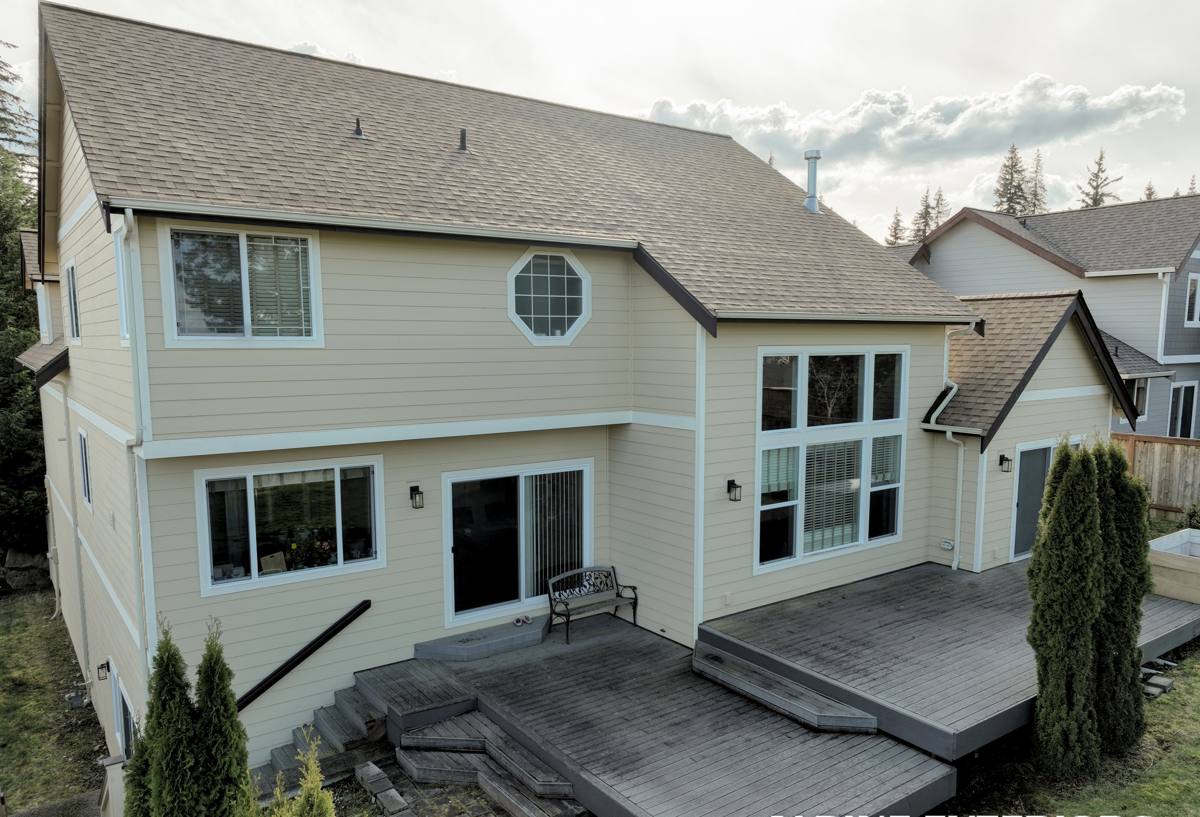
What Whatcom County Weather Does to a Deck
Driving Rain and Standing Moisture
Lynden gets plenty of rain that doesn't fall straight down — wind-driven rain finds its way under boards, into fastener holes, and behind ledger connections if those details aren't handled correctly. Over time, water that has nowhere to go is the single biggest reason decks fail early: rot in framing lumber, corroded hardware, and boards that cup or crown.
Moss and Algae Growth
A shaded deck, or one under overhanging trees, can stay damp for days at a time during the wetter months. That constant moisture is exactly what moss and algae need to take hold. Beyond looking bad, moss on decking is a slip hazard, and it holds moisture against the wood surface longer than bare boards would, accelerating whatever decay process is already underway.
Salt-Influenced Air
Lynden sits inland from the water, but the broader Whatcom County air carries enough coastal moisture and salt content to matter for exposed metal. Fasteners, brackets, and connectors that aren't rated for coastal exposure can corrode faster here than the same hardware would in a drier, inland climate. That corrosion is often invisible until it's a structural problem, since most of a deck's hardware is hidden under the decking or inside the framing.
Freeze-Thaw and Seasonal Swelling
Whatcom County doesn't get brutal winters, but it does get enough freeze-thaw cycling, combined with wood that's rarely fully dry, to stress joints and fasteners over the years. Wood that swells when wet and shrinks when it finally dries out will work screws loose and open gaps at butt joints if the deck wasn't built with that movement in mind.
What a Deck Built for This Climate Actually Requires
None of the problems above are unusual for this part of Washington — they're just the normal conditions a deck has to survive. A correctly built deck accounts for them at every stage, not just at the surface.
- Proper ledger board flashing and waterproofing where the deck attaches to the house, so water can't work its way behind the siding
- Joist tape or flashing on top of framing members to keep standing water off the wood itself
- Stainless steel or coated, coastal-rated fasteners and structural connectors, not standard interior-grade hardware
- Gapping between boards that's sized for the decking material's expected seasonal movement
- Airflow underneath the deck so the structure can actually dry out between rain events instead of staying damp
- Footings set to the correct depth and on solid bearing, since saturated soil around Lynden can shift more than homeowners expect
- Decking material chosen with moss resistance and moisture behavior in mind, not just color and price
Decking Material Choices for Lynden Conditions
There isn't one right answer for every homeowner — budget, maintenance tolerance, and how the deck will be used all factor in. Here's how the common choices actually perform under Whatcom County conditions.
| Material | Moisture & Moss Behavior | Maintenance | Typical Lifespan |
|---|---|---|---|
| Pressure-treated wood | Absorbs water readily; needs sealing to resist moss and rot | Annual cleaning and re-sealing recommended | 15-20 years with upkeep |
| Cedar | Naturally rot-resistant but still surface-absorbent; can gray and grow moss if untreated | Periodic staining or sealing | 15-25 years with upkeep |
| Composite decking | Low water absorption; resists moss better but shaded, poorly ventilated boards can still stay damp on the surface | Occasional washing, no sealing or staining | 25-30+ years |
| PVC/synthetic decking | Essentially non-absorbent; best moss and moisture resistance of the common options | Occasional washing | 25-30+ years |
We're honest with homeowners about trade-offs rather than pushing one product. Composite and PVC decking cost more up front but save on the recurring maintenance that wood requires in this climate. Wood costs less initially but only performs well if someone actually keeps up with sealing and cleaning — and in a climate with this much sustained moisture, that upkeep schedule is tighter than most people plan for.
Framing and Substructure — Where Decks Actually Fail
Homeowners tend to focus on the decking surface because that's what they see, but the framing underneath is where deck failures actually start in this climate. A beautiful composite deck surface built over untreated, unflashed, poorly ventilated framing is still a deck that will fail early — the rot just happens where you can't see it.
We build substructures using treated lumber rated for ground contact where appropriate, proper joist spacing for the decking material chosen, and flashing details at every point where wood meets wood or wood meets the house. Ledger attachment gets particular attention, since a poorly flashed ledger is one of the most common sources of hidden water damage we find when repairing older decks in the area.
Our Process for a Lynden Deck Project
1. On-Site Assessment
We walk the property, look at drainage patterns, sun and shade exposure, existing grade, and how the new deck will tie into the house. Shaded, low-airflow spots get flagged early since they'll need extra attention to ventilation and material choice.
2. Design and Material Selection
We talk through decking material, railing style, and layout based on how the space will actually be used, along with a straightforward rundown of maintenance expectations for each option so there are no surprises later.
3. Permitting
Deck projects in Whatcom County typically require permitting depending on size, height, and attachment to the structure. We handle that process as part of the job so homeowners aren't left navigating it alone.
4. Build
Footings, framing, flashing, and decking go in with the moisture and corrosion protection details covered above built in from the start, not added as an afterthought.
5. Final Walkthrough
We go over the finished deck together, including what maintenance (if any) the chosen material needs and roughly when to expect it.
A Homeowner's Deck Maintenance Checklist
Whatever material you choose, a little seasonal attention goes a long way in this climate.
- Sweep debris off the deck regularly, especially in fall when leaves and needles trap moisture
- Check and clean gaps between boards where debris can build up and hold water
- Look underneath the deck once a year for standing water, moss, or soft framing
- Re-seal or re-stain wood decking on the schedule the manufacturer recommends, not just when it looks worn
- Wash composite or PVC decking periodically to prevent surface algae from taking hold
- Check fastener heads and connectors for early signs of corrosion
- Trim back vegetation that's shading the deck and keeping it damp
Repair, Replace, or Rebuild?
Not every older deck in Lynden needs to be torn out completely. We look at the framing first — if the substructure is sound, sometimes a new decking surface and updated railing can extend the deck's life significantly. But if we find rot at the ledger connection, soft or spongy joists, or corroded structural hardware, that's a sign the problem started years ago and a full rebuild is the more honest recommendation, even if it's not what a homeowner was hoping to hear. We'd rather tell you that up front than sell a surface-level fix over a structural problem.
Why Hire a Crew That Already Works in This Area
Building codes, typical soil conditions, and the realities of Whatcom County's wet season aren't the same everywhere, and a crew that mostly works drier inland climates or comes from out of the area can miss details that matter here — the ledger flashing that has to handle driving rain, the fastener spec that has to handle salt-influenced air, the ventilation gap that keeps moss from taking over a shaded corner. We build decks in Lynden and across the Bellingham area regularly enough that these aren't special considerations we have to think through from scratch each time — they're just part of how we build every deck in this climate.
If you're thinking about a new deck, or you've got one that's showing its age faster than it should, we're happy to come take a look. We offer free, no-pressure estimates — no obligation, just a straight assessment of what your project actually needs.