 Bellingham
 Building Decks for Edgemoor's Waterfront Climate
Edgemoor sits close enough to Bellingham Bay that its homes deal with a different set of conditions than a deck going in further inland. Salt-tinged air off the water, near-constant winter rain, and long stretches of shade under mature trees combine to create a moss and mildew season that can run eight months out of the year. A deck built without that reality in mind will look fine for a season or two, then start showing problems: soft spots, green film on the boards, fasteners bleeding rust through the finish, and railings that loosen because the post connections were never engineered for wet-wood movement.
We build decks for homes throughout Bellingham and Whatcom County, and Edgemoor's combination of coastal exposure and tree cover is one we plan for specifically. That means choosing materials and fastening methods based on how this neighborhood actually behaves through a wet Pacific Northwest winter, not on what looks good in a showroom.
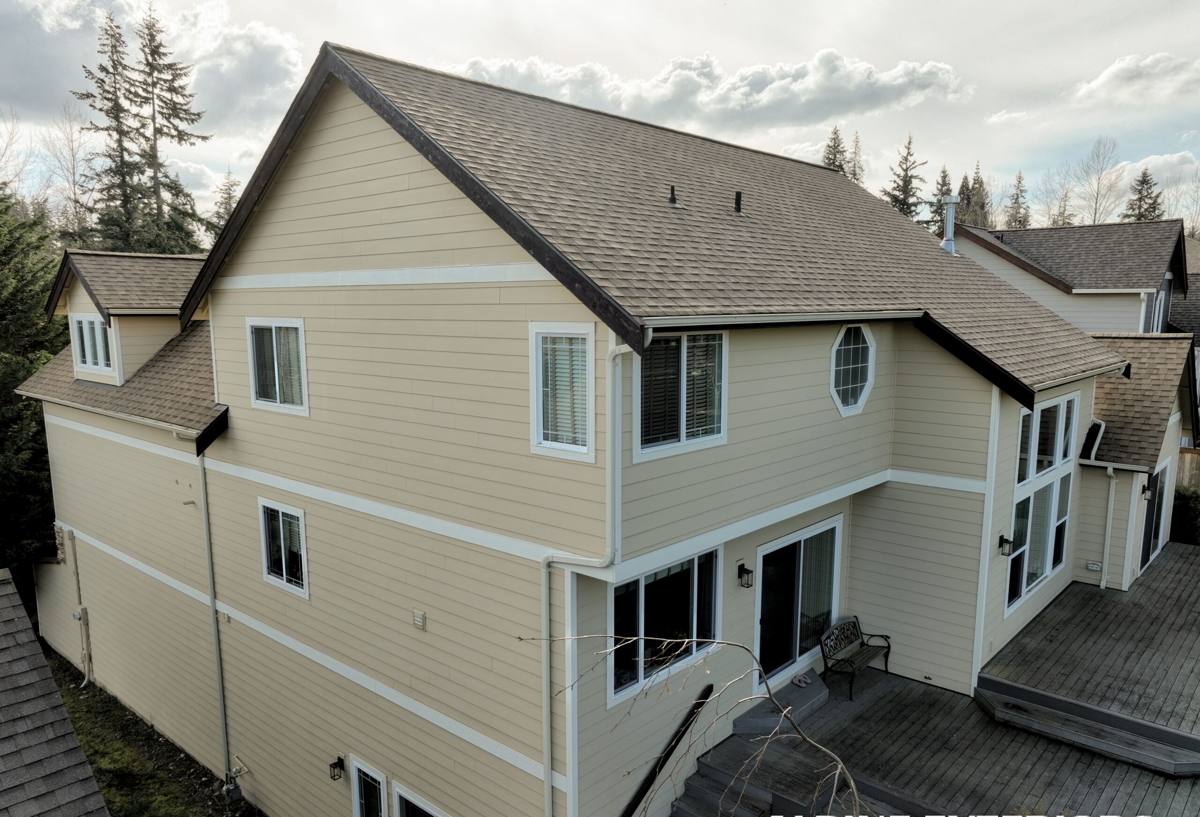
What Edgemoor Homes Need From a Deck
Salt Air and Corrosion
Proximity to the bay means airborne salt settles on exposed metal over time. Standard fasteners and connectors can corrode faster here than they would a few miles inland, and once a fastener starts rusting, it weakens the very connection holding your deck together. This isn't a reason to over-engineer everything, but it is a reason to be deliberate about which hardware goes into a coastal-adjacent build.
Driving Rain and Water Management
Rain here doesn't always fall straight down — wind off the water pushes it sideways into ledger boards, stair stringers, and any spot where the deck meets the house. If flashing and water diversion aren't handled correctly at that ledger connection, water works its way behind the siding and into framing you can't see, which is one of the more expensive repairs a homeowner can face.
Moss, Shade, and Slow Drying
Many Edgemoor lots have significant tree cover, which is part of what makes the neighborhood attractive but also means decks in shaded yards dry out slowly after rain. Standing moisture combined with organic debris (fir needles, leaves, moss spores) is exactly what feeds moss growth and, eventually, rot in untreated or poorly ventilated wood. A deck built with proper airflow underneath and the right board spacing sheds water and dries faster than one that traps it.
Decking Material Options for This Climate
There's no single "best" decking material for every home — the right choice depends on your budget, how much upkeep you're willing to do, and how much sun or shade the deck gets. Here's how the common options actually perform under Edgemoor's conditions.
| Material | Moisture & Moss Behavior | Maintenance | Typical Lifespan |
|---|---|---|---|
| Pressure-treated wood | Resists rot with proper sealing, but absorbs moisture readily; moss can take hold if not cleaned and re-sealed | Annual cleaning, re-staining every 2-3 years | 15-20 years with upkeep |
| Cedar | Naturally rot- and insect-resistant, ages to gray if left unfinished; still needs cleaning to slow moss | Periodic cleaning, occasional oil or stain if a natural look is wanted | 15-25 years with upkeep |
| Composite (capped) | Doesn't absorb water like wood; surface sheds moss more easily and doesn't require sealing | Occasional washing, no staining or sealing | 25-30+ years, manufacturer-warrantied |
| PVC decking | Fully non-absorbent; best moss and mildew resistance of the group | Occasional washing | 25-30+ years, manufacturer-warrantied |
We install all of these depending on what a homeowner wants, but for a shaded, moisture-heavy lot near the water, we're honest with clients that a capped composite or PVC product will fight moss and rot with far less ongoing effort than any wood option. Wood can absolutely work in Edgemoor — it just needs a homeowner who's willing to stay on top of cleaning and sealing.
What a Correct Deck Build Actually Involves
Ledger Attachment and Flashing
Where the deck attaches to the house is the single most important detail on the entire structure. Correct flashing — installed in the right order relative to the house's existing water barrier, with proper fasteners rated for treated lumber contact — keeps water from tracking behind your siding at that joint. This is the detail that separates a deck that lasts decades from one that causes a hidden rot problem five years in.
Footings and Frost Depth
Footings need to be sized and set to Whatcom County's frost depth and soil-bearing requirements, not guessed at. Undersized or shallow footings are one of the leading causes of a deck that develops a noticeable bounce or lean over time.
Joist Spacing and Fastening
Joist spacing depends on the decking material you choose — composite and PVC boards often require tighter spacing than solid wood to avoid flexing between joists. We build to the decking manufacturer's specified spacing, not a generic layout, and use structural screws or approved joist hangers rated for treated lumber and coastal exposure rather than standard nails.
Airflow Underneath
Enough clearance beneath the joists lets air move and moisture escape rather than sit and feed mold or rot in the framing. On lots with heavy shade, this detail matters more than it would on a sun-exposed deck that dries out on its own.
Railings and Guards
Railing posts need a connection method strong enough to meet code load requirements — this is not a place to cut corners with surface-mounted brackets alone. We use through-bolted connections reinforced at the framing level so railings stay solid for the life of the deck.
Permits and Inspections in Whatcom County
Most new decks and significant deck rebuilds in Bellingham and unincorporated Whatcom County require a building permit, particularly once the deck exceeds a certain height off grade or attaches structurally to the house. Permitted work means a third-party inspector checks footings, framing, and railing connections before the decking goes down — an extra layer of accountability that protects you as the homeowner. We handle the permit process as part of the job rather than leaving it for you to navigate.
Our Process, Start to Finish
- On-site assessment — we look at sun/shade exposure, drainage, existing structure (for rebuilds), and how the deck ties into the house
- Material and layout discussion — honest conversation about wood versus composite/PVC based on your budget and how much maintenance you want to take on
- Permit filing — we submit and manage the permit with Whatcom County or the City of Bellingham as applicable
- Demolition (rebuilds only) — removal and disposal of the old structure
- Footings and framing — footings poured to code depth, ledger flashed and attached correctly, joists set and fastened
- Decking installation — boards installed per manufacturer spacing and fastening specs
- Railings and stairs — installed with through-bolted, load-rated connections
- Final inspection and walkthrough — county sign-off, then a walkthrough with you before we call the job done
Signs Your Current Deck Needs Attention
- Green or black film building up on boards even after cleaning
- Soft or spongy spots when you walk across the deck
- Fasteners with visible rust streaks or that have backed out
- Railings that flex or wobble when leaned on
- Gaps or separation where the deck meets the house
- Standing water that doesn't drain within a few hours of rain stopping
- Visible rot at post bases or where boards meet the ledger
If any of these sound familiar, it's worth having someone look at the structure before it becomes a safety issue rather than a cosmetic one. Not every deck showing wear needs full replacement — sometimes framing is sound and it's the decking surface or railings that need attention.
Repair, Rebuild, or New Build?
Not every deck problem calls for tearing everything out. If the footings and framing are sound and code-compliant, we can often replace just the decking surface or railings and leave the structural work in place, which saves cost. But if there's rot at the ledger connection, undersized footings, or framing that was never built to code in the first place, patching the surface just delays a bigger repair. We'll tell you honestly which situation you're in rather than defaulting to the more expensive option.
Why Local Experience in Edgemoor Matters
A crew that's built decks throughout Bellingham and the surrounding water-adjacent neighborhoods already knows which fastener grades hold up to the salt air here, how deep footings need to go for this soil and frost depth, and which decking products actually shed moss instead of collecting it under a tree canopy. That's the difference between a deck built from a generic spec sheet and one built for the specific conditions your yard sees every winter. We're not guessing at how Whatcom County's climate treats a deck over time — we see the results of that climate on jobs we get called out to repair, and we build new decks to avoid becoming one of those calls.
If you're planning a new deck or thinking about replacing one that's showing its age, we're happy to come take a look and talk through honest options for your property. Reach out for a free, no-pressure estimate using the form below.