 Bellingham
 Sunnyland's Climate Is Harder on Siding Than Most Homeowners Realize
Sunnyland sits in one of Bellingham's older, well-established residential pockets, with a mix of mid-century homes and newer infill construction shaded by mature trees. That combination — older wall assemblies, tree cover, and Bellingham Bay just a short distance away — creates a specific set of conditions that siding has to survive year after year. Salt-tinged air moving in off the water accelerates corrosion on fasteners and trim. Driving rain, pushed sideways by Pacific storms, finds its way into laps, seams, and butt joints that weren't sealed correctly the first time. And Whatcom County's long, mild, wet stretch from fall through spring gives moss and algae months of ideal growing conditions on any shaded or north-facing wall.
None of this means siding fails quickly in Sunnyland. It means the products and installation details that work fine in a drier climate — or even in a sunnier part of Bellingham — get exposed here. Cheap caulking dries out and cracks a season sooner. Fiberboard that isn't properly primed on cut edges swells at the first hairline gap. Vinyl chalks and goes brittle faster under the constant damp-then-dry cycling. This page is about what actually holds up on a Sunnyland home, and what correct installation looks like when the climate isn't going to give you any slack.
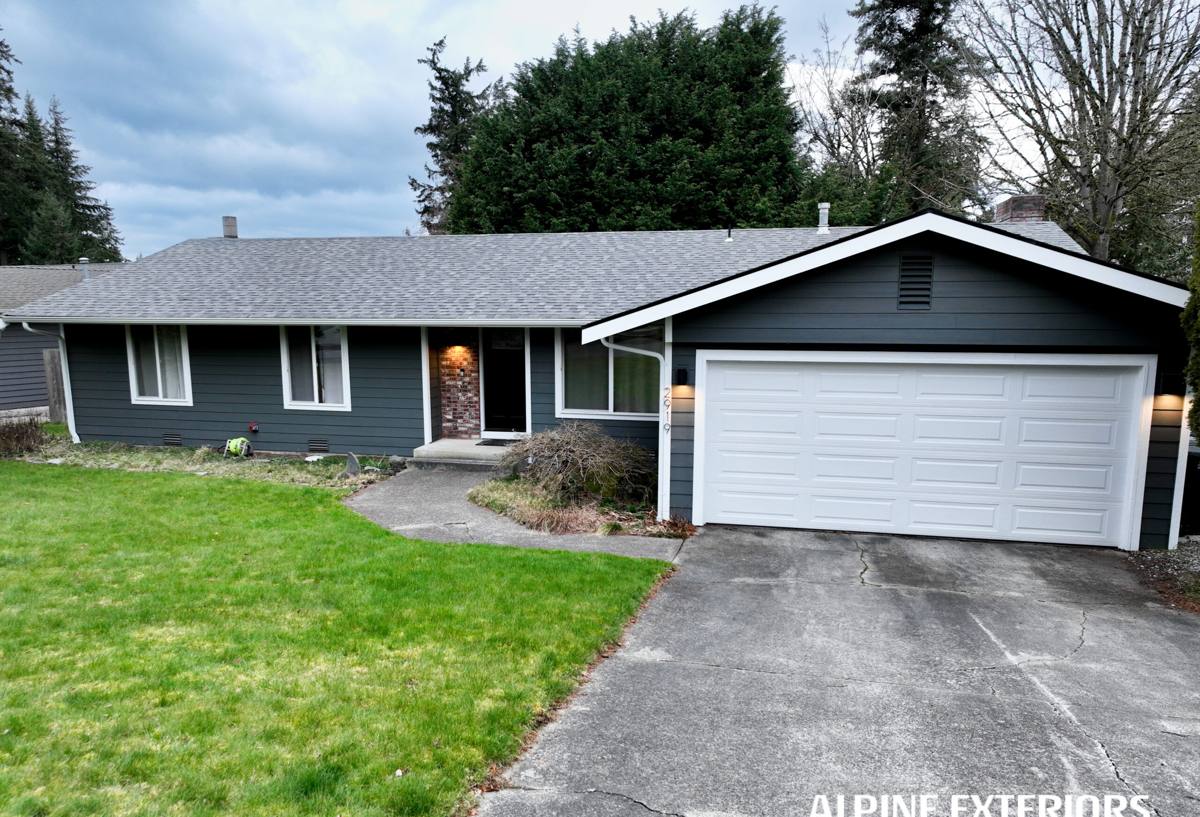
Why We Install Only James Hardie Fiber Cement
We don't install vinyl, LP SmartSide, Cemplank, Allura, primed spruce, or cedar. That's not a marketing line — it's a standard we hold to because we've seen how those products age in this exact climate, and we'd rather build a business on siding that still looks right in fifteen years than chase a lower material cost today.
James Hardie fiber cement is engineered from cement, sand, and cellulose fibers, which makes it dimensionally stable in a way wood-based and vinyl products aren't. It doesn't absorb water and swell the way engineered wood siding can if a seam opens up. It doesn't soften, sag, or warp in heat the way vinyl can on a south-facing wall. And it's non-combustible, which matters more every year as wildfire smoke and ember exposure become a bigger part of Pacific Northwest summers, even for homes nowhere near a fire line.
Hardie's ColorPlus factory finish is baked on under controlled conditions, with a UV-cured, multi-coat process that field-applied paint simply can't match for adhesion and consistency. That matters directly in Sunnyland: a finish that's chemically bonded to the board resists the freeze-thaw and wet-dry cycling that causes field-painted surfaces to peel and chalk first.
Built for This Specific Climate
James Hardie engineers its siding by climate zone, and the Pacific Northwest falls under Hardie's HZ5 category — formulated for regions with sustained moisture exposure and freeze-thaw swings rather than dry heat or hurricane-force wind. That's a meaningfully different product than what gets installed in Arizona or Florida. It's one of the reasons we don't treat "fiber cement" as a single interchangeable category — the engineering behind the specific product line matters as much as the material itself.
What Correct Installation Actually Involves
Fiber cement siding is only as good as the assembly behind it. Most siding failures we get called out to inspect in this region aren't material failures — they're installation shortcuts that let water get behind the cladding, where it has nowhere to go and no reason to dry out quickly in a climate like Whatcom County's.
- A drainage plane (weather-resistant barrier) installed continuously, with proper laps and no gaps at penetrations
- Rainscreen or furring strips where wall assembly and exposure call for it, so any moisture that does get behind the siding can drain and the wall can dry
- Correct nail placement and fastener pattern per Hardie's published installation specs — over-driven or under-driven nails are one of the most common causes of premature panel movement
- Factory-primed or ColorPlus-matched sealant at every cut edge, seam, and joint, not just at the visible face
- Proper flashing at windows, doors, and roof-to-wall intersections — the single most common source of hidden water intrusion on any home in this climate
- Correct clearance from grade, decks, and roofing so siding isn't sitting in standing water or trapped moisture
- Butt joints staggered and sealed, not just butted tight and painted over
Every one of those steps is invisible once the job is finished. That's exactly why they matter — nobody catches a shortcut here until water damage shows up behind the wall years later, and by then the fix is far more expensive than doing it right the first time.
Signs of Trouble We See on Older Sunnyland Homes
A lot of homes in this neighborhood are old enough to be on their second or third exterior. When we're asked to look at an existing siding job, these are the patterns that come up most often:
Moss and algae staining on north- and shade-facing walls
Tree cover keeps these walls damp longer after every rain, which is most of the year here. Moss holds moisture against the surface, and on porous or poorly sealed materials, that moisture eventually works its way past the surface finish.
Caulk failure at trim and joints
Standard caulk has a limited service life, and constant damp-dry cycling shortens it further. Once a bead cracks, it stops shedding water and starts collecting it.
Fastener corrosion and staining
Salt-influenced air accelerates rust on lower-grade fasteners, which shows up as streaking below nail heads long before it becomes a structural issue — but it's a clear sign the wrong hardware was used.
Swelling, delamination, or soft spots at butt joints
This is the classic failure mode for wood-based composite sidings once water gets into an unsealed cut edge. It's rare on properly installed fiber cement, which is one of the clearest arguments for the material itself.
Our Process for a Sunnyland Siding Project
We keep the process straightforward because homeowners deserve to know what's happening at each stage, especially with an exterior job that will be on the house for decades.
- On-site assessment — We walk the exterior, check for moisture intrusion, evaluate the existing wall assembly, and note exposure conditions (shade, wind-driven rain sides, proximity to grade).
- Product and profile selection — Lap siding, panel siding, shingle-style, and trim options are chosen based on the home's architecture and exposure, not a one-size-fits-all default.
- Written estimate — Scope, product lines, ColorPlus color selection, and timeline, laid out clearly before any work starts.
- Prep and removal — Old siding removed, sheathing inspected and repaired if needed, and the drainage plane addressed before a single new board goes up.
- Installation to Hardie spec — Fastening, flashing, sealing, and clearances installed per manufacturer requirements, not shortcuts that happen to look fine on install day.
- Final walkthrough — We review the finished job with the homeowner and go over warranty documentation.
What Drives Cost on a Job Like This
Every home is different, and we won't quote a number without seeing the house, but these are the factors that move the price up or down on a typical Sunnyland siding project:
| Factor | Why It Matters |
|---|---|
| Home size and wall complexity | More corners, gables, and dormers mean more cutting, flashing, and labor time |
| Condition of existing sheathing | Rot or moisture damage found during tear-off adds repair scope before new siding can go on |
| Product line and profile | Lap width, panel style, and shingle-look siding carry different material costs |
| Trim and accessory scope | Corner boards, window trim, and fascia work add to both material and labor |
| Access and site conditions | Tree cover, tight lot lines, and multi-story walls affect staging and labor time |
| Color and finish | Factory ColorPlus finishes vary by line; special order colors can affect lead time |
Maintenance Once Your New Siding Is Up
Fiber cement is low-maintenance compared to wood or engineered wood siding, but "low-maintenance" isn't "no-maintenance," especially with the moss and moisture load this area sees. A short annual routine keeps a correctly installed Hardie exterior looking right for the long haul:
- Rinse the exterior once a year, focusing on shaded and north-facing walls where moss and algae take hold first
- Keep gutters clear so overflow isn't running down the wall face during heavy rain
- Trim back tree branches and shrubs that keep siding damp and shaded longer than necessary
- Inspect caulk lines at trim and penetrations every couple of years and have any cracked beads redone
- Watch for any staining below fasteners or trim, which can flag a developing moisture issue early
Why It Matters That We Already Work in This Neighborhood
A crew that's already done siding work around Sunnyland and the rest of Bellingham knows which walls take the worst of the driving rain, which lots hold shade and moisture longer, and how the salt-air exposure off Bellingham Bay tends to show up on hardware and trim over time. That's not something you can fully substitute with a generic install checklist. It shapes decisions on the job — where extra flashing attention goes, which walls get priority on drainage detailing, and what to flag for a homeowner before it becomes a bigger problem.
It also means accountability. A contractor working across Whatcom County on an ongoing basis has a reputation to protect in the community, not just a single job to finish and move on from.
If you're weighing a siding replacement or repair in Sunnyland, we're happy to take a look at your home, walk you through what we're seeing, and put together a straightforward, no-pressure estimate. There's no obligation — just an honest read on what your house needs.