 Bellingham
 South Hill's Older Homes Face a Specific Window Problem
South Hill is one of Bellingham's more established neighborhoods, with a hillside setting that looks out toward Bellingham Bay and a housing stock that skews older than a lot of newer subdivisions around Whatcom County. That's part of the neighborhood's character, but it also means a lot of these homes are still running on their original windows, or on a round of replacements done decades ago when energy codes and glass technology looked very different. Wood sashes swell and stick. Aluminum frames sweat and go cold to the touch. Old glazing putty dries out and cracks. None of that is a defect specific to South Hill — it's just what happens to windows over enough winters in this climate, and it shows up here as much as anywhere in Bellingham.
What makes South Hill worth talking about on its own, rather than lumping it in with a generic window page, is the combination of hillside exposure and tree cover. Homes higher on the slope catch more wind off the water; homes tucked under mature trees hold more shade and moisture at the sills. Either way, the fix is the same category of problem: windows that were never built for a marine climate, or that have simply reached the end of their useful sealing life.
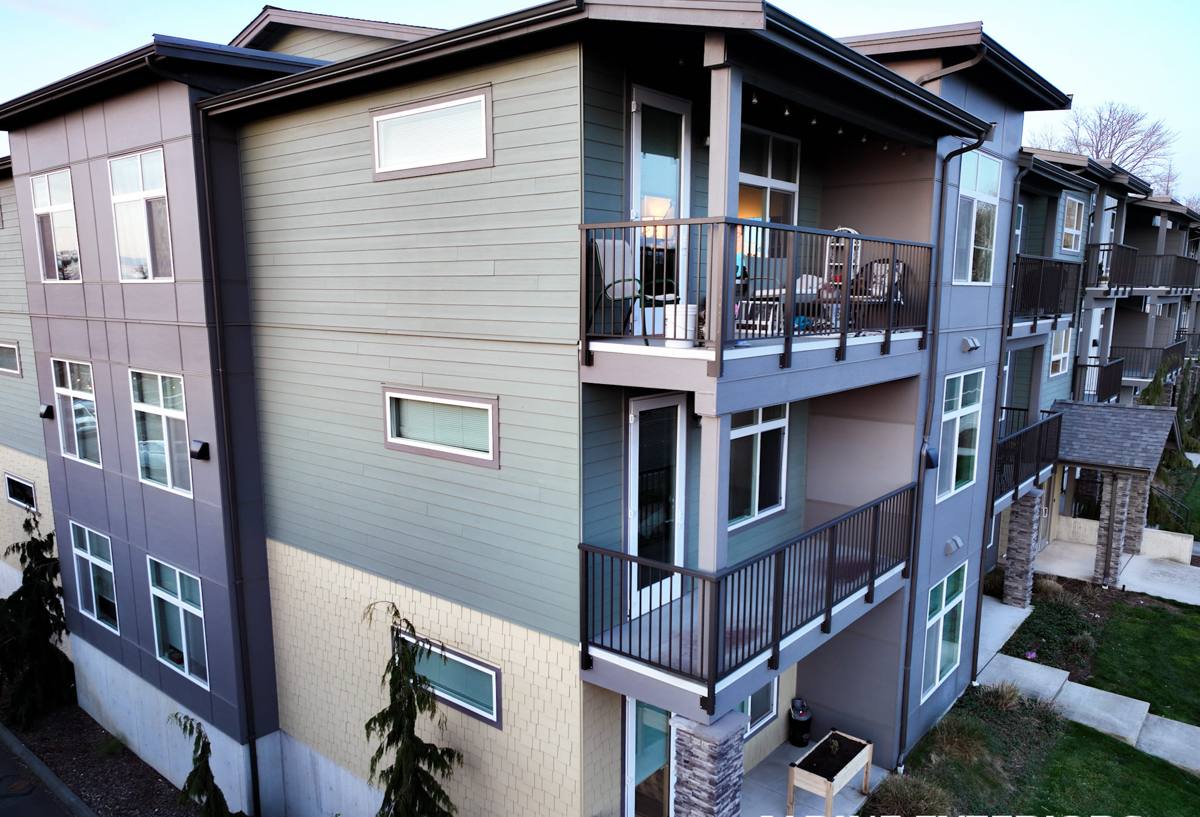
What Bellingham's Climate Does to Windows Over Time
Whatcom County sits in a marine climate, which sounds mild on paper — and mostly is — but it's a specific kind of hard on building materials. It's not extreme cold or heat that wears out a window here. It's persistent moisture, salt-laden air, and long stretches of gray, damp weather with very little drying time in between.
Salt Air and Metal Fatigue
Proximity to Bellingham Bay means the air carries a fine salt content, especially on windier days. Over years, that salt content accelerates corrosion on window hardware — hinges, locks, balance mechanisms, and any exposed aluminum components. A window that operates smoothly for the first decade can start binding or refusing to latch fully once corrosion sets into the moving parts, and a window that won't latch tight isn't sealing the way it's supposed to, energy-efficient glass or not.
Driving Rain and Water Intrusion
Storms coming off the Sound don't just drop rain straight down — wind pushes it sideways into the building envelope, right at the window-to-wall junction. That's where most real-world window failures actually start: not in the glass, but in a flashing detail or sealant joint that was never built to handle sustained, wind-driven water. Once water gets behind the trim, it can sit there for months in our climate before it ever shows up as a visible stain inside.
The Long Moss Season
Bellingham's moss season runs long — realistically much of the fall through spring — and it doesn't stay confined to roofs. Moss and mildew take hold on window sills, in frame corners, and in any spot that stays damp and shaded, which describes a lot of north- and west-facing window exposures on tree-covered South Hill lots. Beyond the cosmetic issue, that sustained moisture is exactly what accelerates wood rot in a sill or jamb over time.
What "Energy-Efficient" Actually Means for a Window
It's a phrase that gets used loosely, so it's worth being specific about what actually drives performance, because not every "energy-efficient" window sold in this region is set up correctly for it.
Glass Package
The glass itself — the number of panes, the low-E coating, and the gas fill between panes — sets the baseline insulating value. For most South Hill homes, a quality double-pane unit with a low-E coating tuned for a heating-dominated climate is the practical sweet spot. Triple-pane exists and does add performance, but it also adds weight, cost, and in some cases makes an older opening harder to fit cleanly — it's worth discussing case by case rather than assuming it's always the right upgrade.
Frame Material and Thermal Break
The frame matters as much as the glass. A frame without a proper thermal break — a barrier that stops heat and cold from conducting straight through the material — undercuts whatever the glass is doing. This is where older aluminum-frame windows tend to fall short: aluminum conducts heat and cold efficiently, which is exactly what you don't want in a window frame.
Air Sealing and Installation
Here's the part that gets skipped over most often: a top-rated energy-efficient window installed with a poor seal against the rough opening will underperform a mid-grade window installed correctly. The gap between the window unit and the framing has to be air-sealed and insulated properly, and the exterior has to be flashed to shed water away from that gap. We'll go into this more below, because it's genuinely the difference between a window that performs for twenty-plus years and one that fails early.
Signs Your South Hill Home Is Ready for New Windows
Not every window problem calls for full replacement — sometimes it's a repair or a reseal. These are the signs that point toward replacement being the right call:
- Visible fogging or condensation trapped between panes of an existing double-pane window (the seal has failed)
- Windows that are cold to the touch on the glass or frame even when the heat is running
- Wood sashes that stick, swell, or won't latch fully — especially on damp, shaded sides of the house
- Soft, discolored, or visibly rotted wood at the sill, jamb, or exterior trim
- Moss, algae, or persistent black mildew staining around the window frame that keeps coming back after cleaning
- A noticeable draft near the window even with it fully closed and locked
- Single-pane glass anywhere original to the home, particularly on the weather-facing side
- A steady climb in heating costs that isn't explained by anything else in the home
Comparing Window Materials for This Climate
There isn't one universally "correct" frame material — it depends on the home, the budget, and how the window is exposed. Here's how the common options stack up specifically against Whatcom County's salt air and moisture:
| Material | Moisture & Salt-Air Behavior | Maintenance | Notes for South Hill |
|---|---|---|---|
| Vinyl | Won't corrode or rot; performs well in coastal moisture | Low — no painting or sealing needed | Solid, cost-effective choice for most full replacements; limited color/profile options on historic-style homes |
| Fiberglass | Excellent — very stable in temperature and moisture swings, resists warping | Low | Higher upfront cost; strong option where frames take direct weather exposure |
| Wood, factory-clad exterior | Good if the cladding and seals stay intact; wood core is vulnerable if water gets behind the cladding | Moderate — depends on cladding integrity over time | Popular for matching the look of older South Hill homes; installation quality matters even more here |
| Aluminum (uninsulated) | Corrodes over time in salt air; conducts cold directly | Moderate to high | We generally don't recommend this for full replacements in this climate — the thermal and corrosion trade-offs are tough to justify |
Why Installation Matters as Much as the Window Itself
We'd rather put a mid-tier window in correctly than a premium window in poorly, and in a climate like this, that's not a small distinction.
Flashing and Weather Barrier Integration
Every window opening needs to be flashed so that any water reaching that joint is directed back out, not into the wall cavity. That means tying the window flange into the home's weather-resistive barrier in the correct shingled order — bottom, sides, then top — so water always sheds downward and outward. Skipping or rushing this step is invisible on install day and can take years to show up as rot, which is exactly the kind of failure that's expensive to catch late.
Fitting Older, Sometimes Irregular Openings
A lot of South Hill homes have openings that have settled or shifted slightly over the decades — nothing dramatic, but enough that a window can't just be dropped in and assumed to be square and level. We check and correct for that at each opening rather than forcing a standard-size unit into a non-standard gap, which is one of the more common shortcuts that leads to drafts and premature seal failure.
Our Process for South Hill Window Projects
We start with an on-site look at the actual openings — not just a quote based on a phone description — because the condition of the framing and existing flashing changes what the job actually involves. From there:
- We assess each window opening for rot, settling, and existing flashing condition, not just the visible glass and sash
- We walk through material and glass options honestly, including what we would and wouldn't recommend for that specific exposure
- We remove old units carefully to avoid unnecessary damage to interior trim or exterior siding
- We repair any rot or compromised framing we find before setting the new window — this isn't an upsell, it's a job we won't skip past
- We install and flash each window to shed water properly, then air-seal and insulate the gap around the frame
- We do a final check on operation, sealing, and exterior finish work before calling the job done
Why a Crew That Already Works South Hill Makes a Difference
Every neighborhood in Bellingham has its own mix of home ages, exposures, and quirks, and South Hill's combination of hillside wind exposure, tree-shaded moisture, and an older housing stock is a specific one. A crew that's already worked on homes in this part of town has seen how these particular houses tend to be framed, where rot typically shows up first, and what the salt air off the bay actually does to hardware over time — instead of treating every job like a generic swap-out. That's not a marketing point, it's just what experience in a specific climate and neighborhood buys you: fewer surprises mid-project and a better read on what a given opening actually needs.
If your South Hill home has windows that are drafty, fogged, sticking, or just old enough that you're not sure what they're actually costing you in heating bills, we're happy to take a look. We offer free, no-pressure estimates — you'll get a straight assessment of what your windows need, not a sales pitch, and the form below is the easiest way to get that started.