 Bellingham
 Sunnyland sits close enough to Bellingham Bay that the same weather pattern hits it year after year: salty marine air drifting in off the water, sideways rain driven by wind off the Sound, and long gray stretches where moisture just sits on north-facing walls and fence lines without ever fully drying out. Add a Pacific Northwest moss season that can run from October through May, and you've got a neighborhood where siding takes a steady, cumulative beating rather than one dramatic storm event. Most of the repair calls we get in this part of Bellingham aren't from a single incident — they're from years of small moisture and organic-growth problems that finally caught up with the siding.
This page is specifically about repairing existing siding on Sunnyland homes — what actually needs fixing, what a correct repair looks like, and when a repair is the right call versus when it's time to talk about replacement instead.
Why Sunnyland Siding Wears the Way It Does
Whatcom County's coastal position means Sunnyland homes deal with a few compounding stressors that inland Washington siding doesn't see nearly as much:
- Salt-laden air: Airborne salt from Bellingham Bay accelerates corrosion on fasteners, flashing, and any exposed metal trim, and it can also degrade cheaper paint films faster than a dry inland climate would.
- Driving rain: Wind-driven rain off the Sound pushes water sideways into seams, laps, and butt joints that were only ever designed to shed water falling straight down. Poorly caulked or poorly lapped siding takes on water here that it wouldn't in a calmer climate.
- Extended moss and algae season: Shaded, north- and west-facing walls under mature trees — common throughout Sunnyland's older, tree-lined lots — stay damp long enough for moss and algae to take hold. Moss roots hold moisture directly against the siding surface, which is a very different (and slower, more insidious) failure mode than a single storm event.
- Freeze-thaw cycling: Bellingham gets enough winter cold snaps that any water already trapped behind or inside siding can freeze, expand, and widen existing cracks or delaminated seams.
None of this means Sunnyland siding fails faster than siding elsewhere in Whatcom County — it means it fails in specific, predictable ways, and a repair crew that doesn't already know the pattern can miss the actual cause and just patch the symptom.
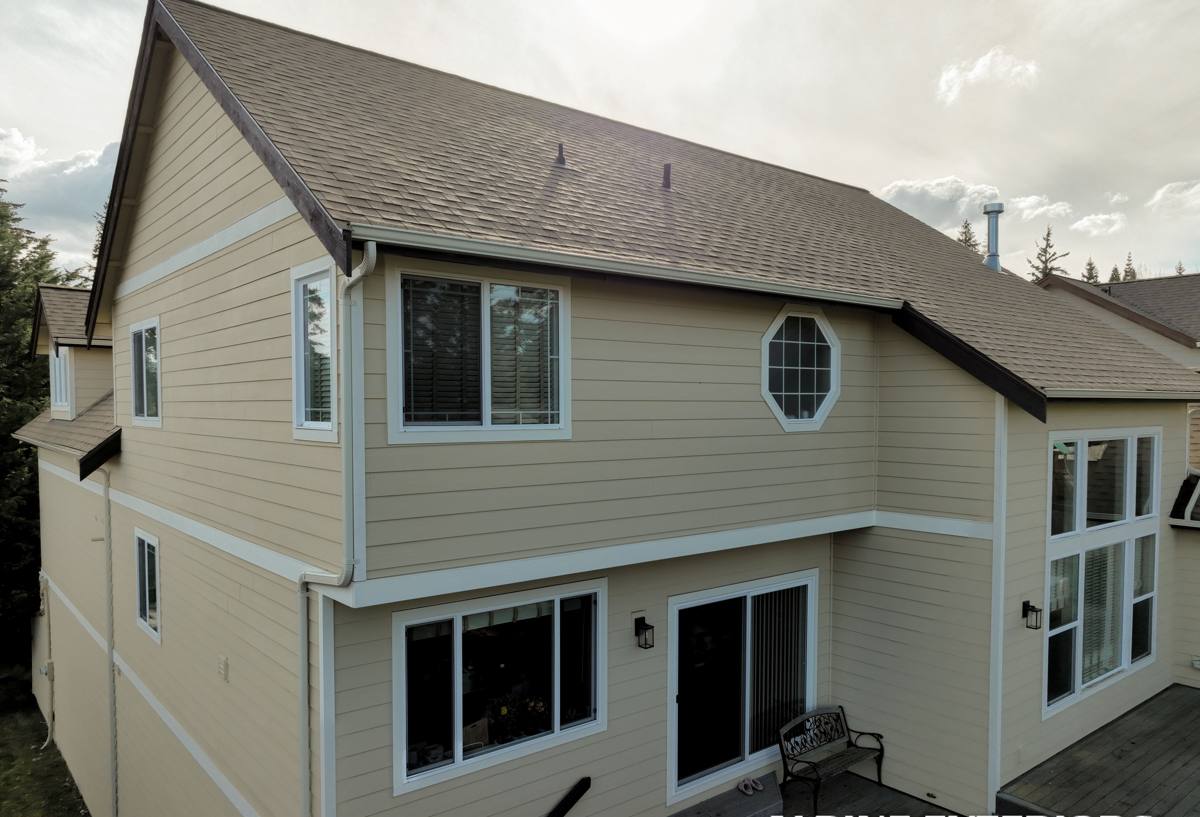
Common Sunnyland Siding Problems We See
Moisture Intrusion at Seams and Penetrations
The most common failure point on any siding system isn't the flat field of the wall — it's the transitions: where siding meets trim, where it wraps a window or door, where it's penetrated by a hose bib, light fixture, or vent. Driving rain finds these gaps over time, and once water gets behind the siding it can rot sheathing, degrade house wrap, and cause paint to bubble or peel from the back side out, which often shows up as damage that looks worse than it should for the home's age.
Moss and Algae Colonization
On shaded walls and anywhere siding sits close to landscaping, moss and algae growth is more than cosmetic. Moss holds a film of moisture against the siding surface continuously, which on wood-based or improperly sealed products can lead to soft spots, swelling, and accelerated paint failure. Removing moss without addressing the shade, drainage, or clearance issue that let it grow back just buys a season or two before it returns.
Cracked, Warped, or Delaminated Panels
Older siding — especially wood composite or engineered wood products installed before manufacturers refined their moisture-resistance formulations — is prone to edge swelling, delamination, and cracking once water gets into the panel itself. This is one of the most common reasons a homeowner calls about "repair" and we end up recommending a section be replaced outright, because a swollen or delaminated panel won't hold paint or caulk reliably even after it's patched.
Fastener and Flashing Corrosion
Salt air is hard on exposed metal. Rusting nail heads that bleed through paint, corroding flashing above windows and doors, and failed caulk joints around trim are all more common closer to the water than they are further inland — and they're often the actual root cause behind a stain or streak a homeowner assumes is just dirt.
Repair or Replace? How We Make That Call
Not every problem needs a full re-side, and we're not going to tell you it does. The honest answer depends on how far the damage has spread, what's underneath it, and what material you currently have.
| Situation | Usually a Repair | Usually Replacement |
|---|---|---|
| Damage extent | Isolated to a few boards or one wall section | Spread across multiple walls or the whole elevation |
| Underlying sheathing/framing | Dry, sound wood behind the siding | Soft, rotted, or water-stained sheathing found on inspection |
| Siding material | Sound fiber cement with isolated cracks or impact damage | Failing wood composite, warped hardboard, or brittle old vinyl |
| Cause | One-time impact, isolated flashing failure, localized moss | Systemic moisture intrusion or a material past its service life |
| Age of siding | Well within expected service life | Near or past the manufacturer's realistic lifespan |
When a repair is the right call, we do the repair — we're not in the business of upselling a full re-side to a homeowner who just needs three boards fixed. But if we open up a section and find rotted sheathing, ongoing moisture intrusion, or a siding material that's failing systemically rather than in one spot, we'll tell you plainly and explain why patching it would just be a short-term fix on a longer-term problem.
What a Correct Siding Repair Actually Involves
A repair that holds up through another Whatcom County winter isn't just pulling off a damaged board and nailing up a new one. Our process on a Sunnyland repair call typically covers:
1. Diagnose the Cause, Not Just the Symptom
Before anything gets replaced, we trace the damage back to its source — is water getting in through a failed caulk joint, a flashing gap, a clogged gutter dumping water directly onto a wall, or moss holding moisture against the surface? Replacing a board without fixing what caused it to fail means you're paying for the same repair again in a few years.
2. Check the Sheathing and Framing Underneath
Once the damaged siding is off, we inspect what's behind it. Sound, dry sheathing means we proceed with the repair. Soft or water-damaged sheathing needs to be addressed before new siding goes back on — covering rotted framing with new siding just hides a structural problem.
3. Match the Repair to What's There
If the existing siding is James Hardie fiber cement, we can typically source matching profile and color to make the repair blend in cleanly. If the existing siding is a product we don't install — vinyl, LP SmartSide, cedar, or an older composite — we'll do the repair honestly with compatible materials where that's the right call, and give you a straight answer about whether a full or partial section replacement in James Hardie makes more sense long-term, without pressuring you either way.
4. Address Moss and Growth at the Root Cause
Where moss or algae growth is part of the problem, we clean the affected area properly and talk through what's actually causing it — overhanging vegetation, poor sun exposure, gutter overflow, grade sloping toward the foundation — so it doesn't just grow back in a season.
5. Rebuild Flashing and Sealant Details Correctly
Any repair that touches a window, door, or penetration gets flashing and sealant redone to spec, not just caulked over. This is the detail work that actually keeps driving rain out, and it's the step that gets skipped most often by crews trying to move fast.
6. Finish and Match Color
New material gets primed, painted, or color-matched so the repair doesn't stand out as an obvious patch. With James Hardie's factory ColorPlus finish, this is more straightforward on Hardie siding than on field-painted materials, since the factory finish is engineered for UV and moisture resistance and holds color more consistently over time.
Homeowner Checklist: Signs Your Sunnyland Siding Needs a Look
- Soft or spongy spots when you press on the siding, especially near the bottom of walls or below windows
- Paint that's bubbling, peeling, or cracking in a pattern that follows seams or panel edges
- Visible moss or algae growth, particularly on shaded north- or west-facing walls
- Streaking or dark staining that returns quickly after cleaning
- Warped, buckled, or separated boards, especially near corners and trim
- Rust streaks below nail heads or metal flashing
- Gaps or cracked caulk around windows, doors, and other penetrations
- Higher-than-expected heating bills, which can point to moisture-compromised insulation behind damaged siding
If you're seeing more than one or two of these, it's worth having someone look before the next stretch of driving rain gets further behind the siding than it already has.
Why We Only Repair and Replace with James Hardie
When a repair does call for new material, we use James Hardie fiber cement — the same standard we install fleet-wide. In a climate like Sunnyland's, that decision comes down to how the material actually behaves in salt air and sustained moisture, not marketing. Fiber cement doesn't absorb water the way wood-based composites do, so it isn't prone to the swelling and delamination that drives a lot of our repair calls in the first place. It's non-combustible, holds paint and factory color far longer than field-applied finishes, and James Hardie's HZ product lines are engineered specifically for climate zones like the Pacific Northwest's. That doesn't mean every home in Sunnyland needs to be re-sided in Hardie today — but when we're replacing a damaged section, it's the material we stand behind, backed by a strong transferable warranty.
Why a Crew That Already Works Sunnyland Matters
Siding repair in this neighborhood isn't generic exterior work. A crew that already knows how Sunnyland's tree cover, bay-adjacent air, and drainage patterns interact with siding will diagnose the actual cause faster and won't waste your money re-treating a symptom. Local knowledge also means we know what a realistic repair timeline looks like around Bellingham's wetter months, and we plan the work — sequencing, drying time, paint cure windows — around what the weather is actually going to do, not an idealized forecast.
Get an Honest Look at Your Siding
If you're dealing with moss, staining, cracked boards, or a spot that just doesn't look right, we're glad to take a look and give you a straight answer — repair or replace, no pressure either way. Reach out for a free estimate using the form below.