 Bellingham
 Why Windows Fail Faster in Columbia
Columbia sits close enough to Bellingham Bay that salt-laden air is a daily fact of life, not an occasional weather event. Add Whatcom County's long wet season — months of driving rain pushed sideways by wind off the water — and you have two forces working against every window in the neighborhood at once. Salt air accelerates corrosion on hardware, screws, and metal flashing. Wind-driven rain finds any gap in a window's seal and pushes water uphill, against gravity, into places a dry-climate installer would never think to check.
Then there's moss season, which in this part of Washington runs most of the year. Moss and algae hold moisture against siding and trim longer than plain rain would on its own. Around window openings, that means the wood trim, sill, and sealant joints stay damp for extended stretches instead of drying out between storms. Over years, that constant dampness is what actually rots a sill or delaminates a frame — not any single storm.
None of this means Columbia homes need exotic materials. It means the replacement has to be installed with the local climate in mind: correct flashing sequence, the right sealants, and hardware that won't corrode prematurely. A window that performs fine in a drier inland climate can underperform here if it's installed the same way.
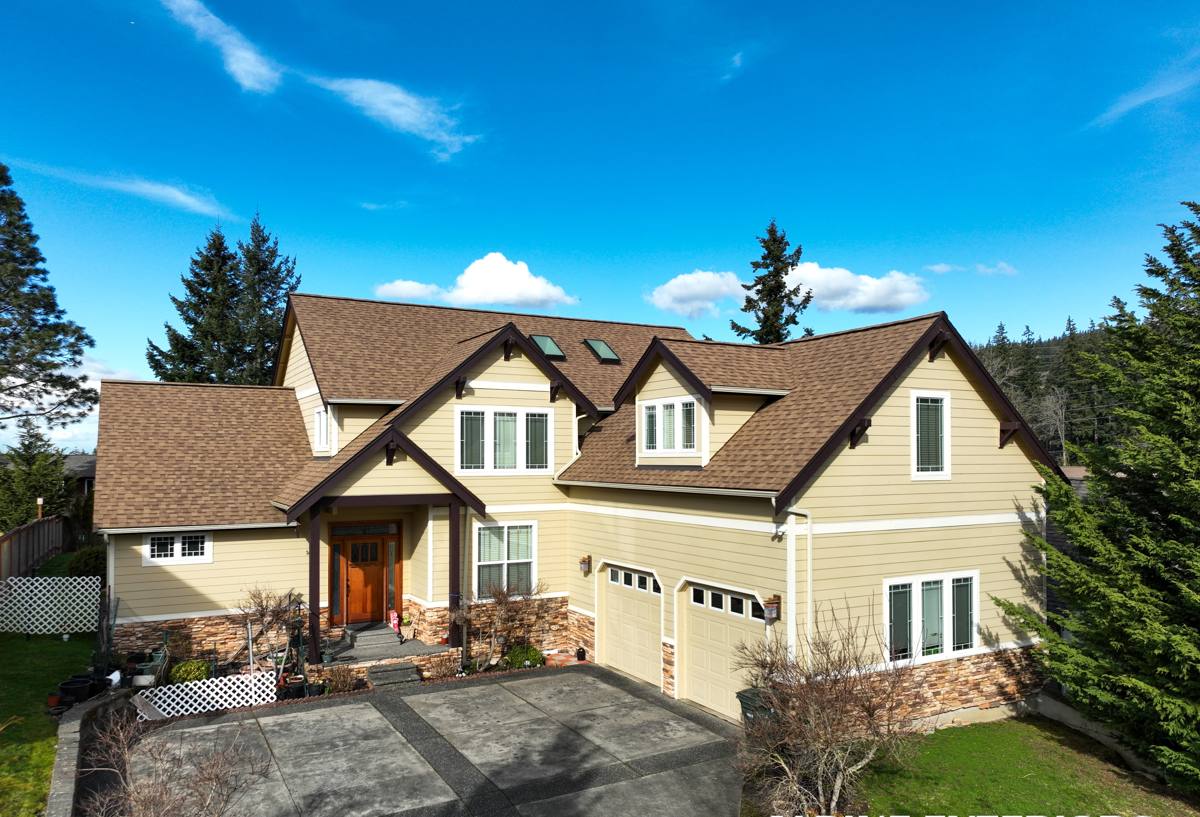
Signs a Columbia Home Needs Window Replacement
Most window failures show themselves gradually. By the time you notice a problem, it's usually been developing for a while. Watch for these signs, especially on walls facing the water or prevailing wind:
- Fogging or a permanent haze between panes — the seal on the insulated glass unit has failed
- Soft or spongy wood at the sill or bottom corners of the frame
- Visible gaps between the frame and siding, or cracked/missing exterior caulk
- Windows that are hard to open, close, or lock — frames have swelled or warped
- Cold drafts near the frame edge even when the window is fully latched
- Moss or dark staining creeping onto the trim from the roofline or siding above the window
- Noticeably higher heating bills in a home that hasn't changed its heating habits
Any one of these on its own isn't necessarily an emergency. Several together, or any sign of active rot, is a good reason to get a window looked at before the damage spreads to the framing around it.
What a Correct Window Replacement Actually Involves
It's Not Just Swapping Glass
A window replacement done right is as much about what happens in the wall as what happens in the window itself. Pulling the old unit lets us see the condition of the rough opening — the framing, sheathing, and any existing flashing — before it gets covered back up. In a climate like this one, that inspection matters more than in drier regions, because hidden moisture damage is common and easy to miss from the outside.
Flashing and Sealing, In the Right Order
Water management around a window opening depends on layering materials so water is always directed outward and downward, never trapped. That means flashing tape and sill pans installed before the window goes in, the window's nailing fin integrated with the house wrap correctly, and exterior sealant used to close gaps — not to substitute for proper flashing. Skipping or reversing this sequence is the single most common cause of leaks behind a "new" window, and it's not something you can see once the trim is back on.
Insulation and Air Sealing
The gap between the new window frame and the rough opening needs to be insulated and air-sealed, not just caulked at the surface. A window can have a great energy rating on paper and still perform poorly if that perimeter gap is left loose or over-packed with the wrong material.
Choosing Materials for a Salt Air, High-Rain Climate
Material choice matters more here than in a mild, dry climate, mainly because of how each option handles sustained moisture exposure and coastal air over the long run.
| Frame Material | How It Handles This Climate | Maintenance |
|---|---|---|
| Vinyl | Doesn't rot or corrode; handles damp and salt air well; some flexing in temperature swings | Low — occasional cleaning |
| Fiberglass | Very stable in wet and salty conditions; matches wood's expansion rate closely | Low — occasional cleaning |
| Wood (unclad) | Needs consistent upkeep to resist rot in a climate this wet; not our default recommendation for exposed walls | High — repainting/sealing on a schedule |
| Aluminum-clad wood | Good exterior protection if the cladding and seams are done correctly; interior wood still needs monitoring | Moderate |
We're not against wood-framed windows on principle — they have real appearance advantages — but on a wall that takes direct rain and salt air, we're upfront that they carry a higher maintenance burden than vinyl or fiberglass. That's a trade-off we'd rather explain honestly than gloss over.
Glass and Hardware Notes
Double-pane, low-E glass is the practical standard for this region — it manages heat loss without needing the added cost of triple-pane in most Bellingham homes. For hardware, look for corrosion-resistant fasteners and locks; standard steel hardware can start showing rust within a few years this close to the bay.
Our Process for a Columbia Window Replacement
- On-site assessment — we look at each window individually, since exposure varies a lot from one wall of a house to another
- Honest scope — we tell you which windows need replacement now, which can wait, and why
- Material selection — matched to that wall's exposure, your budget, and how the home looks from the street
- Removal and inspection — checking the rough opening for hidden moisture or rot before anything new goes in
- Correct flashing and installation — sequenced for wind-driven rain, not just a calm-day install
- Interior and exterior finish work — trim, caulking, and cleanup so the job looks finished, not just functional
- Walkthrough — we show you the operation of each window and explain any maintenance specific to the material you chose
What Window Replacement Costs — and What Drives the Price
Costs vary window to window, but a few factors consistently move the number more than others:
| Factor | Why It Matters |
|---|---|
| Number and size of windows | Larger openings and multi-window projects have different per-unit economics |
| Frame material | Vinyl is typically the most budget-friendly; fiberglass and clad-wood cost more upfront |
| Condition of the rough opening | Rot repair found during removal adds labor and material beyond the window itself |
| Wall exposure | Walls facing prevailing wind and rain may warrant upgraded flashing details |
| Access | Second-story or hard-to-reach windows take more time and equipment |
We give exact numbers after seeing the windows in person — anyone quoting a firm price over the phone for a job they haven't looked at is guessing.
Why a Crew That Already Works in Columbia Matters
Window replacement in this neighborhood isn't fundamentally different work than anywhere else in Whatcom County, but familiarity helps in small, practical ways. Knowing how homes in this area were typically built and how they've weathered gives us a head start on what to check for before we even pull the first window. We also know which flashing and sealant approaches have held up over multiple wet seasons here versus which ones look fine on day one and fail in year three.
There's also the simple matter of accountability. A crew based in and around Bellingham has a reputation in the community to protect and is available if a question comes up after the job is done — not a call center for a company that installed once and moved on.
Keeping New Windows Performing in This Climate
A correctly installed window still benefits from a little seasonal attention:
- Rinse salt residue off exterior frames and glass periodically, especially after storms
- Check exterior caulk lines once a year for cracking or gaps and have them touched up before they fail
- Clear moss or debris from the sill and surrounding trim rather than letting it sit
- Operate locks and hardware occasionally in the off-season so they don't seize up
- Watch for condensation between panes, which signals a seal failure worth addressing early
None of this is labor-intensive, but skipping it is how a well-installed window ends up needing early attention anyway.
If your windows in Columbia are showing their age or you're planning ahead for a renovation, we're happy to take a look and give you a straightforward assessment — no pressure, no obligation. Use the form below to request a free estimate.