 Bellingham
 Why York Homes Need Siding Built for This Climate
York sits close enough to Bellingham Bay and the surrounding wetlands that homes in this part of town take on a specific mix of weather stress: salt-tinged air off the water, long stretches of driving rain pushed in by Pacific storms, and a moss season that can run from October well into spring. None of these things individually destroys siding fast. Together, over years, they find every weak point in a wall system — a poorly lapped joint, a caulk line that was never meant to be the primary defense, a paint film that couldn't keep up with the moisture cycle. Whatcom County's marine climate is mild compared to a lot of the country, and that mildness is exactly what lets moss, algae, and slow water intrusion work uninterrupted for most of the year without a hard freeze to reset anything.
Siding in York doesn't need to survive extreme heat or brutal winters. It needs to survive being damp, or at least humid, for the better part of nine months a year, while also standing up to salt-laden air and wind-driven rain that gets pushed sideways against north and west-facing walls. That's a different design problem than siding for a dry climate, and it's why the product and the installation details matter more here than the marketing usually lets on.
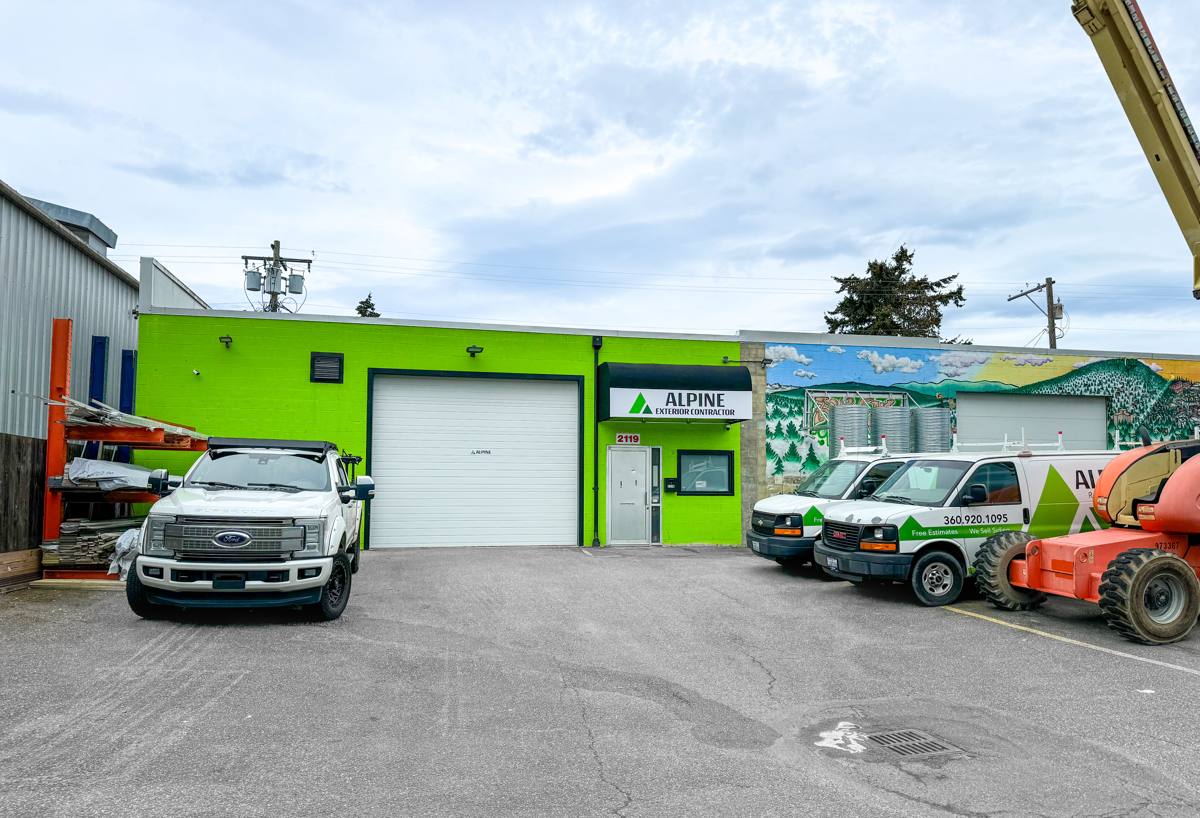
What Salt Air, Rain, and Moss Actually Do to a Wall
Salt Air
Bellingham isn't a heavy surf coast, but bay proximity still puts a fine mist of salt-bearing moisture on exterior surfaces, especially on days with onshore wind. Salt is hygroscopic — it pulls moisture out of the air and holds it against whatever surface it lands on. On siding materials that aren't dimensionally stable or that have exposed fastener heads and cut edges, that translates into faster corrosion of metal components and a wetter substrate for longer stretches than an inland home would ever see.
Driving Rain
Storms coming off the Strait of Georgia and Puget Sound don't just fall straight down — they get pushed horizontally into wall assemblies, especially on exposed elevations. Driving rain finds gaps at butt joints, poorly caulked penetrations, and undersized laps. A siding system that relies on caulk and paint film alone to keep water out, rather than on the geometry of the lap and a correctly installed water-resistive barrier behind it, will eventually let water behind the cladding.
Moss and Algae
Constant low-grade dampness, filtered light under mature trees (common on York's more established lots), and mild temperatures are ideal moss and algae conditions. These organisms hold moisture against the siding surface, and on materials that swell, absorb water, or rot when chronically wet, that's a slow path to real damage. On a stable substrate, moss and algae are a cosmetic and maintenance issue, not a structural one — but only if the material underneath doesn't degrade while it's damp.
What Correct Fiber Cement Installation Looks Like Here
Fiber cement resists moisture absorption, doesn't rot, and doesn't provide organic material for moss and fungi to feed on — but the material only performs to that standard if it's installed correctly. In a climate like York's, a handful of details matter more than they would in a drier region:
- Water-resistive barrier first. A correctly lapped, taped WRB behind the siding is the actual water management layer — the siding sheds bulk water, the barrier handles what gets past it.
- Proper flashing at every penetration. Windows, doors, hose bibs, light fixtures — each one is a place water can get behind the cladding if flashed wrong, and driving rain will find it.
- Correct lap and clearance. Hardie's installation specs call for minimum overlaps and ground/roof clearances that are easy to shortcut on a rushed job and expensive to fix later.
- Fastener placement and count. Under-fastened or misplaced fasteners create movement, which opens hairline gaps at joints — exactly where wind-driven rain gets in.
- Factory-primed or ColorPlus finish sealed at every cut. Field-cut edges left unsealed are a common failure point in wet climates; every cut edge needs to be primed or coated before it goes up.
None of this is exotic. It's the difference between following the manufacturer's installation manual and treating siding as a cosmetic wrap. On a home in a low-rain, low-humidity climate, skipped details might not show up for a decade. In York's conditions, they show up faster — and they show up as water damage, not just a paint problem.
Why We Install James Hardie and Nothing Else
We standardized on James Hardie fiber cement products years ago and don't install vinyl, LP SmartSide, Cemplank, Allura, primed spruce, or cedar. That's not a marketing position — it's a decision based on what holds up in this specific climate over the long run.
Hardie's fiber cement is non-combustible and dimensionally stable — it doesn't expand and contract with moisture the way wood-based products do, which matters directly in a climate where the material is rarely fully dry. The ColorPlus factory finish is baked on under controlled conditions, which gives it more consistent adhesion and UV resistance than field-applied paint, and it comes with its own finish warranty separate from the product warranty. Hardie also engineers its HZ (HardieZone) product lines for specific climate zones — the HZ5 formulation used in the Pacific Northwest is built around exactly the wet, moderate-temperature conditions York deals with.
We've seen what the alternatives do over time in this climate: wood-based composite siding that's sensitive to moisture at cut edges and butt joints, vinyl that can't compete on fire resistance or feel, and fiber cement competitors that don't carry the same track record or factory finish warranty structure. None of those are "bad products" in the abstract — they're just not what we're willing to put our name behind on a home that has to handle nine months of damp weather a year, every year, for decades.
How the Options Compare in This Climate
| Material | Moisture Behavior | Fire Resistance | Long-Term Maintenance in York's Climate |
|---|---|---|---|
| James Hardie Fiber Cement | Dimensionally stable, doesn't rot | Non-combustible | Low — factory finish holds up well in damp conditions |
| Vinyl Siding | Doesn't absorb water, but can warp/crack with age | Combustible, can melt/deform | Moderate — seams and fading over time |
| LP SmartSide / Wood Composite | Moisture-sensitive at cut edges and joints | Combustible | Higher — edge sealing and joint maintenance critical |
| Cedar | Absorbs moisture, needs regular refinishing | Combustible | High — repainting/staining cycle every few years |
Our Process for a York Fiber Cement Installation
Every job follows the same sequence, because skipping a step is how water problems start:
- Inspection and tear-off. We remove the existing siding and inspect the sheathing underneath for rot, soft spots, or prior water damage — this is often the first real look anyone's had at the wall in decades.
- Sheathing repair. Any compromised sheathing gets replaced before anything else happens. Installing new siding over damaged sheathing just hides a problem.
- Water-resistive barrier install. A new WRB goes on, properly lapped and taped, with attention to how it integrates with window and door flashing.
- Flashing at all penetrations. Windows, doors, vents, and fixtures are flashed to shed water outward and down, not into the wall assembly.
- Hardie installation to manufacturer spec. Correct laps, clearances, and fastening patterns, with all field-cut edges primed or sealed.
- Final walkthrough. We check caulking at trim and penetrations, confirm clearances at grade and roof lines, and go over care and maintenance with the homeowner.
What to Check Before You Hire Anyone for This Kind of Work
Fiber cement installation is not forgiving of shortcuts, and in a marine climate the consequences of a bad install show up faster. Before hiring a contractor for a York siding project, a homeowner should be comfortable asking:
- Are you James Hardie certified or factory-trained on their installation requirements?
- Will you replace or repair damaged sheathing if we find it during tear-off, and how is that priced?
- What water-resistive barrier and flashing details will you use around windows and doors?
- What are the manufacturer's minimum clearances at grade and roofline, and will the install meet them?
- Does your work come with a workmanship warranty separate from the manufacturer's product warranty?
A contractor who answers these clearly and specifically has done this kind of work before in this kind of climate. A contractor who's vague about flashing details or clearances is one to be cautious about, regardless of price.
Why Local Experience in York Matters
A crew that already works in and around York knows what this specific microclimate does to a house — which elevations take the worst of the driving rain, how much moss pressure to expect under mature tree cover, and how salt air off the bay factors into material and fastener choices. That's not something you get from a general installation manual; it's something you get from doing this work, on homes like this, in this exact part of Whatcom County, repeatedly. It shows up in small decisions — flashing details, caulk selection, where extra attention goes on the exposed elevations — that add up to a siding job that actually holds up here.
Get a Straight Answer for Your Home
Every home in York is a little different — tree cover, sun exposure, proximity to the water, and the condition of what's currently on the wall all affect what a proper installation looks like. If you're weighing your siding options or dealing with an aging system that's starting to show its age, we're happy to take a look and give you a straightforward, no-pressure estimate. Use the form below to get started.