 Bellingham
 Decking Built for Barkley's Version of Bellingham Weather
Barkley sits close enough to Bellingham Bay to catch salt-laden air off the water, and far enough into the Pacific Northwest weather pattern to get months of steady, driving rain every year. Add in the shaded, damp stretches that show up every fall and winter — the stretch most homeowners here just call "moss season" — and you've got a climate that is genuinely hard on outdoor structures. A deck that's fine in Spokane or Boise will not necessarily hold up the same way in Whatcom County.
That's not a knock on any particular product. It's just physics. Wood fibers absorb moisture and release it as the weather swings, which is what drives cupping, splitting, and the slow rot that shows up at fastener holes and end cuts. Composite decking was developed specifically to resist that cycle, but only when it's installed correctly for the site conditions it's actually going into. A composite deck installed the same way you'd install one in a dry climate can still trap moisture underneath, grow algae in shaded corners, or fail early at the fastener line. The material matters, but the installation matters just as much.
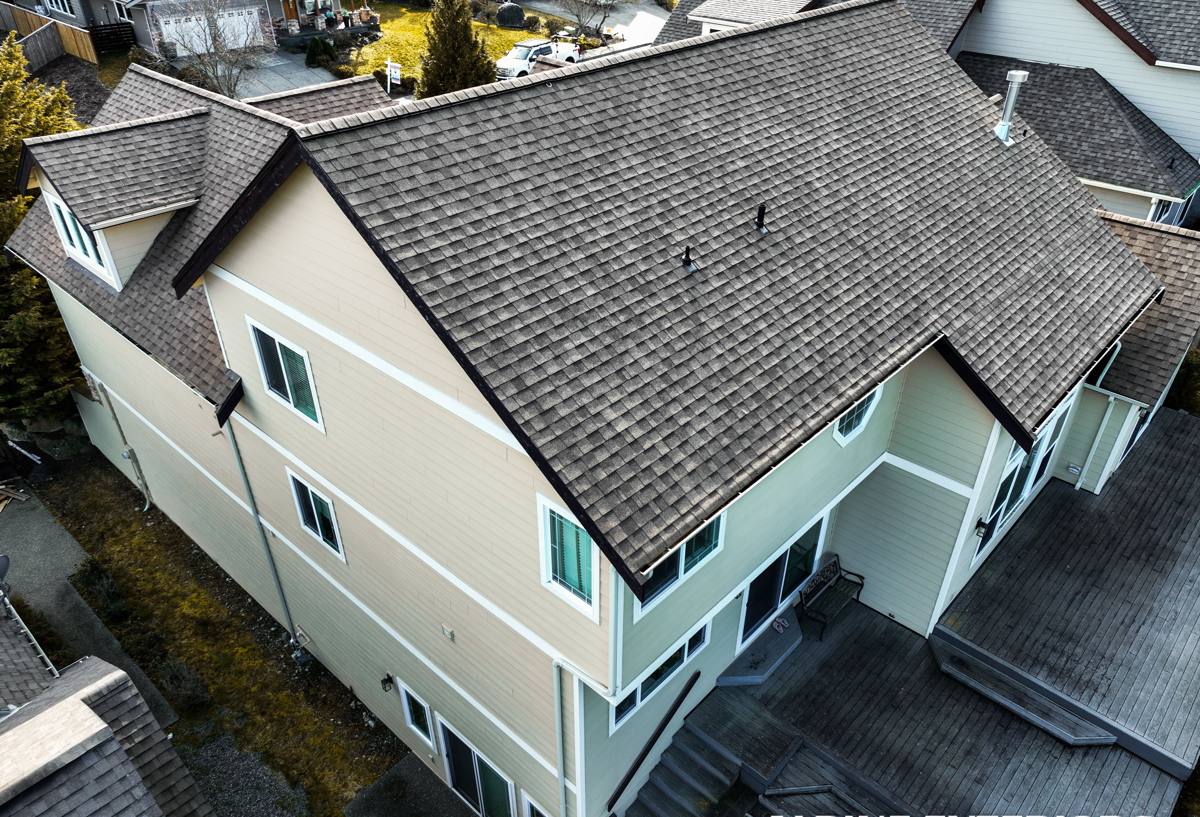
What a Correct Composite Deck Installation Actually Involves
Composite decking looks simple from the top — it's the parts you don't see that determine whether it lasts 10 years or 30.
Substructure and Ledger Attachment
Any deck attached to the house needs a properly flashed ledger board, with the flashing lapped correctly behind the house's water-resistive barrier or siding so water sheds outward, not into the wall framing. This is the single most common failure point we see on older decks — a ledger that was fastened straight to the siding with no flashing at all, which works fine until the first winter of driving rain finds the gap. Joists and beams also need to be sized and spaced for composite board spans specifically, since composite doesn't behave structurally like solid wood.
Fasteners and Hardware
Everything below the decking board — joists, hangers, screws, hidden fastener clips — should be corrosion-resistant hardware rated for treated lumber and coastal exposure. In a straight-line coastal air environment, using standard interior-grade fasteners is a shortcut that shows up as rust streaks and loosened boards within a few years, not a few decades.
Airflow Underneath the Deck
Composite boards don't rot, but the framing underneath them still can if it never dries out. Decks built low to the ground, or boxed in tight with skirting and no venting, trap moisture underneath and create the exact damp, shaded conditions where algae and moss get a foothold — both on the framing and eventually on the board undersides and butt joints. Proper clearance and ventilation gaps are a climate detail, not a cosmetic one.
Composite, Wood, or PVC: An Honest Comparison
We get asked regularly why we lean toward composite for most Barkley projects. Here's the straightforward trade-off breakdown:
| Material | Moisture behavior | Maintenance | Typical lifespan here |
|---|---|---|---|
| Pressure-treated wood | Absorbs and releases moisture with weather swings; prone to cupping and splitting | Annual sealing/staining recommended in this rainfall | 10–15 years before major repair or replacement |
| Capped composite | Moisture-resistant cap layer sheds water; core doesn't wick like solid wood | Periodic washing to stay ahead of surface algae/moss | 25–30+ years, backed by manufacturer warranty |
| PVC decking | Fully synthetic, no wood fiber to absorb moisture | Lowest maintenance, but can feel and flex differently underfoot | 25–30+ years |
Wood isn't a bad material — it's just a higher-maintenance one in a climate that rains as much as ours does. If a homeowner wants the real wood look and understands the upkeep, we'll build that well too. Most Barkley homeowners who ask us about decking are specifically trying to get away from re-staining every year, which is why composite comes up so often.
Our Process on Barkley Deck Projects
- Site visit and assessment — we look at drainage, sun/shade exposure, existing structure condition (if it's a rebuild), and how the deck ties into the house.
- Design and material selection — board style, color, railing, and fastening system based on the home and budget, not a one-size template.
- Permitting — most decks attached to the house, or built more than a couple feet off grade, need a permit in Bellingham. We handle that filing so it isn't on your plate.
- Demolition (if replacing an old deck) — including an honest look at the ledger and framing underneath, since that's often where the real problems are hiding.
- Framing and flashing — built to span and drain correctly for our rainfall, not just to code minimums.
- Decking, fasteners, and railing installation — hidden fastener systems where the product supports it, for a clean surface with no exposed screw heads collecting grime.
- Final walkthrough — we go over basic care with you before we leave the job.
Moss Season and Long-Term Deck Care
Composite decking doesn't rot, but it isn't immune to what grows on top of it. In shaded corners, under overhangs, or anywhere leaves and debris collect, moss and algae can still form a thin film on the board surface — especially through the wetter months. It's a surface issue, not a structural one, but it affects both appearance and slip resistance if it's ignored for too long.
- Sweep leaves and debris off the deck regularly through fall, especially in shaded corners near the house or fence line.
- Wash the deck surface once or twice a year with a soft-bristle brush and a composite-safe cleaner — avoid pressure washers on high settings, which can damage the cap surface.
- Keep gutters and downspouts near the deck clear so you're not dumping extra roof runoff directly onto the boards.
- Trim back overhanging branches or shrubs that keep sections of the deck shaded and damp longer than the rest.
- Check railing post bases and stair stringers each spring — these lower, wetter areas are where problems show up first if something was installed wrong.
What a Barkley Composite Deck Typically Costs
Every project is different, but these are the factors that actually move the price:
| Cost factor | Why it matters |
|---|---|
| Deck size and shape | Square footage and the number of corners, levels, or curves directly affect material and labor |
| Height off grade | Taller decks need more substructure, railing, and often stairs |
| Board and railing selection | Composite lines vary in price by cap type, color, and warranty length |
| Existing structure condition | Replacing decking on solid framing costs less than a full tear-off and rebuild |
| Site access | Tight side-yard access or elevated lots can add labor time |
We'd rather give you a real number after seeing the site than a rough figure that doesn't hold up once we're standing on your property.
Signs You've Hired the Right Deck Contractor
- They ask about drainage and sun exposure before talking about board colors.
- They can explain, specifically, how they'll flash the ledger where the deck meets your house.
- They're willing to pull the required permit rather than suggesting you skip it.
- They don't push the cheapest board line as the only option without explaining the trade-offs.
- They talk about airflow and clearance underneath the deck, not just what's visible on top.
Why It Matters to Hire a Crew That Already Works in Barkley
A lot of deck problems we get called out to fix weren't caused by bad material — they were caused by a build that didn't account for local conditions. A crew based outside Whatcom County, working here occasionally, isn't necessarily thinking about salt air corrosion on fasteners or how much shade and moisture a given lot holds onto through the winter. A crew that works Bellingham and the surrounding area regularly builds those details in as a matter of habit, not an afterthought.
That local familiarity also shows up in smaller, practical ways — knowing what the permitting process actually requires, knowing how to grade and drain a deck footprint on Whatcom County's clay-heavy soils, and knowing which details matter most given how many wet months this deck will actually see every year. None of that shows up on a spec sheet, but it's the difference between a deck that looks right on day one and one that still looks right in year fifteen.
If you're planning a new deck or replacing an old one in Barkley, we're happy to take a look and give you a straight, no-pressure estimate — just fill out the form below.