 Bellingham
 Building New in Barkley? The Window Install Matters More Than the Window
Barkley is one of Bellingham's newer planned neighborhoods, and it's still filling in with new homes, additions, and infill builds. If you're framing a new house or putting on an addition anywhere in this part of Whatcom County, the windows you choose matter — but how they get installed matters more. A good window installed poorly will leak. A mid-grade window installed correctly will outlast it. New-construction window work is a different trade than swapping out old windows in an existing wall, and it needs to be treated that way from the first stud layout to the final bead of sealant.
This page is about that specific job: installing windows during new construction — not replacing windows in a finished house. If you're looking for replacement window information, that's a different process with different products and different trade-offs. New-construction windows are installed with a nailing flange directly into the rough opening before siding goes on, which means the window and the water-management details around it become part of the wall's structure, not something bolted in after the fact.
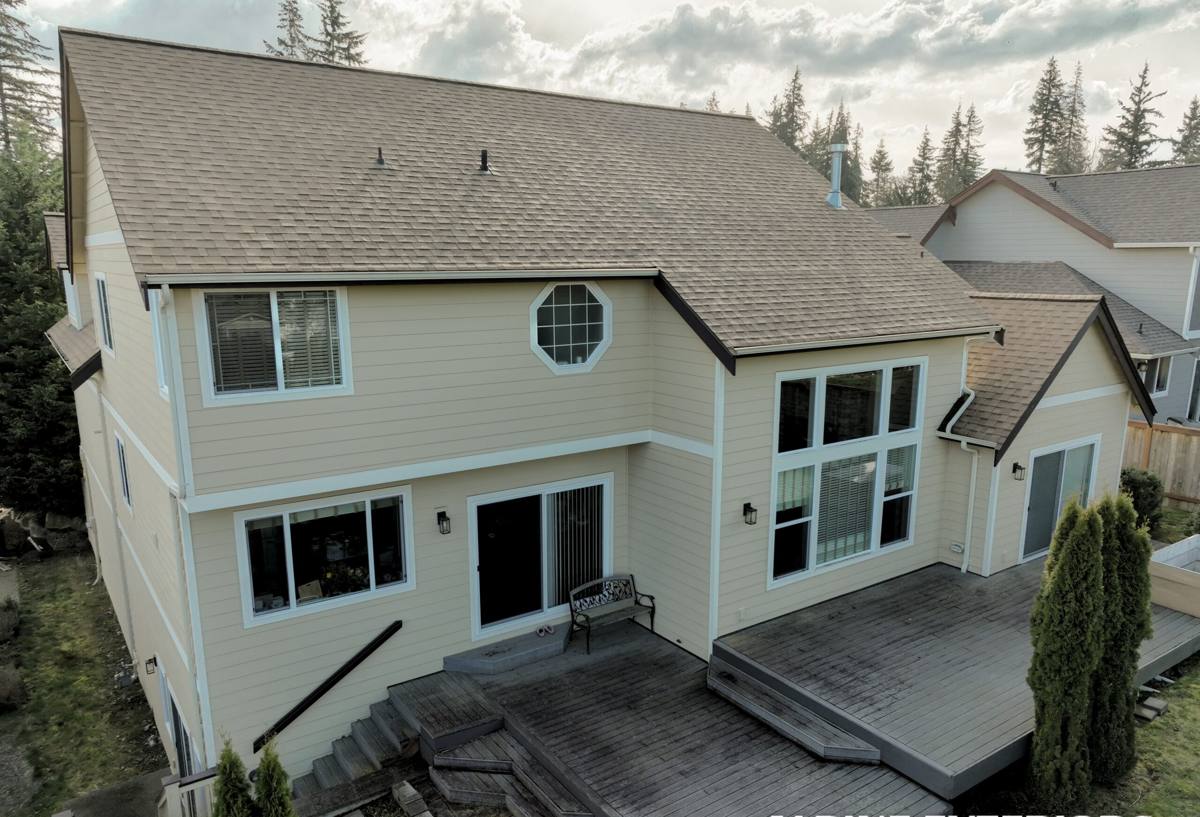
What Bellingham's Climate Actually Does to a New Window Install
Whatcom County doesn't get hurricanes or hailstorms, but it gets something arguably harder on a building envelope: sustained, wind-driven rain over long stretches of the year, combined with salt-laden air off Bellingham Bay and the Strait of Georgia, and enough shade and moisture to grow moss on nearly any surface that stays damp. None of that is dramatic in the moment. It's cumulative. A flashing detail that's "close enough" might not show a problem for two or three winters — and by the time it does, the damage is inside the wall cavity, not on the surface where you'd catch it early.
- Driving rain: Pacific storms push rain sideways, not just down — which means water hits window flanges and head flashings at an angle, testing side-lap and end-dam details that vertical-rain climates never stress.
- Salt air: Proximity to the bay accelerates corrosion on exposed fasteners, hinges, and lower-grade cladding. It's a slow tax on anything that isn't rated or protected for it.
- Long moss season: Cool, damp, shaded conditions for much of the year mean moss and algae will colonize any window sill, trim, or siding detail that holds moisture instead of shedding it.
For a new build, this means the window opening's flashing sequence — not the window brand — is usually the single biggest factor in whether that window is dry in year one and still dry in year fifteen.
What a Correct New-Construction Window Install Involves
The Rough Opening and Flashing Sequence
Every window opening should be flashed in a specific order so water is always directed outward and downward, never trapped: sill pan first, then the window itself set into that pan, then side flashing, then head flashing that laps over the housewrap above the opening. Skipping the sill pan, or flashing out of sequence, is one of the most common causes of hidden rot in new construction — and it's invisible once siding goes on.
Housewrap and Weather-Resistive Barrier Integration
The window flange needs to be properly integrated with the housewrap or weather-resistive barrier — taped and lapped shingle-style so every layer sheds water to the layer below it, all the way down to the foundation. This is where a lot of production-pace framing crews cut corners, because it takes real time to do correctly and it's never inspected as closely as structural framing.
Sealant and Fastening
Nailing flanges get fastened per the manufacturer's schedule — not "close enough" spacing — and any sealant used has to be compatible with the housewrap, the flange material, and our climate's temperature swings. The wrong sealant, or sealant used to compensate for a bad flashing job, will fail years before the window does.
Interior Air Sealing and Insulation
The gap between the window frame and the rough opening needs to be air-sealed and insulated correctly — not overpacked with rigid foam that can bow the frame, and not left open, which invites condensation and drafts. This step affects comfort and energy bills as much as it affects moisture control.
Salt Air, Rain, and Moss: What We Build In From the Start
| Climate Factor | What It Stresses | What We Do About It |
|---|---|---|
| Wind-driven rain | Head flashing laps, side-flashing seals, sill pan drainage | Full shingle-lap flashing sequence with a true sill pan on every opening, not just the exposed sides |
| Salt air off the bay | Fasteners, hardware, and unprotected trim | Corrosion-appropriate fasteners and flashing metals, especially on west- and water-facing elevations |
| Moss and algae growth | Sills, trim, and any horizontal or shaded surface that holds moisture | Detailing that sheds water off sills and trim instead of pooling it, plus material choices that don't invite growth |
| Temperature swings | Sealant flexibility and flange fastening | Sealants and installation methods rated for the temperature range we actually see here, not warm-climate products |
How Our Process Works on a Barkley Build
New-construction window work happens at a specific point in the build schedule, and timing matters. We coordinate directly with your framer or general contractor so the window install lines up correctly with the housewrap and siding sequence — not rushed ahead of it, and not delayed so long that the opening sits exposed to weather longer than it needs to.
- Plan review: We look at the window schedule and rough opening sizes before anything is framed, so there are no surprise mismatches once framing is done.
- Opening prep and flashing: Sill pans and flashing go in before the window does — every opening, every time, regardless of how exposed that wall looks.
- Window set: Windows are set plumb, level, and square, fastened per manufacturer spec, then integrated into the housewrap.
- Interior finish coordination: We air-seal and insulate the perimeter gap so it's ready for interior trim without leaving hidden gaps.
- Final check: A walk-through of every opening before siding closes it in, because that's the last point where a flashing mistake is easy to fix.
Why a Crew That Already Works Barkley Is Worth Choosing
Barkley's mix of new construction and infill building means local crews see the same lot conditions, HOA or design-review expectations, and inspection patterns repeatedly. That familiarity isn't about shortcuts — it's about knowing what typically goes wrong on builds in this specific part of Bellingham, and building in the extra attention before it becomes a problem. A crew that's only worked drier or more sheltered parts of the state may not instinctively treat sill pan flashing or fastener corrosion resistance as non-negotiable, because in their usual climate, it's less punishing to skip. Here, it isn't optional.
We also know the practical side: coordinating with framers already working Barkley job sites, understanding typical siding sequencing on new builds in this neighborhood, and being available to walk a site before it's closed in — not just show up once and leave.
Choosing Window Products for New Construction
We install a range of window lines and don't push a single manufacturer as the only right answer — the correct product depends on your budget, the home's design, and how exposed a given elevation is to wind and rain. What we won't do is compromise on installation method to accommodate a cheaper product, or skip flashing steps to save time on a premium one. A well-built vinyl or fiberglass window installed correctly will outperform an expensive window installed carelessly, every time, in this climate.
Questions Worth Asking About Any Window Product
- What's the frame material, and how does it hold up to sustained moisture and salt air over decades, not just years?
- What's the actual warranty structure — does it cover the glass, the frame, and labor, or just parts?
- How does the manufacturer's installation instruction handle flashing integration — is it clear, or does it leave gaps that installers have to guess at?
- Is the U-factor and solar heat gain rating appropriate for a Pacific Northwest heating climate, not a generic national average?
Getting Ready for Your New-Construction Window Install
If you're at the framing or pre-siding stage of a Barkley build, the best time to bring in a window installer is before the rough openings are finalized — not after. A quick review of your plans against actual window sizes avoids costly rework once framing is locked in.
If you'd like a free, no-pressure estimate on your new-construction window install, we're happy to look at your plans or walk the site and talk through what your build needs. There's a form below — reach out whenever you're ready.