 Bellingham
 Why Decks Wear Out Faster in Birch Bay
Birch Bay sits right on the water, and that location is exactly what makes deck replacement here different from a job inland. Salt-laden air corrodes fasteners, hinges, and any hardware that isn't rated for a marine-adjacent environment. Wind-driven rain off the Strait doesn't just fall straight down — it gets pushed sideways under railings and into ledger connections, joints, and end grain that a standard deck design never accounts for. And Whatcom County's long, gray moss season means any horizontal wood surface that doesn't shed water well will start growing a green film within a year or two, which holds moisture against the boards even longer.
None of this means a deck in Birch Bay can't last. It means the materials, fasteners, and drainage details have to be chosen for this specific exposure, not for a generic Pacific Northwest spec. A deck built the same way you'd build one in a dry inland neighborhood will show its age here in half the time.
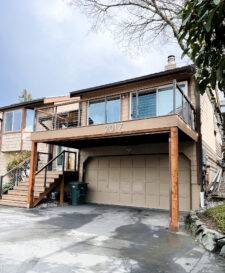
Signs a Deck Needs Replacement, Not Just Repair
Homeowners often ask us to "fix a few boards" and end up needing a full replacement once we're underneath. The visible surface is usually the last part to fail — the structure underneath fails first and quietly.
- Soft or spongy spots when you walk across the decking, especially near the house or stair landing
- Rust streaks bleeding out from screw heads or bracket connections
- A ledger board (where the deck attaches to the house) that's discolored, soft, or pulling away slightly
- Persistent moss or black staining that comes back within weeks of cleaning
- Railing posts that wiggle at the base, which usually means the post-to-frame connection has rotted
- Gaps between boards that have closed up or warped unevenly, changing how water drains off the surface
If it's one or two boards and the frame underneath is sound, repair makes sense. If the ledger, joists, or post bases are compromised, patching the surface just hides a structural problem that will keep spreading.
What We Check Before Recommending Replacement
We probe the ledger board and joist ends with a screwdriver, check post bases where they meet the ground or footing, and look at the flashing behind the ledger where it meets the house siding. In a salt-air environment, corrosion at fastener points is often more advanced than the wood around it looks, so we check hardware condition separately from wood condition.
Materials That Actually Hold Up on the Coast
There's no single "best" decking material — there's a best fit for how you use the deck, your maintenance tolerance, and your budget. What matters in Birch Bay specifically is how each option handles salt exposure and constant moisture cycling.
| Material | How It Handles Salt Air & Rain | Maintenance |
|---|---|---|
| Pressure-treated fir/hem-fir | Treatment resists rot, but surface still needs sealing to shed water and slow graying | Annual cleaning, re-seal every 2-3 years |
| Cedar | Naturally rot-resistant, ages to a silver-gray patina, but softer surface can hold moss if not cleaned | Cleaning 1-2x per year, optional staining |
| Composite decking | Doesn't absorb water or rot; performs well in salt air; color can fade slightly over years | Occasional wash, no sealing or staining |
| PVC/cellular decking | Fully water-resistant, best option for constant spray/splash zones | Lowest maintenance, occasional wash |
Whatever surface material you choose, the hardware matters just as much. We use stainless steel or coated fasteners rated for coastal/marine exposure rather than standard exterior-grade screws, because standard hardware is where we most often see early corrosion failures in this area.
What a Correct Deck Replacement Involves
Structure First
A deck is only as good as what's underneath it. That means proper footing depth and spacing for our soil conditions, joists sized and spaced for the actual load (furniture, hot tub, gathering space — tell us how you'll use it), and post bases set to keep wood off standing water.
The Ledger Connection
Most deck failures we see near the water start at the ledger board — the piece that bolts the deck to the house. This connection needs proper flashing that directs water away from the house framing, not just caulk over a gap. Done wrong, it lets water track behind your siding, which turns a deck problem into a siding and framing problem.
Drainage and Airflow
Board spacing, joist tape, and ventilation underneath the deck all affect how fast the structure dries out between rain events. In a climate with as much sustained damp weather as Whatcom County gets, a deck that can't dry out between storms will start failing years before one that can.
Railings and Stairs
Railing posts take constant wind load right at the water, so post connections get reinforced hardware, not just angle-driven screws. Stair stringers get the same treatment as joists — proper support, proper fasteners, no shortcuts because they're a smaller piece of the job.
Our Process for a Birch Bay Deck Replacement
- On-site assessment — We inspect the existing deck's frame, ledger, and footings to confirm what's actually driving the need for replacement.
- Design and material walkthrough — We go over decking, railing, and hardware options honestly, including trade-offs in cost and maintenance for your specific spot.
- Permit handling — We take care of the permitting process where required so you don't have to navigate it yourself.
- Demolition and disposal — Old decking, framing, and hardware are removed and hauled off.
- Structural rebuild — Footings, framing, and ledger flashing are installed to code, built for this coastal exposure.
- Decking, railing, and finishing — Surface material and railings go in, with attention to fastener placement and drainage gaps.
- Final walkthrough — We walk the finished deck with you and go over any care recommendations specific to the material you chose.
Local Considerations for Birch Bay Homeowners
Because Birch Bay is close to the water, some properties fall under shoreline setback or critical area regulations that affect where and how a deck can be built or rebuilt, particularly if the footprint is changing. Whatcom County permitting requirements can also apply depending on the scope of work and whether the existing structure is being expanded. We handle this coordination as part of the job so you're not stuck figuring out county requirements on your own.
Wind exposure is another local factor worth planning around — decks facing open water or exposed lots take more direct wind-driven rain than a deck tucked against a hillside. We factor orientation into material and railing recommendations rather than treating every deck the same regardless of where it sits.
Keeping a New Deck Looking Good Through Moss Season
A well-built deck still needs some seasonal attention in this climate. A little maintenance goes a long way toward protecting the investment:
- Sweep debris off the surface regularly, especially in fall, so organic matter doesn't sit and hold moisture
- Rinse or lightly scrub off moss and algae before it gets established rather than after
- Check railing and stair connections once a year for any looseness
- Keep gutters and downspouts near the deck clear so runoff isn't dumping directly onto or under it
- For wood decks, reseal or restain on the schedule appropriate to the product — don't wait until it's visibly gray and dry
Cost Factors to Expect
Every deck replacement is different, but a few factors consistently move the price up or down. We give a firm, itemized estimate after seeing the site, not a phone-quote guess.
| Factor | Why It Matters |
|---|---|
| Deck size and shape | More square footage and complex angles mean more material and labor |
| Decking material chosen | Composite and PVC cost more upfront than wood but reduce long-term maintenance |
| Height and stairs | Elevated decks and multi-run stairs add framing and railing complexity |
| Ledger and flashing condition | Water damage found at the house connection can require siding or framing repair beyond the deck itself |
| Site access | Tight lots or waterfront access limitations can affect demolition and material delivery |
| Permitting scope | Projects near shoreline setbacks may require additional review time |
Why Hire a Crew That Already Works in Birch Bay
A contractor who mainly builds decks inland doesn't always think about salt exposure, wind-driven rain, or shoreline permitting requirements until it becomes a problem after the fact. We work throughout Whatcom County, including Birch Bay and the surrounding coastal areas, so material choices, fastener specs, and ledger flashing details are built into how we plan the job from the start, not addressed as an afterthought when something starts corroding early.
If your deck is showing rust streaks, soft spots, or persistent moss that won't stay gone, or if it's simply reached the age where structural components are more of a question mark than a certainty, we're happy to take a look. Reach out for a free, no-pressure estimate using the form below — we'll walk the deck, tell you honestly what condition it's in, and lay out your options.