 Bellingham
 Decking Built for How Cordata Actually Weathers
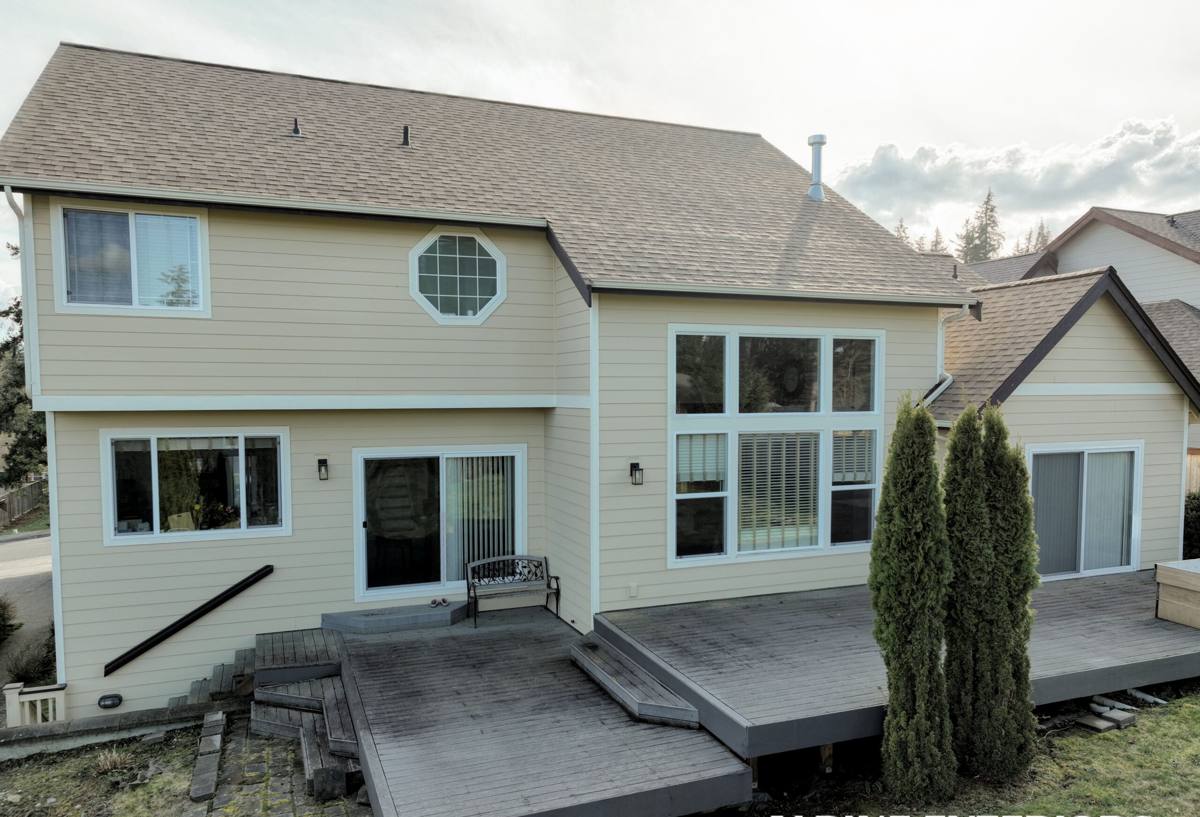
Cordata sits in north Bellingham, close enough to Bellingham Bay to catch the salt-tinged air that moves through Whatcom County, and shaded enough in places by mature trees and closely built lots that decks here rarely get a full day of sun. That combination — moist air, driving rain off the water, and long stretches of shade — is exactly what wears out a poorly built deck. It's also exactly what composite decking, installed correctly, is good at resisting. This page covers what Cordata homes specifically need from a composite deck, what a correct installation actually involves, and what to check before you hire anyone to build one.
Why the Local Climate Changes the Decking Conversation
Whatcom County doesn't get the kind of dramatic weather that damages a deck overnight. It gets the slow kind: months of damp air, a rain season that can stretch from fall well into spring, and a moss season that follows right behind it. None of that is unusual for western Washington, but it matters a lot for how a deck should be built and what it's built out of.
Salt Air
Homes closer to the bay deal with airborne salt that accelerates corrosion on exposed metal — fasteners, brackets, railing hardware. It doesn't damage composite boards directly, but it will eat cheap or unprotected hardware over time, which is why fastener choice matters as much as board choice.
Driving Rain
Wind-driven rain gets up under railings, into ledger connections, and into any gap in flashing that wasn't detailed correctly. A deck surface can be completely water-resistant and still fail underneath if the framing and flashing weren't built to shed water away from the house.
A Long Moss Season
Shaded, damp surfaces in this part of the county grow moss and algae for a good chunk of the year, not just in the depths of winter. Board texture, drainage gaps, and airflow underneath the deck all affect how much moss actually takes hold — and how easy it is to clean off when it does.
What Composite Decking Is — And Where It Fits
Composite decking is made from a blend of wood fiber and plastic, usually with a protective cap layer bonded to the outside on quality boards. It's not immune to weather, but it doesn't absorb water the way solid wood does, it won't splinter or rot, and it doesn't need to be sanded, stained, or sealed on a yearly cycle. In a climate like this one, that's the main appeal: less annual upkeep against a lot of annual moisture.
It's not the right answer for every project or every budget, and we're upfront about that. Composite costs more upfront than pressure-treated wood, and a poorly installed composite deck will still trap moisture, sag, or grow moss just as readily as any other decking — the material doesn't fix a bad build.
What a Correct Composite Deck Build Actually Involves
Most of the problems we see on decks in this area aren't about the decking board at all — they're about what's underneath it. A correct build addresses the whole system, not just the walking surface.
- Substructure and framing: Joists and beams sized correctly for the span and load, using lumber rated for ground contact or exposure where required.
- Drainage and slope: A slight slope away from the house and gaps between boards that actually let water pass through instead of pooling.
- Ledger flashing: Proper flashing where the deck attaches to the house — this is the single most common point of hidden water damage on older decks in wet climates.
- Fastener selection: Corrosion-resistant, coated, or stainless hardware sized for coastal-adjacent air, not generic zinc fasteners that corrode early.
- Hidden fastening systems: Clip-based fastening (used with most modern composite boards) that avoids surface screw holes where water and grime collect.
- Ventilation underneath: Enough clearance and airflow below the deck to keep the framing dry and to limit the damp, shaded conditions moss prefers.
Skip any one of these and the deck may look fine for a season or two before problems show up — usually right where they're hardest to see, at the ledger board or the framing.
Composite vs. Wood vs. PVC in This Climate
Each of these materials handles Cordata's conditions differently. There's no universally "best" choice — it depends on your budget, how much upkeep you want to do, and how the deck sits relative to shade and sun.
| Factor | Pressure-Treated Wood | Composite | PVC/Cellular |
|---|---|---|---|
| Moisture resistance | Moderate — absorbs water, needs sealing | High — doesn't absorb water like wood | Very high — no wood fiber to absorb moisture |
| Moss/algae resistance | Low in shaded, damp spots | Moderate to high, depends on board texture and capping | High, smooth surfaces shed growth more easily |
| Annual maintenance | Sanding, staining, sealing | Occasional washing | Minimal washing |
| Upfront cost | Lowest | Mid-range | Highest |
| Typical lifespan with correct install | Shorter without consistent upkeep | Long, backed by manufacturer warranty | Long, backed by manufacturer warranty |
| Appearance in heavy shade | Grays and shows algae staining fastest | Holds color well, capped boards resist staining | Holds color very well |
For most Cordata homes dealing with regular shade and moisture, composite lands as the practical middle ground — meaningfully less upkeep than wood without the top-end cost of full PVC systems.
Capped vs. Uncapped Boards
Not all composite decking is built the same. Capped composite boards have a protective polymer shell wrapped around the wood-plastic core, which is what actually resists moisture absorption, staining, and fading. Uncapped or partially capped boards cost less but expose more of the wood-fiber core to weather, meaning they can absorb moisture and show wear faster — a real consideration in a climate that stays damp as long as this one does. We talk through board tier and capping with every homeowner before quoting a project, because it's one of the biggest factors in how the deck performs ten years out, not just how it looks on day one.
Our Process for a Cordata Deck Project
- On-site assessment: We look at sun exposure, drainage, existing framing (if it's a rebuild), and how the deck ties into the house.
- Material walkthrough: We go over board tiers, colors, and railing options based on your budget and how much shade the deck actually gets.
- Written quote: Clear scope, materials, and price before anything starts — no surprise add-ons mid-project.
- Framing and flashing first: We build and inspect the structural work before a single composite board goes down, since that's the part that determines whether the deck lasts.
- Deck install: Hidden fastening, proper board spacing for drainage, and railing installed to code.
- Final walkthrough: We go over the finished deck with you, including basic care so you know what to expect through the wet season.
What Actually Drives the Cost
Composite decking pricing varies a lot project to project, and anyone quoting a firm number without seeing the site is guessing. These are the factors that move the price most:
| Cost Factor | Why It Matters |
|---|---|
| Existing structure condition | A rebuild from the ground up costs more than resurfacing sound framing |
| Board tier and capping | Fully capped, higher-tier boards cost more per square foot than base-tier composite |
| Deck size and shape | Cutouts, angles, and multiple levels add labor beyond simple square footage |
| Railing system | Composite or metal railing systems vary widely in price versus basic wood rail |
| Site access | Tight lots or limited equipment access can add labor time |
| Permitting | Height, guardrails, and attachment to the house may require permits depending on the project |
As a broad range, composite decking typically runs more than pressure-treated wood upfront and less than full PVC systems — where your project lands depends on the factors above. We'll give you real numbers once we've seen the site.
Checklist: What to Ask Before You Hire a Deck Contractor Here
Bellingham and Whatcom County have no shortage of contractors who'll build a deck. Fewer of them build to hold up against this specific combination of shade, salt air, and year-round moisture. Before you hire anyone, ask:
- Do you flash the ledger board where the deck meets the house, and can you explain how?
- What fastener material do you use, and is it rated for coastal-adjacent conditions?
- Is the composite board fully capped, and which brands do you carry?
- How do you handle drainage and airflow underneath the deck?
- Is your quote itemized, and does it include permitting if required?
- What does the manufacturer warranty actually cover, and is your installation labor covered separately?
Why a Crew That Already Works Cordata Matters
A deck built by someone who hasn't worked this specific mix of conditions — shaded lots, damp air moving in off the bay, a moss season that outlasts most people's patience — tends to make the same avoidable mistakes: not enough drainage slope, standard hardware where coastal-rated hardware should be, or board spacing that looks fine dry and traps moisture wet. Working regularly in Whatcom County means we're not guessing at how a deck behaves here; we're building to conditions we deal with on every project in this part of Bellingham.
If you're planning a new composite deck or replacing an aging one in Cordata, we're happy to take a look and walk you through honest options for your budget and site — no pressure, no obligation. Use the form below to request a free estimate.