 Bellingham
 Building Decks for Cordata's Climate
Cordata sits inland from Bellingham Bay but still lives inside the same marine weather system that defines Whatcom County: long wet winters, a short dry summer window, and a moss season that seems to start earlier every year. A deck built here isn't just a place to put a barbecue — it's an exterior structure that spends eight or nine months a year under some combination of rain, standing damp air, and shade from mature evergreens. That combination is exactly what breaks decks that were designed for drier climates.
We work on decks throughout Cordata and the surrounding Bellingham neighborhoods, and the failure patterns we see are consistent: fasteners that rust and streak the boards, ledger boards that trap moisture against the house, joists that never fully dry out between storms, and surfaces that turn slick with algae by November. None of that is inevitable. It's a function of material choice, fastening detail, drainage, and airflow — all things we control at build time.
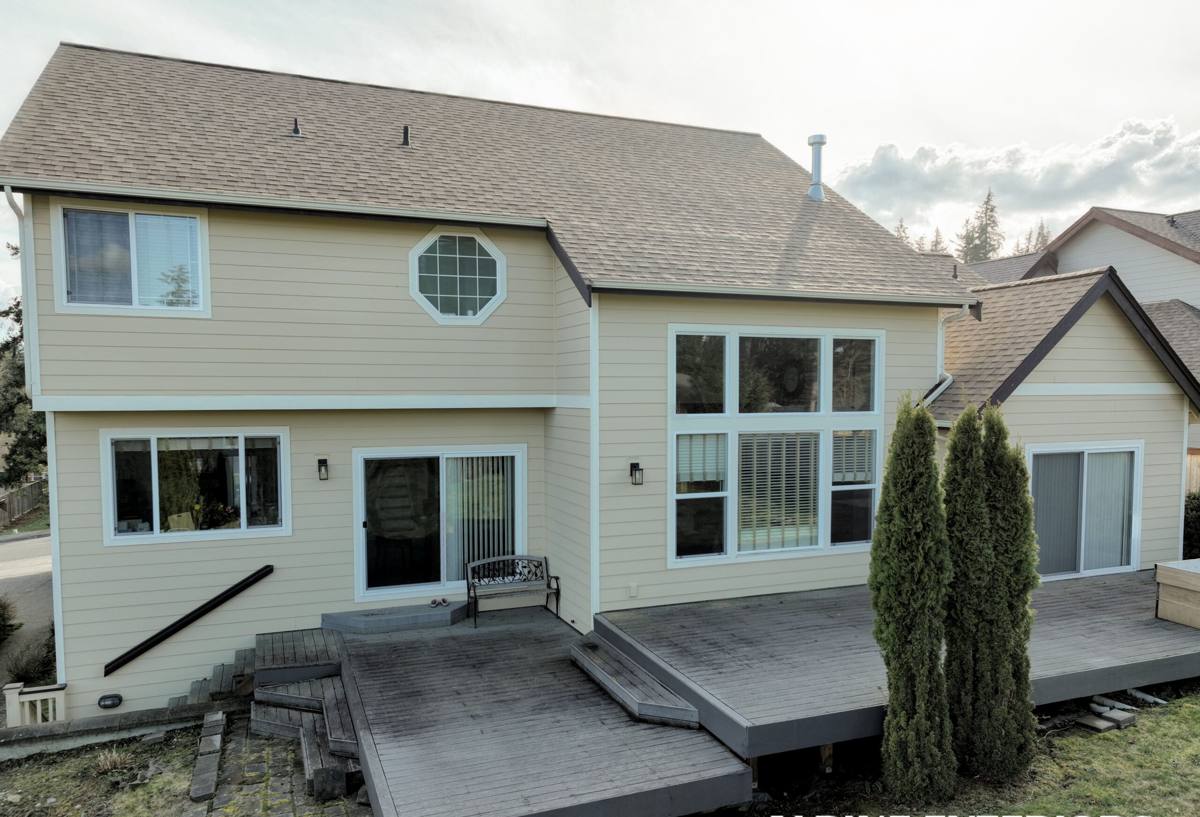
What Cordata Homes Need From a Deck
Lots in this part of Bellingham tend to have a mix of open yard and tree cover, which means a deck design has to account for both direct rain exposure and shaded, slow-drying zones — sometimes on the same structure. A deck tucked under fir or cedar canopy will collect needle litter and stay damp longer than one in open sun, even a few feet away. We look at sun exposure, prevailing wind and rain direction, and drainage slope before we ever talk decking material, because those factors decide how the whole structure needs to be built, not just what it's topped with.
Salt Air and Corrosion
Even set back from the water, Bellingham's marine air carries enough moisture and salt content to accelerate corrosion on lower-grade hardware over time. Cheap electro-galvanized screws and joist hangers will show rust streaking down decking boards within a couple of seasons. It's one of the most common "why does my new deck already look old" complaints we hear, and it always traces back to fastener quality, not the decking itself.
Driving Rain and Water Management
Whatcom County rain rarely falls straight down — wind-driven rain gets up under boards, into end grain, and behind ledger connections if those details aren't flashed correctly. A deck that looks fine on a dry day can be quietly rotting at the ledger-to-house connection because water has been wicking behind it for two winters. This is the single most expensive mistake we get called to fix, because by the time it's visible, it's usually a structural repair, not a cosmetic one.
Moss and Slip Hazards
Moss and algae growth on decking is a maintenance issue and a safety issue. Shaded, north-facing, or tree-covered sections of a deck can go green well before the rest of the structure, and once moss gets a foothold in the grain of a wood board, pressure washing alone won't fully clear it — it comes back thicker. Material choice and airflow underneath the deck both make a real difference in how fast this happens.
Decking Material Options for This Climate
There's no single "best" decking material — there's a best material for a given budget, look, and how much maintenance a homeowner actually wants to do. Here's how the common options compare for a wet, moss-prone climate like ours.
| Material | Moss/Algae Resistance | Maintenance | Typical Lifespan Here |
|---|---|---|---|
| Pressure-treated wood | Fair — needs regular cleaning and sealing | Annual cleaning, reseal every 1-2 years | 10-15 years with upkeep |
| Cedar | Good natural resistance, but graying and softening without upkeep | Reseal or stain every 1-2 years | 15-20 years with upkeep |
| Composite decking | Very good — resists moisture absorption, but surface can still film with algae | Periodic wash, no sealing needed | 25-30+ years |
| PVC/capped polymer | Best — non-porous surface sheds moisture and resists staining | Occasional wash | 25-30+ years |
We install all four categories. Wood — pressure-treated fir or cedar — still makes sense for homeowners who want a traditional look and are willing to keep up a cleaning and sealing schedule. Composite and capped polymer decking cost more up front but make the most sense for anyone tired of resealing a deck every other spring, or for shaded lots where moss is a persistent problem.
What a Correct Deck Build Actually Involves
A deck is only as good as what's underneath it. The visible boards get all the attention, but the parts that determine whether a deck lasts 10 years or 30 are mostly out of sight.
Framing and Fasteners
We use stainless steel or heavy hot-dip galvanized fasteners and hardware rated for ground contact and coastal exposure — not the minimum-grade hardware that ships with big-box lumber packages. Joist hangers, structural screws, and post bases all need to hold up to decades of damp exposure, not just pass inspection on day one.
Ledger Flashing
Where a deck attaches to the house, we install proper flashing and a water-resistant membrane between the ledger board and the siding — never just fasteners through the wall. This is the detail that prevents the slow, hidden rot that turns into a costly repair years later.
Joist Tape and Board Spacing
Joist protection tape over the top of each joist keeps standing water from soaking into end grain where boards are fastened down. Correct board spacing lets water drain through rather than pooling on the surface, and it also lets air move underneath the deck, which is one of the biggest factors in how fast moss and mildew take hold.
Post Footings
Whatcom County's clay-heavy, often saturated soils mean footings need to be set below frost depth and sized correctly for the load — undersized or shallow footings are a common cause of a deck that starts to feel spongy or uneven within a few years.
Repair, Resealing, and Restoration
Not every deck in Cordata needs to be torn out and rebuilt. A lot of what we do is targeted repair: replacing rotted ledger sections, swapping out rusted hardware, re-securing loose railings, and resurfacing boards that have gone gray and slick. If the framing underneath is sound, restoring the surface — cleaning, brightening, and resealing wood, or simply pressure washing composite — can add years of life at a fraction of a full rebuild cost.
The judgment call is knowing which is which. Soft or spongy spots near the ledger, visible daylight gaps at fastener holes, or a railing post that wiggles are signs the structure itself needs attention, not just the surface. We'll tell you honestly which category your deck falls into before we recommend anything.
Signs Your Deck Needs More Than a Cleaning
- Soft, spongy, or discolored wood near the house-to-deck connection
- Rust streaking below screw heads or joist hangers
- Railing posts or stair stringers that flex or wobble
- Persistent green or black film that returns within weeks of cleaning
- Gaps opening up between boards or at the ledger board
- Standing water that doesn't drain within an hour or two after rain
Our Process
We keep the process straightforward because deck projects don't need to be complicated to be done right.
- On-site assessment: We look at the existing structure (if there is one), sun and rain exposure, drainage, and how the space will actually be used.
- Material and design conversation: We walk through wood versus composite versus capped polymer honestly, including what each one actually costs to own over time, not just to install.
- Written estimate: Clear scope, materials, and price before any work starts — no surprise add-ons.
- Build or repair: Proper flashing, fastener grade, joist protection, and footing depth handled as standard practice, not an upsell.
- Walkthrough: We go over maintenance expectations for whatever material you chose so you know what upkeep actually looks like here.
Maintenance That Actually Matters in Whatcom County
Every deck material benefits from a seasonal rinse before the wet season sets in, but wood decking needs more active care here than in drier climates. A yearly inspection of the ledger connection, fastener condition, and any shaded sections prone to moss will catch small problems while they're still small. Composite and PVC decking need far less attention, but even those benefit from clearing leaf litter and debris out of the gaps between boards so water keeps draining the way it's designed to.
Why Hire a Crew That Already Works Cordata
A deck contractor who only occasionally works in this climate tends to build to a generic spec — the kind of detailing that's fine in a drier region but leaves gaps here. Crews who work Cordata and the rest of Bellingham regularly know which fastener grades actually hold up to marine air, which lot orientations turn into moss traps, and where ledger connections tend to fail first in this rainfall pattern. That local pattern recognition is the difference between a deck that needs attention in year three and one that's still solid at year twenty.
We're not the only deck builder in Whatcom County, but we build every deck — here in Cordata and across Bellingham — to hold up against the specific conditions this region throws at it: driving rain, marine air, and a moss season that doesn't take a break. If you're planning a new deck, or trying to figure out whether an existing one needs repair or replacement, we'll come take a look and give you a straight answer. Reach out for a free, no-pressure estimate using the form below.