 Bellingham
 Why Edgemoor Roofs Wear Differently Than Roofs Inland
Edgemoor sits close enough to Bellingham Bay that the air itself is part of the roofing equation. Salt-laden moisture off the water settles on shingles, metal flashing, and fasteners day after day, and it doesn't rinse off the way ordinary rain does. Add Whatcom County's driving rain — the kind that comes in sideways off a southwest wind rather than falling straight down — and you get water finding its way under laps and around flashing that would stay dry in a calmer climate. Layer on a moss season that, thanks to mature tree cover and near-constant shade on plenty of Edgemoor lots, can run eight or nine months out of the year, and it's easy to see why a shingle roof built to a generic national spec often underperforms here.
None of this means asphalt shingles are a poor choice for this neighborhood. It means the details of the install — the underlayment, the ventilation, the flashing metal, the shingle class — have to be chosen for this specific combination of salt, wind-driven rain, and shade, not for a textbook climate. That's the difference between a roof that looks fine for a year or two and one that actually holds up through a decade of Bellingham winters.
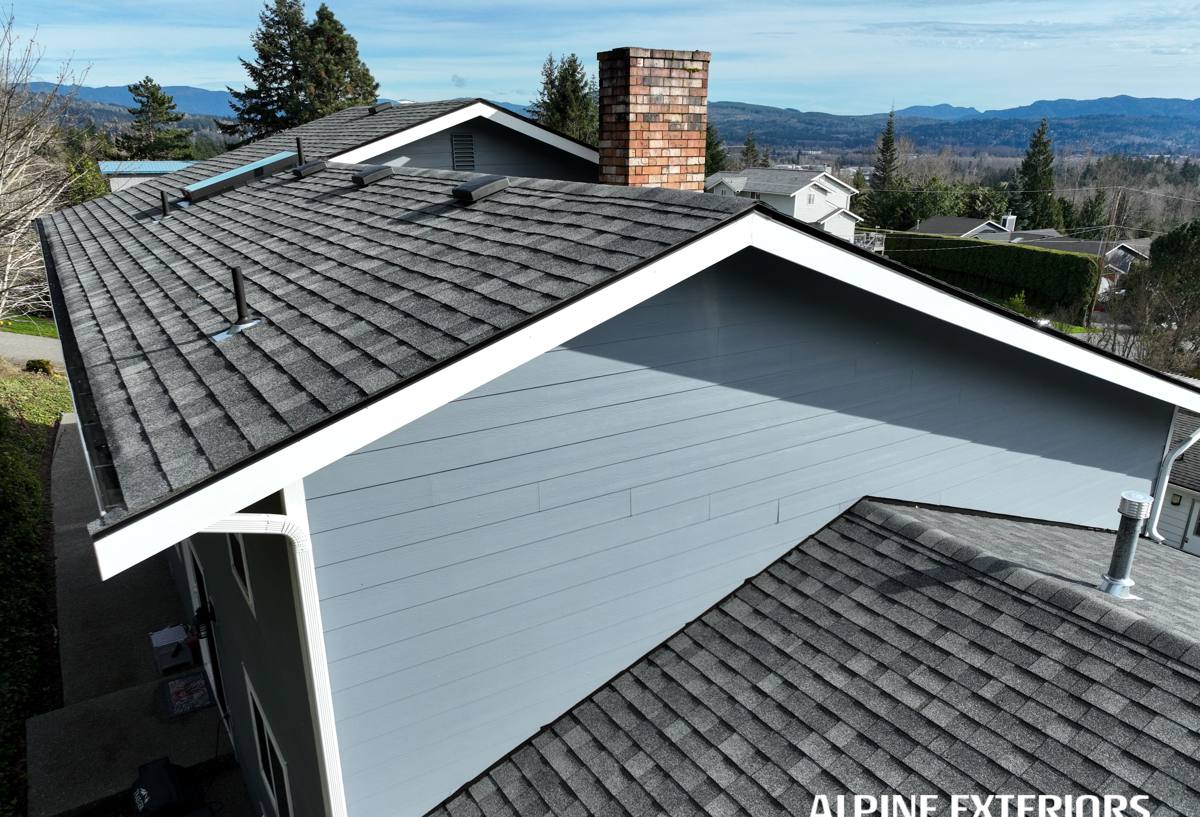
What a Correctly Built Shingle Roof Needs in This Climate
A shingle roof is a system, not a single product nailed to plywood. In Edgemoor, a handful of details matter more than they would in a drier, less shaded part of the county.
Underlayment and Ice-and-Water Protection
Synthetic underlayment holds up better than old-style felt when it's exposed to repeated wetting and drying, which is the normal cycle here for months at a time. We run ice-and-water shield membrane along eaves, valleys, and around any roof penetration — chimneys, vents, skylights — because those are the spots where driving rain and pooled moisture from moss buildup are most likely to work their way under the shingle course.
Ventilation and Trapped Moisture
Balanced intake and exhaust ventilation keeps the underside of the roof deck close to outside temperature and humidity. Without it, warm moist air from the house condenses against the cold underside of the decking, and that trapped moisture is exactly what feeds moss and rot from the inside out. A roof can look fine from the ground and still be breaking down from underneath because the attic was never properly vented.
Flashing and Salt-Air Corrosion
Cheap or mismatched flashing metal corrodes faster near the bay than it would a few miles inland. We use flashing rated to hold up to salt exposure at valleys, chimneys, and wall-to-roof transitions, and we take the extra time on those details because a flashing failure — not a worn-out shingle field — is the most common source of an actual roof leak.
Signs an Edgemoor Roof Needs a Look
Most shingle roof problems give warning signs well before there's an active leak inside the house. Worth checking for, especially on shaded north-facing slopes:
- Granules collecting in gutters or at downspout outlets — a sign shingles are wearing faster than they should
- Dark streaking or green-black patches, particularly under tree cover or on slopes that stay damp longest
- Shingle edges that are curling, cupping, or lifting instead of lying flat
- Soft or spongy spots when walking the roof, which usually means the decking underneath is compromised
- Daylight visible through the roof boards from inside the attic
- Ceiling or wall staining that shows up after a stretch of driving rain
- Missing or damaged flashing around chimneys, skylights, or vent pipes
Any one of these on its own isn't necessarily an emergency, but they're worth a professional look before the next storm cycle rather than after.
Choosing a Shingle for Salt Air, Rain, and Moss
Not every asphalt shingle handles this climate equally well. The differences aren't about brand marketing — they're about the granule composition, the weight of the shingle, and how the manufacturer rates it for wind and algae resistance.
| Shingle Type | Wind & Rain Performance | Moss/Algae Resistance | Typical Lifespan Here |
|---|---|---|---|
| Standard 3-tab | Adequate in sheltered spots; weaker in exposed, wind-driven rain | Low unless algae-resistant granules are specified | Shorter end of the range in shaded, damp lots |
| Architectural/laminate | Stronger wind rating, better lay-flat performance in driving rain | Better than 3-tab, best when paired with AR granules | Mid-to-long range with proper ventilation |
| Algae-resistant (AR) laminate | Same strong wind performance as standard laminate | Copper/zinc granules actively resist algae growth | Best fit for shaded, damp Edgemoor lots |
| Premium/heavyweight designer | Highest wind rating, thickest profile | Usually includes AR granules as standard | Longest lifespan, higher upfront cost |
Why Algae-Resistant Granules Matter Here
Algae-resistant shingles use copper or zinc granules woven into the surface layer specifically to slow the growth that causes those dark streaks and, eventually, moss colonization. In a climate as damp and shaded as parts of Edgemoor, that's not a cosmetic upgrade — it's a practical one. A shingle without AR granules on a north-facing, tree-shaded slope will typically show algae and moss staining years before the same shingle on a sun-exposed slope across town.
How We Approach a Shingle Roofing Job Here
- Full roof and attic inspection, including a check of ventilation, decking condition, and existing flashing
- Careful tear-off of the old roofing material, checking the deck as we go rather than covering up problems
- Repair or replacement of any soft, rotted, or delaminated decking before anything new goes down
- Ice-and-water shield at eaves, valleys, and penetrations, then synthetic underlayment across the field
- New flashing at chimneys, skylights, walls, and valleys, matched to the exposure the roof actually gets
- Shingle installation following the manufacturer's nailing pattern and exposure spec, not a shortcut version
- Ridge and intake ventilation checked and corrected so the finished roof can actually breathe
- Full cleanup, including a magnetic sweep for stray nails, and a walk-through of the finished work
Skipping steps in that list is how a roof ends up looking fine at handoff and failing early. We don't shortcut the deck inspection or the ventilation check just because they're less visible than the shingles themselves.
Repair or Full Replacement? What Actually Drives the Decision
Not every roof problem in Edgemoor calls for a full tear-off, and not every roof is a good candidate for another round of patching. The honest answer usually comes down to a few factors.
| Factor | Leans Toward Repair | Leans Toward Replacement |
|---|---|---|
| Roof age | Under roughly two-thirds of its rated lifespan | At or beyond its rated lifespan |
| Extent of damage | Isolated to one slope or one flashing detail | Widespread granule loss, curling, or moss across multiple slopes |
| Decking condition | Solid, no soft spots found on inspection | Soft, spongy, or rotted decking in multiple areas |
| Layers already on the roof | Single layer, room to reroof if needed later | Multiple layers already present, tear-off required |
| Storm or wind damage | Limited to a small, repairable area | Structural or widespread, often involves an insurance claim |
Cost ranges vary a lot based on roof size, pitch, access, and decking condition, so we don't quote a number over the phone. In general terms, a targeted repair tends to run from a few hundred dollars into the low thousands, while a full tear-off and replacement is a bigger investment that scales with square footage and roof complexity. We'll walk the roof, explain what we find, and give you the real range for your specific situation before any work starts.
Moss Season Maintenance That Actually Helps
Once a shingle roof is properly installed, a short list of maintenance habits does most of the work of keeping it that way through Whatcom County's long damp stretch:
- Keep gutters and valleys clear of needles and debris so water and moss spores don't sit and accumulate
- Trim back overhanging branches where it's practical, since more sun exposure on a slope slows moss growth
- Skip pressure washing — it strips protective granules and can force water under the shingle laps
- Have moss physically removed by hand or low-pressure methods rather than scraped, which can tear the shingle surface
- Schedule a roof check after major fall or winter storms, when wind-driven rain is most likely to expose a weak flashing point
None of this is complicated, but it's the kind of upkeep that gets skipped when nobody's watching the roof closely — which is exactly when small problems turn into deck repairs.
Why It Matters to Hire a Crew That Already Works in Edgemoor
A roofing crew that works this neighborhood regularly already knows which slopes hold shade the longest, how exposed a given lot is to wind coming off the bay, and which flashing details tend to fail first in this specific microclimate. That's not something you get from a national installation manual — it comes from doing the work here, on roofs with the same salt air and moss pressure yours deals with. It also means faster, more accurate estimates, since we're not guessing at how Whatcom County weather will treat a given roof design — we've already seen how it plays out.
If you're weighing a repair against a full replacement, or you just want a straight answer about what condition your roof is actually in, we're glad to take a look. The estimate is free, there's no pressure attached to it, and you can use the form below to get started.