 Bellingham
 Edgemoor's Exposure: Salt Air, Rain, and a Long Moss Season
Edgemoor sits close to the water, and that proximity shapes everything about how siding ages here. Homes in this part of Bellingham take on a steady mix of salt-laden air off Bellingham Bay, wind-driven rain that hits walls at an angle rather than falling straight down, and shaded, damp conditions that keep moss and algae active for much of the year. None of these factors alone is unusual for Whatcom County. Together, on a home that's close to the water and often tucked under mature trees, they add up to one of the tougher exterior environments we work in locally.
Salt air is corrosive to exposed metal fasteners and hardware, and it accelerates the breakdown of coatings that aren't formulated to resist it. Driving rain finds every gap in flashing, trim, and siding laps that a calmer climate would never expose. And moss doesn't just look bad — where it colonizes a siding surface, it holds moisture against that surface far longer than open air would, which matters a lot depending on what the siding underneath it is made of.
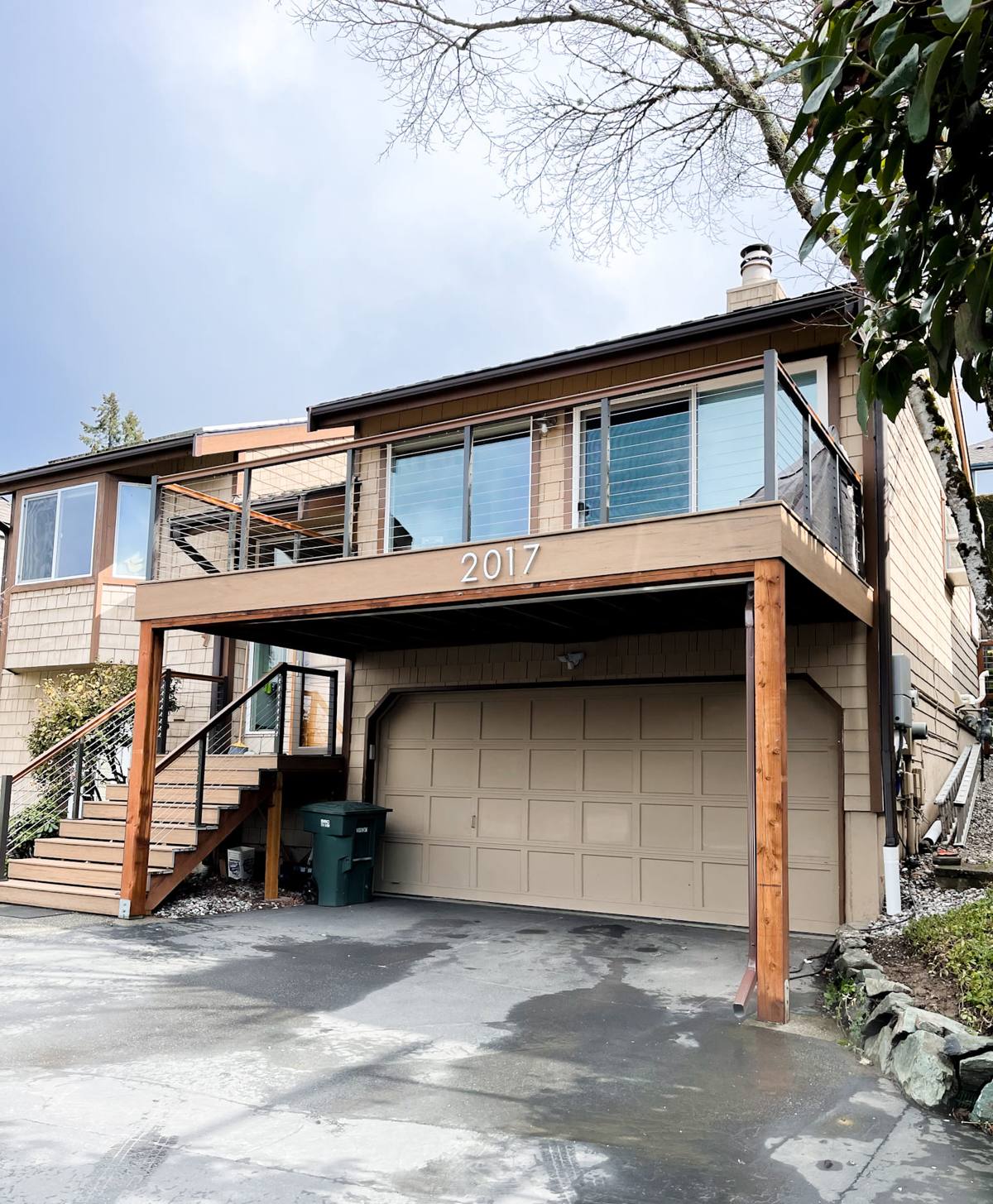
What This Climate Does to the Wrong Siding Material
We've walked enough Bellingham exteriors, including plenty near the water in neighborhoods like Edgemoor, to see a pattern: siding failures here are almost always moisture failures, not just cosmetic ones. Materials that are dimensionally unstable when wet — wood-based composites, primed spruce, some engineered wood products — respond to Bellingham's damp season by swelling at edges and fastener points. Once that starts, paint and caulking can no longer keep up, and moisture gets a path into the substrate. Vinyl siding doesn't absorb water the same way, but it moves a lot with temperature swings, and in a marine climate with persistent shade and moisture, the gaps and laps in vinyl systems become long-term collection points for algae and grime that pressure washing only partially solves.
This is regional experience, not a claim about any one product being defective. It's simply that Edgemoor's combination of salt exposure, wind-driven rain, and shade-driven moss growth is a stress test, and some siding materials handle that stress test better than others.
Why We Install James Hardie Fiber Cement — and Nothing Else
We install James Hardie fiber cement siding exclusively. That's a deliberate standard, not a limitation on what we're capable of installing. Fiber cement is cement, sand, and cellulose fiber — it doesn't swell, rot, or feed the kind of organic growth that wood-based products can. It's also non-combustible, which matters increasingly in this region. James Hardie's ColorPlus factory finish is baked on under controlled conditions rather than field-painted, which gives it more consistent adhesion and UV resistance than a coating applied on-site in variable weather — a real advantage on a schedule where Bellingham can hand you rain on short notice.
James Hardie also engineers specific product lines (their HZ5 designation, for example) for regions with harsher moisture and freeze-thaw exposure, which the Pacific Northwest coast qualifies as. Combined with a strong transferable warranty, that engineering is why we standardized on this one product system rather than offering a menu of siding types. We'd rather do one thing very well on every Edgemoor home we touch than offer options we don't fully stand behind.
What Fiber Cement Does Well Against This Specific Climate
- Resists moisture-driven swelling at butt joints and fastener penetrations, the two spots where wood-based sidings fail first
- Holds paint and factory finish longer under salt air and UV exposure than field-applied coatings
- Doesn't provide an organic food source for moss and algae the way wood fiber products can
- Non-combustible, which is a growing consideration as wildfire smoke seasons extend further into Western Washington
- Rigid enough to hold straight lines and tight reveals through Bellingham's temperature and humidity swings
What a Correct Installation Actually Involves
Fiber cement siding is only as good as the installation behind it. On a marine-exposed property, the details underneath the siding matter as much as the siding itself.
Weather-Resistive Barrier and Flashing First
Before any siding goes up, we're relying on a continuous weather-resistive barrier and correctly lapped flashing at every window, door, and penetration. In a driving-rain environment like Edgemoor's, water will find any shortcut taken at this stage — and it won't show up as a problem for years, which is exactly why it has to be done right the first time.
Fastening and Clearances
James Hardie specifies fastener type, spacing, and embedment for a reason — under-driven or over-driven nails, or the wrong fastener for the substrate, create the small gaps that salt air and rain exploit over time. We also hold proper clearance between siding and grade, decks, and roof lines, since ground-level and roof-line moisture and splash-back are common failure points on homes near the water.
Joints, Caulking, and Trim
Butt joints and trim transitions get factory-matched caulking rated for the exposure, and we follow Hardie's specified gaps rather than butting boards tight — tight joints trap moisture instead of shedding it. Trim details around windows and corners are also where a lot of the visual character of a home comes through, so we treat that work as both a performance detail and a finish detail.
Ventilation Behind the Cladding
Proper rainscreen or drainage-plane detailing gives any incidental moisture that does get behind the siding a way to drain and dry out, rather than sitting against the wall assembly. This is especially relevant on shaded Edgemoor lots where a wall can stay damp longer after a storm than a sun-exposed wall would.
Our Process, Start to Finish
- Walkthrough and assessment — we look at your home's specific exposure: how much direct salt air and wind it takes, how shaded the walls are, and where the current siding or trim is already showing moisture stress.
- Detailed estimate — a written scope covering surface prep, flashing and barrier work, siding and trim material, and finish color, so there's no ambiguity about what's included.
- Prep and tear-off — removal of existing siding, inspection of sheathing for hidden rot or damage, and repair of anything the old siding was covering up.
- Barrier, flashing, and install — the weather-resistive barrier, flashing, and James Hardie siding and trim go on to manufacturer spec, with attention to the joint and fastening details above.
- Final walkthrough — we go over the finished job with you before we consider it done.
Cost Factors on an Edgemoor Home
Every home is different, but the same handful of variables drive most of the price difference between projects in this area:
| Factor | Why It Matters Here |
|---|---|
| Home size and wall complexity | More corners, gables, and trim transitions mean more labor and flashing detail |
| Existing siding condition | Hidden sheathing damage from past moisture intrusion, common on older water-exposed homes, adds repair scope |
| Siding profile and trim selection | Lap width, shake-style panels, and trim board size all affect material cost |
| Color and finish | Factory ColorPlus finishes vary slightly by line and color depth |
| Access and site conditions | Sloped lots, mature landscaping, and proximity to neighboring structures affect setup and labor time |
Why a Crew That Already Works Edgemoor Matters
A siding crew that regularly works this part of Bellingham already knows what to expect before the first board comes off the wall — where moisture tends to hide behind older siding near the water, how shaded lots change drying time between weather windows, and how to sequence a tear-off around Whatcom County's rain patterns instead of getting caught mid-project by them. That familiarity translates into fewer surprises, tighter scheduling around weather, and installation details that are already dialed in for this specific exposure rather than generic best practices applied without local context.
Maintaining Your Siding After Installation
Fiber cement is low-maintenance, not no-maintenance. A little attention keeps it performing the way it's designed to in this climate:
- Rinse siding periodically to clear salt residue and organic buildup before moss or algae gets established
- Keep gutters clear so overflow doesn't run down and hold water against wall sections
- Trim back vegetation and tree cover where practical to reduce shade-driven moisture retention
- Inspect caulking at joints and trim every year or two and have any cracked or failing sections redone
- Address any paint or finish damage promptly rather than letting exposed edges sit through a wet season
If you're weighing a siding replacement on an Edgemoor property, we're happy to walk the exterior with you, point out what your home's specific exposure is doing to the current siding, and put together a straightforward, no-pressure estimate for a James Hardie installation done right. Use the form below to get started.