 Bellingham
 Fairhaven Roofs Work Harder Than Roofs a Few Miles Inland
Fairhaven sits close to Bellingham Bay, and that location shapes everything about how a roof ages here. Homes just a few miles inland deal with rain and cooling too, but they don't get the same combination of salt-laden air, wind-driven rain coming off the water, and the deep, mature tree canopy that keeps large sections of roof shaded and damp for weeks at a stretch. A roof installed without that context in mind will often look fine for a couple of years, then start showing granule loss, moss colonies, and soft decking well ahead of schedule. A roof installed with Fairhaven's conditions in mind is built to shed water fast, resist corrosion at every metal point, and dry out between storms instead of staying wet.
This page is specifically about new roof installation for homes in and around Fairhaven — what the local climate demands, what a correct installation actually involves, and how we approach the job so you're not replacing this roof again in twelve years instead of twenty-five or thirty.
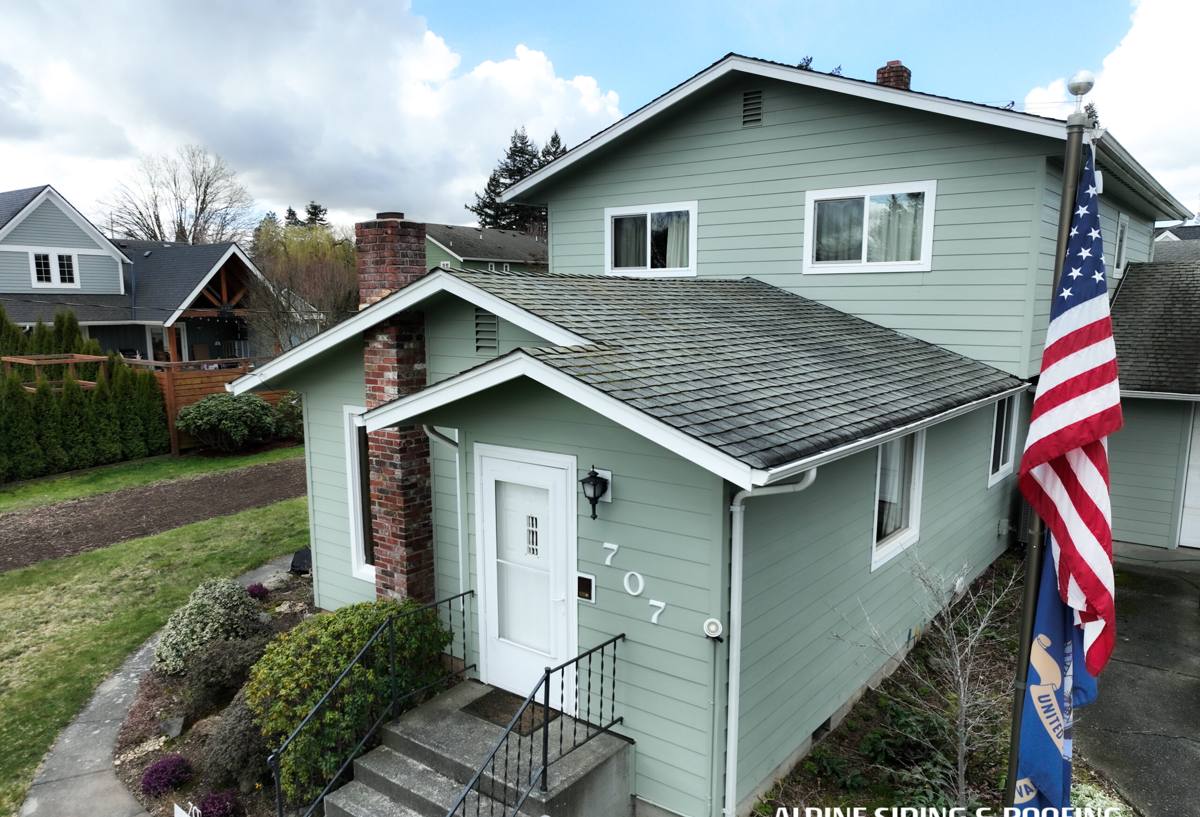
What Salt Air, Driving Rain, and Moss Actually Do to a Roof
Salt Air and Corrosion
Proximity to Bellingham Bay means a light but steady exposure to salt in the air, especially on roof faces that catch onshore wind. Salt accelerates corrosion on exposed fasteners, unpainted flashing, and lower-grade metal components. Over years, that shows up as rust streaking below nail heads, pitted flashing at valleys and chimneys, and premature failure at the exact points that are supposed to keep water out. It's not dramatic — it's slow, and it's easy to miss until a leak forces the issue.
Driving Rain and Wind
Whatcom County storms coming off the water don't just fall straight down — wind pushes rain sideways and up under laps, edges, and poorly sealed penetrations. A roof that would perform fine in a calmer inland setting can leak in Fairhaven simply because the wind-driven component of the rain wasn't accounted for at the eaves, rakes, and valleys during installation.
Moss, Shade, and Slow-Drying Surfaces
Mature trees are part of what makes Fairhaven's residential streets attractive, but shaded, north-facing, and low-slope roof sections stay damp far longer after a storm than sections that get direct sun. That extended dampness is exactly what moss and algae need to establish. Once moss takes hold, it lifts shingle edges, holds water against the roof deck, and works its way into laps and fastener lines — turning a cosmetic problem into a moisture problem within a season or two if it's not managed.
Signs a Fairhaven Home Needs a New Roof, Not Another Repair
Repairs make sense when the underlying roof system is still sound. A full installation makes sense when the damage is systemic rather than isolated. Signs worth taking seriously include:
- Granule loss heavy enough that you can see bare, shiny patches on multiple slopes, not just one spot
- Moss growth returning within months of cleaning, especially on shaded or north-facing slopes
- Soft or spongy decking underfoot when walked, or visible sagging between rafters
- Rust staining or pitting at flashing around chimneys, skylights, and valleys
- Daylight visible through the roof deck from inside the attic
- Interior water stains that reappear after every significant storm, even after past patch repairs
- A roof that's already 20+ years old and has never been fully replaced, only patched
If you're seeing two or more of these, it's worth getting a straight answer on whether repair still makes sense or whether you're better off putting the money into a full system that's built for another few decades.
What a Correctly Installed Roof Includes Here
"New roof" covers a lot of ground depending on what's actually done underneath the visible material. For a home in Fairhaven's conditions, the components below matter more than they would in a drier, more sheltered location.
| Component | Why it matters in Fairhaven's climate |
|---|---|
| Ice-and-water membrane at eaves, valleys, and penetrations | Backs up the primary underlayment where wind-driven rain and standing moisture concentrate |
| Synthetic underlayment (full deck) | Holds up to extended damp exposure far better than old-style felt, which degrades faster under prolonged moisture |
| Corrosion-resistant flashing and fasteners | Salt air accelerates rust on standard-grade metal; proper flashing avoids early failure at joints |
| Balanced intake and exhaust ventilation | Moves moist air out of the attic so condensation doesn't rot decking from the inside |
| Sealed, properly lapped valleys | Valleys carry the highest water volume on the roof and are the first place bad installation shows up |
| Algae-resistant shingle granules (where applicable) | Slows moss and algae colonization on shaded slopes between cleanings |
Skip any one of these and the roof may still look correct from the ground for a year or two — the failures just show up later, usually as a leak or as decking that needs to be replaced when the roof is redone again.
Our New Roof Installation Process
1. Inspection and Honest Scope
We start by getting on the roof, not just looking at it from the driveway. We check the decking, existing ventilation, flashing condition, and how the current roof has aged — including any moss or moisture patterns specific to your lot's tree cover and sun exposure. You get a clear picture of what's actually needed before any work starts.
2. Tear-Off and Deck Assessment
Full tear-off lets us see the deck directly rather than guessing at its condition. Any soft, delaminated, or water-damaged sheathing gets replaced before anything new goes down — installing new roofing over a compromised deck just hides the problem for a while.
3. Underlayment and Water-Shedding Details
Ice-and-water membrane goes down first at eaves, valleys, and around every penetration, followed by full synthetic underlayment across the deck. This is the layer doing the real work if wind ever drives rain past the surface material, so we don't treat it as an afterthought.
4. Ventilation Check and Correction
We evaluate intake and exhaust ventilation as part of the install, not as a separate add-on. Poor ventilation is one of the most common causes of premature decking rot in this climate, and it's far cheaper to correct during a roof replacement than after.
5. Material Installation and Detail Work
Field material goes down to manufacturer specification, with particular attention to valleys, step flashing at walls, and penetrations — the spots most exposed to Fairhaven's wind-driven rain. This is where installation quality shows up first, for better or worse.
6. Final Inspection and Cleanup
We walk the finished roof, check every flashing point and seam, and do a full magnetic sweep and debris cleanup of the property before we consider the job done.
Material Choices for Fairhaven Homes
Fairhaven has a mix of housing stock, from older, character-driven homes near the historic district to newer builds further out. Material choice depends on your roof's slope, the home's style, and your maintenance preferences — not on any one product being universally "better."
- Architectural asphalt shingles — the most common choice locally; good value, wide style range, and available with algae-resistant granules that help on shaded slopes
- Metal roofing — sheds rain and moss buildup aggressively due to its smooth surface and steep-shed profile; higher upfront cost, very low long-term maintenance
- Synthetic/composite shingles — useful where a home's character calls for a specific look but the maintenance and moisture behavior of a natural material isn't worth the trade-off
We'll walk through what fits your specific roof and budget rather than pushing one material as the default answer for every home.
Ventilation and Moisture Control Matter More This Close to the Water
A roof's ventilation system is invisible from the street, which is exactly why it gets overlooked. In a maritime climate like Bellingham's, attics accumulate moisture from both outside humidity and everyday indoor activity — showers, cooking, laundry — venting upward. Without balanced intake at the eaves and exhaust at the ridge, that moisture condenses on the underside of the decking instead of leaving the attic. Over a few winters, that's enough to rot sheathing from the inside, well before the shingles themselves show their age. We check and correct ventilation as a standard part of every installation, not as an upsell.
Why Hire a Crew That Already Works in Fairhaven
A roofing crew that mostly works inland projects doesn't necessarily think about salt exposure on fasteners or how a shaded valley behaves differently from a sun-exposed one. Crews who regularly work Bellingham's waterfront-adjacent neighborhoods build those details into the job by default — better flashing grade, correct underlayment coverage, and ventilation sized for a wetter, shadier lot. That local pattern recognition is worth more than it sounds like on paper; it's the difference between a roof that needs attention again in a decade and one that quietly does its job for thirty years.
It also matters for practical reasons: knowing local permitting requirements, being able to schedule around Whatcom County's wetter months, and having a crew that can respond quickly if weather interrupts a job mid-installation.
What Affects the Cost of a New Roof in Fairhaven
Every roof is different, and we don't publish flat prices because roof size, pitch, access, decking condition, and material choice all move the number. In general terms, the factors below have the biggest impact:
| Factor | How it affects cost |
|---|---|
| Roof size and number of facets | More square footage and more valleys/hips mean more material and labor |
| Roof pitch and access | Steep or hard-to-access roofs require more safety setup and slower work |
| Decking condition | Rotted or delaminated sheathing found at tear-off adds replacement cost |
| Material selection | Asphalt, metal, and composite materials sit at different price points and labor requirements |
| Ventilation and flashing upgrades | Bringing older ventilation or flashing up to current standards adds scope but reduces future risk |
We'll give you a specific, itemized number after we've actually looked at your roof — not a rough guess based on square footage alone.
If your roof is showing its age or you just want a straight assessment of how much life it has left, we're happy to take a look. We offer free, no-pressure estimates for homes throughout Fairhaven and the rest of Bellingham — fill out the form below and we'll get you scheduled.