 Bellingham
 Storm Damage Roofing in Happy Valley: A Different Kind of Wear
Happy Valley sits close enough to Bellingham Bay that salt-laden air is part of daily life for every roof in the neighborhood, and close enough to the surrounding hills and tree canopy that wind doesn't move in a straight line — it swirls, drops debris, and drives rain sideways under flashing that would stay dry in a more open part of Whatcom County. That combination is why storm damage here rarely looks like the textbook picture of a few missing shingles after a big blow. It's slower, sneakier, and often already underway by the time a homeowner notices a stain on the ceiling.
We work on roofs across Bellingham, but Happy Valley's mix of mature trees, older homes with decades of built-up moss, and its proximity to the water means storm damage repair here has to account for things a generic roof crew might miss. This page covers what that actually looks like — what to watch for, what a correct repair involves, and how we approach it.
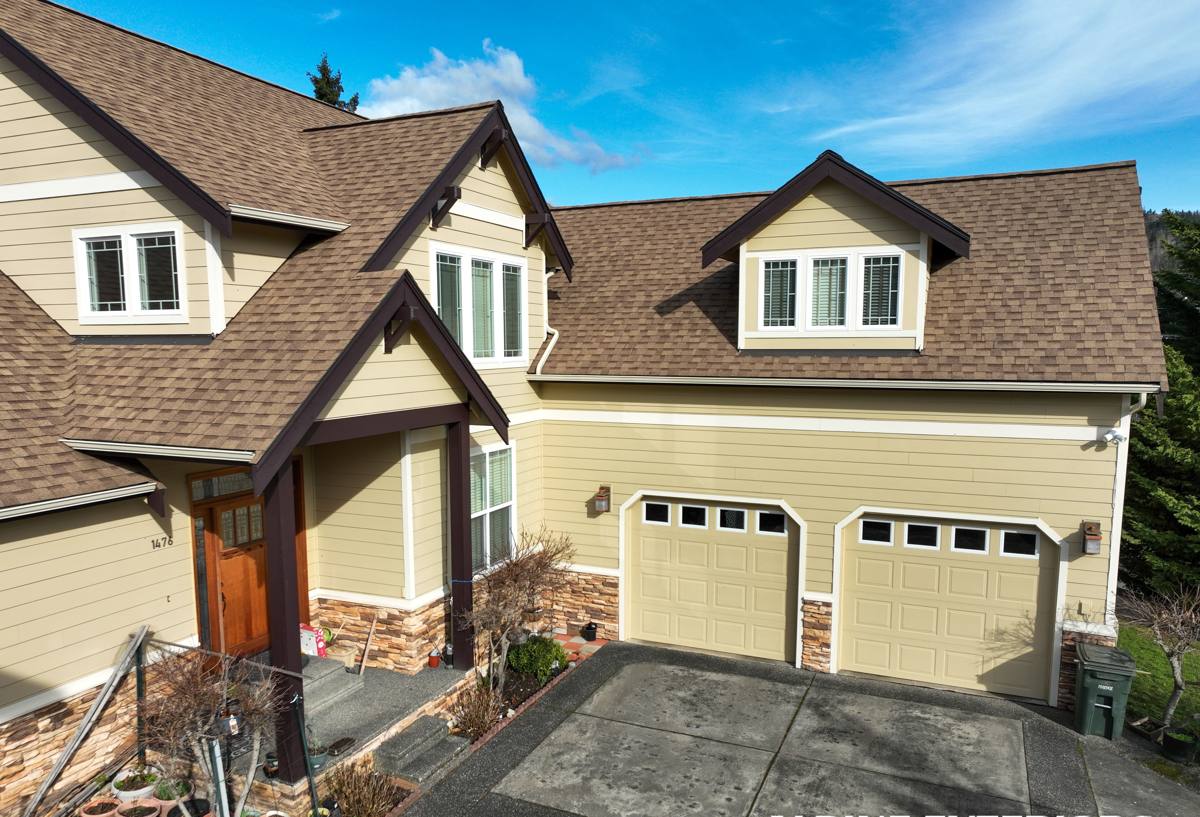
What Our Weather Actually Does to a Roof
Three things drive most of the storm-related roof calls we get from this part of Bellingham:
- Salt air corrosion — metal flashing, fasteners, and gutter hardware near the bay corrode faster than the same materials would inland, which means small storms can find weaknesses that wouldn't exist on a roof twenty miles east.
- Driving, wind-pushed rain — Pacific storms rarely arrive as calm, straight-down rainfall. Wind pushes water uphill under shingle laps and sideways into vents, soffits, and anywhere flashing has started to lift.
- A long moss season — our wet, mild winters and shaded lots (common where tree cover is heavy) give moss and moisture-loving growth most of the year to work into shingle mat and granule surfaces, softening them well before a storm ever hits.
None of these cause dramatic failures on their own. What they do is quietly weaken a roof's defenses so that the next windstorm or heavy rain event turns a minor vulnerability into an active leak.
Signs of Storm Damage Worth Checking After Any Rough Weather
Most storm damage in this neighborhood doesn't announce itself with a hole in the roof. It shows up in smaller signs that are easy to dismiss until they've caused real water intrusion. After any windstorm or heavy rain event, it's worth walking the property and checking for:
- Granules collecting in gutters or at downspout outlets (a sign of shingle wear, often accelerated by moss)
- Shingles that look lifted, curled, or out of alignment compared to the rest of the field
- Soft or discolored patches of moss or algae that appeared or expanded after the storm
- Flashing around chimneys, skylights, or roof-to-wall transitions that looks bent, separated, or rusted
- New or worsening water stains on interior ceilings, especially near exterior walls or chimneys
- Debris — branches, needles, or larger limbs — that landed on the roof and wasn't there before
- Gutters pulling away from the fascia or sagging under debris and water weight
- Damp insulation or a musty smell in the attic, which often shows up before any visible ceiling stain
Any one of these on its own might be minor. Two or three together, especially after a named storm or a windy week, is worth a professional look before the next rain event finds the same weak point.
Why Tree Cover Changes the Repair, Not Just the Cause
Debris Impact Damage
Where a roof sits under or near mature trees, storm damage often starts as impact — a branch or limb striking the roof surface hard enough to crack shingles or dent metal flashing without necessarily punching all the way through. That kind of damage can look cosmetic from the ground but leave the underlayment exposed to the next rain. We check impact points individually rather than assuming a quick shingle swap covers it.
Shade, Moisture, and Slower Drying
Shaded roof sections dry out slower after a storm than open, sun-exposed sections. That extra dwell time for moisture is exactly what moss and organic growth need to establish, and it's also what lets minor storm damage — a lifted shingle tab, a small flashing gap — turn into a persistent leak instead of drying out and self-sealing the way it might on a more exposed roof.
Gutter and Drainage Load
Storms in tree-heavy neighborhoods dump needles, cones, and leaf litter into gutters at the same time they're dumping rain. A gutter system that's even partially blocked during a storm backs water up under the roof edge, which is one of the most common causes of fascia and soffit damage we see after a storm in this part of Bellingham.
What a Correct Storm Damage Repair Involves
A storm damage repair done right isn't just patching the spot that's visibly damaged. It's a sequence:
- Immediate protection — if there's active water intrusion or an exposed section, that gets tarped or temporarily sealed first to stop further damage while a full repair is planned.
- Full roof inspection, not just the damaged area — storm forces rarely damage only one spot. We check the whole roof plane, flashing details, and gutter system, because wind-driven rain finds every weak point, not just the obvious one.
- Underlayment and decking check — if water has been getting under the shingles for any length of time, the underlayment and roof decking underneath need to be checked for softness or rot before new shingles go back on. Covering over damaged decking is the single most common shortcut we see in poor repairs.
- Matching materials where possible — for a partial repair, matching shingle type, color, and profile to the existing roof so the repair doesn't stand out or create a mismatched wear pattern down the line.
- Flashing and moisture barrier correction — if the storm found a gap in flashing around a chimney, vent, or wall transition, that detail gets corrected, not just re-caulked, since caulk alone is a temporary fix over a flashing problem.
- Gutter and drainage check — confirming water is actually moving off the roof correctly once repairs are complete, especially important on tree-shaded lots where debris load is a factor.
Repair or Replace: How We Help You Decide
Not every storm-damaged roof needs full replacement, and not every roof that looks rough from the ground is actually a repair candidate. The right call depends on the age of the roof, how widespread the damage is, and what condition the decking is in underneath.
| Factor | Favors Repair | Favors Replacement |
|---|---|---|
| Roof age | Under roughly half its expected service life | Near or past its expected service life |
| Damage extent | Localized to one section or a few isolated spots | Widespread across multiple roof planes |
| Decking condition | Solid, no soft spots found on inspection | Soft, delaminated, or rotted decking present |
| Moss/organic growth | Surface-level, hasn't compromised shingle mat | Long-term growth has degraded shingle material broadly |
| Storm history | First significant storm event on this roof | Repeated storm damage in the same areas over time |
We'll tell you honestly which side of that table your roof falls on. A repair that's done correctly can buy a roof several more good years; patching a roof that's already past its useful life just delays a bigger problem and can end up costing more overall.
Insurance and Storm Claims: What We Can and Can't Do
Many storm damage repairs in Whatcom County involve a homeowner's insurance claim, and we work with that process regularly — documenting damage with photos, providing a written scope and estimate, and answering an adjuster's questions about what we found. What we won't do is inflate a scope of work to match a settlement number or claim damage that isn't actually there. Our estimate reflects what the roof needs, and if that differs from an initial adjuster assessment, we'll walk you through exactly why, in plain terms, so you can bring that documentation back to your insurer.
Our Process for a Happy Valley Storm Repair Call
- Initial contact and triage — if there's active leaking, we prioritize getting a temporary protective measure in place quickly.
- On-site inspection — a full roof and gutter assessment, including areas beyond the obviously damaged spot, since Happy Valley's tree cover and salt air conditions mean secondary damage is common.
- Written estimate — a clear scope of work and cost range, explained in person, not just handed over as a number.
- Scheduling around weather — storm repair work depends on dry windows, and we're upfront about timing rather than rushing a repair into a wet stretch where it won't seal properly.
- The repair itself — decking, underlayment, flashing, and shingle work as needed, using materials matched to your existing roof where a full replacement isn't warranted.
- Final walkthrough — reviewing the completed work and confirming drainage and flashing details are functioning before we consider the job done.
Why a Crew That Already Works This Neighborhood Matters
A roofer who works Happy Valley regularly already knows what to expect before climbing the ladder: which storm patterns tend to hit which roof orientations, how much moss growth is normal versus a sign of a bigger moisture problem, and how the neighborhood's tree cover and closeness to the water change the math on flashing, drainage, and material choice. That familiarity means fewer surprises, a more accurate first estimate, and a repair that accounts for conditions specific to this part of Bellingham rather than a one-size-fits-all approach borrowed from a drier, more open part of the county.
If a recent storm has left your roof looking questionable, or you'd just like an honest assessment before the next one hits, we're glad to come take a look. The estimate is free, there's no pressure attached to it, and you'll get a straight answer about whether you're looking at a repair or something bigger — just fill out the form below to get started.