 Bellingham
 What Sudden Valley's Setting Does to a Roof
Across Whatcom County, roofs deal with driving rain off the Sound and a long stretch of damp, mossy months every year. Sudden Valley adds its own wrinkle on top of that regional pattern. Tucked into the trees around Lake Whatcom, homes here sit under heavy forest canopy that keeps roof surfaces shaded and slow to dry out after a storm. That shade is part of what makes the neighborhood pleasant to live in, but it's also exactly the condition moss, algae, and moisture need to take hold.
Needle litter and leaf debris from the surrounding trees collect in valleys, behind chimneys, and along eave edges faster than they would on a more open lot. Left alone, that debris holds water against shingles or roofing felt and accelerates wear in exactly the spots where a roof already struggles to shed water — hips, valleys, and low-slope transitions. Add in the region's steady winter rain and you get a roof that's rarely given a full chance to dry between weather systems.
None of this means a Sudden Valley roof is doomed to constant repair. It means the repair work has to account for shade, debris, and moisture retention specifically, not just patch a leak and move on.
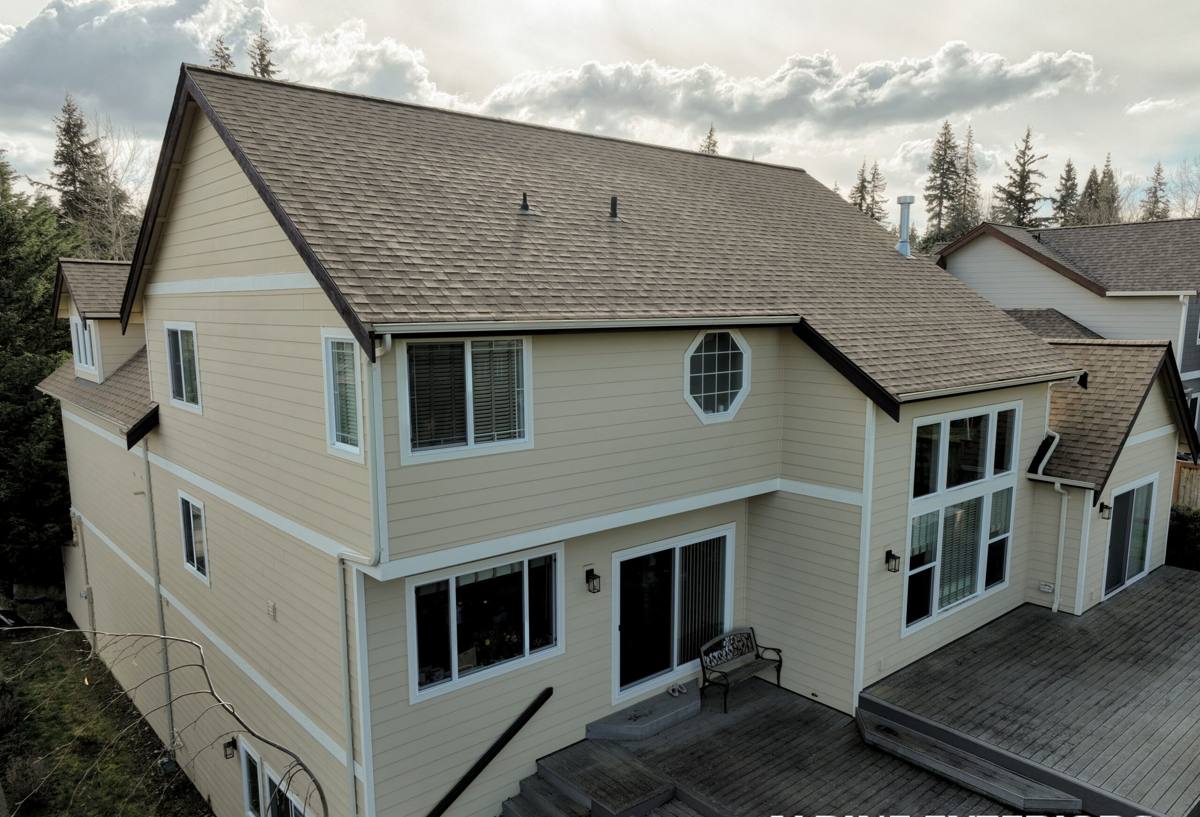
Signs a Roof Needs Repair, Not Just a Look
Most roof problems don't announce themselves as a dramatic leak on day one. They show up as smaller signals first, and catching them early is what keeps a repair a repair instead of a full replacement.
- Dark streaking or a green-black tint on shingles, especially on the shaded, north-facing slopes common under tree cover
- Moss growing in mats rather than a light film — mats hold water and can lift shingle edges
- Granules collecting in gutters or at downspout outlets
- Soft or spongy spots underfoot when walking a low-slope section
- Water staining on interior ceilings, especially near chimneys, skylights, or where two rooflines meet
- Daylight visible through the attic roof deck
- Debris buildup in valleys that never seems to fully clear on its own
Any one of these on its own might not be urgent. Several together, or one that's gotten worse over a season, is worth a look before the next round of heavy rain.
What a Correct Repair Actually Involves
A roof repair that holds up around here starts with figuring out why the damage happened, not just where. A missing shingle three feet from a moss mat and a missing shingle from wind exposure get fixed differently, even if the patch looks the same from the ground.
Diagnosis before patching
We look at the roof deck condition under the damaged area, not just the surface. Trapped moisture from moss or debris often does more damage to the decking and underlayment than to the shingles themselves, and a repair that skips that check just reseals a problem that's already underway.
Matching materials, not just covering the hole
Shingle color and profile change over the years, and a mismatched patch stands out and can shed water differently than the surrounding field. We aim for a repair that blends in and performs the same as the original roofing, not a visibly different section.
Addressing the cause, not just the symptom
If moss or debris caused the failure, the repair includes clearing and treating the surrounding area — otherwise the same spot fails again within a season or two. If the cause is a flashing detail around a chimney or vent, that flashing gets corrected as part of the job, not left in place around the new patch.
Common Repair Scenarios We See in Sudden Valley
Moss-related shingle damage
Moss doesn't just sit on a roof — its root structure lifts shingle tabs and holds moisture underneath them. By the time it's visibly thick, there's usually some granule loss and edge lifting to address along with the moss itself.
Valley and low-slope wear
Needle and leaf litter concentrates in valleys and against any low-slope transition. Over time this traps water long enough to degrade the underlayment even when shingles above look intact.
Flashing failures around chimneys and vents
Constant damp conditions accelerate corrosion and sealant breakdown at flashing joints faster than on a drier, more exposed roof. These are common leak points and usually cheaper to correct early than after they've caused interior damage.
Gutter and edge damage from tree debris
Overloaded gutters back water up under the roof edge. This shows up as fascia rot or edge shingle damage that looks separate from the gutter problem but usually isn't.
Repair or Replace: How We Make That Call
Not every damaged roof needs a full replacement, and not every leak is fixable with a patch. We walk through a few honest factors with homeowners before recommending either path.
| Factor | Points Toward Repair | Points Toward Replacement |
|---|---|---|
| Age of roofing | Well within expected lifespan | Near or past the material's typical service life |
| Extent of damage | Localized to one section or detail | Spread across multiple slopes or repeated failures |
| Deck condition | Solid, dry decking under the damaged area | Soft, delaminated, or repeatedly wet decking |
| Repair history | First or infrequent repair needed | Same areas failing again after prior repairs |
| Moss/moisture pattern | Isolated to a shaded corner or valley | Widespread across most of the roof |
We'd rather tell a homeowner a repair will hold for several more years than push a replacement that isn't needed yet — and we'll say so plainly when a repair genuinely isn't the right long-term answer either.
Our Process, Start to Finish
- Assessment. We inspect the affected area and the roof as a whole, including a look in the attic where accessible, to understand cause and extent.
- Straightforward estimate. We explain what we found, what we recommend, and why — including whether a repair is genuinely sufficient.
- Scheduling around weather. Roof repairs need a reasonably dry window to do properly. We plan around Whatcom County's rain patterns rather than rushing a patch into wet material.
- The repair itself. Removal of damaged material, correction of the underlying cause, and installation of matching materials.
- Cleanup and check. Debris cleared, gutters checked near the repair area, and a final look to confirm the fix is solid.
Why Local Experience in Sudden Valley Matters
A repair crew that mostly works flatter, more open neighborhoods can still do competent work on a Sudden Valley roof, but they're often seeing the shade-and-debris pattern for the first time on your roof. Knowing ahead of time that a valley under tree cover needs extra attention to underlayment condition, or that a north-facing slope near the lake is going to hold moss longer than the same slope elsewhere, changes what gets checked and how the job is scoped.
It also affects timing. Access around Sudden Valley's tree-lined lots and the neighborhood's road layout is worth planning for, and a crew familiar with the area builds that into scheduling rather than discovering it the day of the job.
Between-Repair Maintenance That Actually Helps
A repair lasts longer when the conditions that caused the damage are kept in check afterward. This is especially true under tree cover, where debris and moss are an ongoing fact of life rather than a one-time problem.
- Clear valleys and gutters at least once in fall after leaf drop and once in late winter
- Have moss treated or removed before it forms thick mats, not after
- Trim back branches that overhang the roofline where practical
- Check attic ventilation — poor airflow keeps roof decking damper than it should be
- Look at flashing around chimneys and vents each year for early sealant wear
- Address small leaks or stains promptly rather than waiting for the next dry season
Materials and Workmanship We Stand Behind
For repair work, we match materials to what's already on the roof whenever a reasonable match exists, since mixing incompatible products can create new moisture or wear problems at the seams between old and new. Where the existing material has reached the end of its practical life in that section, we'll say so and talk through options rather than patching over a roof that's already failing nearby.
We're upfront about trade-offs on any product choice — some materials shed moss better but cost more, others are easier to spot-repair later but show wear sooner in shaded conditions. The right call depends on the specific roof and how long the homeowner plans to stay in the house, not a one-size answer.
If you're dealing with a leak, moss buildup, or a section of roof that just doesn't look right, we're happy to take a look and give you a straightforward assessment. The estimate is free, there's no pressure to sign anything on the spot, and if a small repair is genuinely all that's needed, that's what we'll recommend — just fill out the form below to get started.