 Bellingham
 Why Roofs in Lynden Wear Differently Than Roofs Inland
Lynden sits in the Nooksack River valley, a few miles south of the Canadian border and a short drive inland from Bellingham Bay. That location gives it a climate that's a little different from the rest of Whatcom County. Fog settles into the valley on clear, cold mornings. Farmland and open fields to the west mean less tree cover and more direct exposure to wind and driving rain than you'd get in a wooded neighborhood closer to Bellingham. And while Lynden isn't right on the water, moisture off the Sound still shows up as salt-tinged air on windy days, which is one more reason roofing materials and fasteners in this region need to hold up to more than just rain.
What all of this adds up to is a roof that spends a lot of the year damp. Not necessarily soaked, but damp — the kind of persistent, low-grade moisture that doesn't dry out fast between storms. That's the condition moss, algae, and slow rot all love. A roof replacement done right for a Lynden home accounts for that reality from the deck up, not just at the shingle layer.
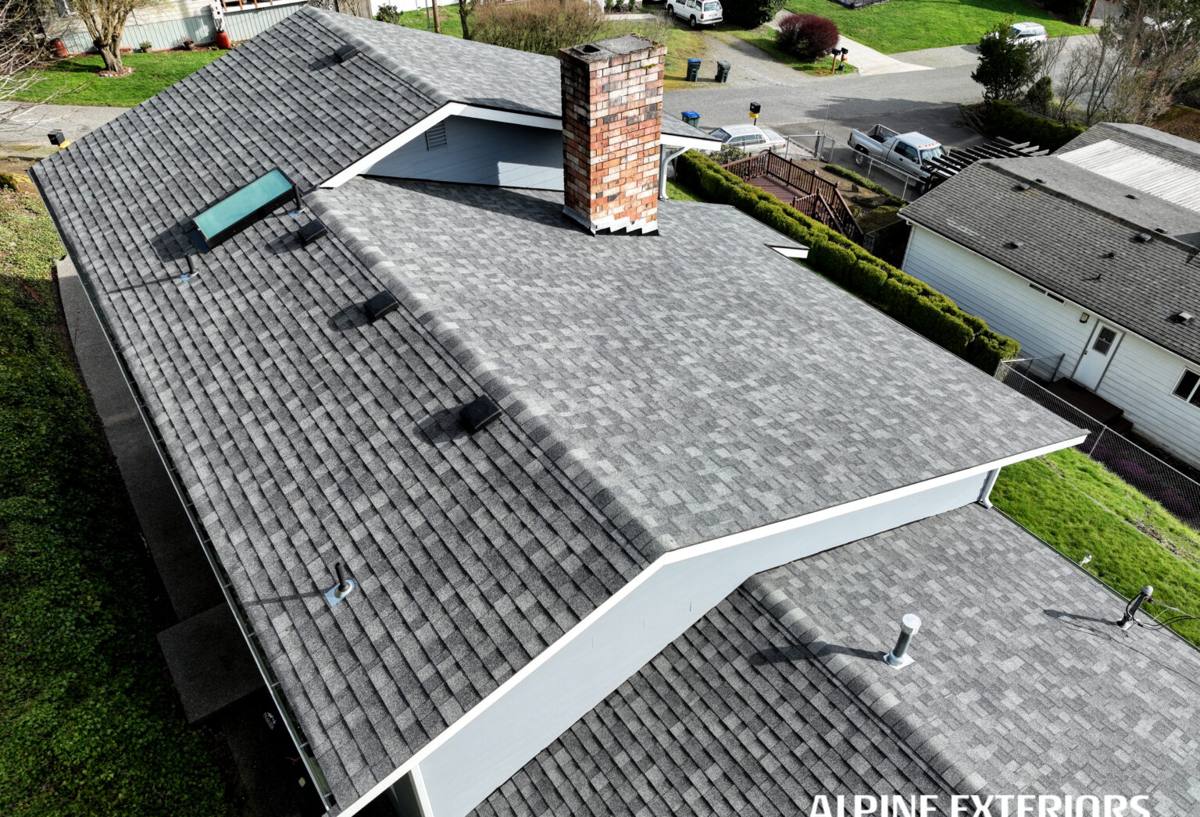
Signs a Lynden Roof Has Reached the End of Its Life
Roofs rarely fail all at once. They give warning signs first, and in this climate those signs often show up as moisture damage before they show up as missing shingles. Here's what we look for, and what you can check from the ground or the attic yourself:
- Granules collecting in gutters or at downspout outlets — a sign the shingle surface is wearing thin
- Moss or algae streaking that keeps coming back within a season or two of cleaning
- Soft or spongy spots when walked, or visible sagging along the roof plane
- Daylight visible through the roof deck from inside the attic
- Water stains on ceilings or attic framing, even faint or old-looking ones
- Curling, cracking, or cupping shingles, especially on south- and west-facing slopes
- Flashing around chimneys, vents, or valleys that's rusted, lifted, or resealed with visible caulk patches
- A roof that's 20+ years old on asphalt composition, or showing wear well before that if ventilation has been poor
Any one of these on its own might be a repair. Several together, or a roof already past its expected service life, usually means replacement is the more honest recommendation — repairs on a roof that's structurally tired tend to become a pattern of small fixes that never quite solve the underlying problem.
What a Correct Roof Replacement Actually Involves
Full Tear-Off and Deck Inspection
We don't recommend layering new shingles over old ones. A full tear-off is the only way to actually see the roof deck — the plywood or OSB sheathing underneath — and in a valley climate like Lynden's, that's exactly where hidden problems tend to hide. Soft, delaminated, or water-stained sheathing gets replaced before anything new goes down. Skipping this step is how a roof looks fine for a year or two and then fails from the inside out.
Underlayment and Water Barrier
Underlayment is the roof's backup layer, and in a climate with sustained rain events it matters as much as the shingles themselves. We use synthetic or felt underlayment rated for the exposure, with self-adhered ice-and-water membrane at vulnerable points — eaves, valleys, and around any roof penetration — where wind-driven rain is most likely to find a way in.
Flashing Done Right
Most roof leaks trace back to flashing, not shingles. Chimneys, skylights, sidewalls, and valleys all need properly formed and sequenced metal flashing, not caulk standing in for a seal. Caulk fails; correctly installed flashing doesn't need to rely on it.
Ventilation That Matches the Climate
A roof that can't breathe traps moisture in the attic, which speeds up sheathing rot and shortens the life of the new roofing from underneath. Balanced intake and exhaust ventilation is part of every replacement we do, not an upsell — it's what keeps a damp-climate roof deck dry between storms.
Roofing Material Options for Whatcom County Weather
There's no single "right" material for every Lynden home — it depends on the roof's slope, the home's style, and the owner's priorities around maintenance and budget. Here's how the common options compare for this climate specifically:
| Material | Typical Lifespan | Moss & Moisture Behavior | Relative Cost |
|---|---|---|---|
| Asphalt composition shingle | 20–30 years | Good with algae-resistant granules; needs periodic moss treatment | $ |
| Standing seam metal | 40–60 years | Excellent — moss struggles to gain a foothold on smooth metal | $$$ |
| Synthetic (composite) shingle | 30–50 years | Very good; engineered to resist moisture absorption | $$ |
| Cedar shake | 20–30 years with upkeep | Requires the most maintenance in a wet, shaded climate | $$–$$$ |
We install algae-resistant asphalt shingles as our standard recommendation for most Lynden homes — they offer the best balance of cost, performance, and long-term availability of matching materials for repairs. Metal is a strong option for homes with simpler rooflines and owners planning to stay long-term, since the upfront cost is offset by decades of low maintenance. Cedar shake can look great, but we're upfront with clients that in a valley climate with persistent moisture, it demands more regular upkeep than most other options — that's a maintenance trade-off worth knowing before you commit, not a knock on the material itself.
Our Roof Replacement Process, Start to Finish
- On-site inspection. We walk the roof (or inspect from ladder and attic where walking isn't safe) and document its actual condition — deck, flashing, ventilation, and shingle wear.
- Honest scope and estimate. We tell you what we found, what needs to happen, and what it costs — including any deck repair that only becomes visible once tear-off starts.
- Material selection. We walk through the options above based on your roof, your budget, and how long you plan to stay in the home.
- Scheduling around the weather. Roofing in this region means working around rain windows. We plan tear-off days to minimize how long a roof deck sits exposed.
- Tear-off and deck repair. Old roofing comes off, the deck gets inspected, and any compromised sheathing is replaced before anything new goes on.
- Underlayment, flashing, and ventilation installed. The parts you won't see again once the roof is finished — done to the standard that keeps the roof dry for decades, not just for the first season.
- Final roofing installed. Shingles, metal panels, or synthetic material installed to manufacturer specification, including proper nailing pattern and exposure.
- Cleanup and final walkthrough. Magnetic sweep for stray fasteners, debris hauled off, and a walkthrough so you know exactly what was done.
Timeline Expectations
A typical single-family roof replacement in Lynden takes one to a few days of active work once materials are on site, weather permitting. Larger or steeper roofs, or ones needing significant deck repair, take longer. We build weather flexibility into scheduling rather than rushing a tear-off into a forecast that doesn't cooperate.
Moss, Algae, and Keeping a New Roof Performing Long-Term
Even the best-installed roof in this climate will see some moss and algae growth over time — that's just the reality of a long, wet, low-sun season in the Pacific Northwest. What changes with a correctly installed roof is how much that growth actually threatens the roof underneath it. Algae-resistant shingles, proper ventilation, and clean valleys and gutters slow growth down and keep it from working its way under the roofing material.
A few habits go a long way after a replacement: keep gutters clear so water isn't backing up under the eaves, trim back overhanging branches to let the roof dry faster after rain, and have moss treated (not power-washed, which can strip granules) rather than left to spread. None of that replaces a properly built roof, but it extends the life of one.
Permits and Codes in Whatcom County
Roof replacement in Lynden and the surrounding Whatcom County jurisdictions typically requires a permit, and inspections at key stages of the work. Requirements around underlayment, ice barrier placement, and ventilation are tied to current building code for this climate zone. We handle the permitting and inspection process as part of the job — it's not something you should have to manage or chase down yourself.
Why Hire a Crew That Already Works in Lynden
Roofing crews that work across a wide, varied region tend to install to a generic standard. A crew that regularly works Lynden and the rest of Whatcom County knows this valley's particular mix of fog, wind-driven rain, and moss pressure, and builds roofs accordingly — heavier attention to flashing and ventilation than you'd get from a one-size-fits-all install. That local familiarity also means faster response if something needs a look after a storm, and a crew that's still around — and still local — years after the job is done, not a name from out of the area you can't easily reach again.
We're not going to tell you a roof replacement is a small decision — it's one of the more significant investments in a home, and it's not one to rush or shop purely on price. What we can offer is a straightforward, no-pressure look at your roof's actual condition, an honest recommendation, and a crew that installs to a standard built for this specific climate. If your roof is showing its age, or you just want a second, honest opinion, use the form below to request a free estimate.