 Bellingham
 Building Decks for Sudden Valley's Lake-and-Forest Setting
Sudden Valley sits along Lake Whatcom, tucked into tree cover that gives the community its privacy and its shade — and its year-round dampness. A deck out here lives a different life than one built on an open, sunny lot closer to downtown Bellingham. Overhanging conifers mean less direct sun to dry things out after a storm, more organic debris collecting in board gaps, and a longer window every year where wood stays damp to the touch. Add in the driving rain that rolls through Whatcom County off the Sound and the long moss season that follows, and you've got conditions that will find every weak point in a deck's design within a few years if it wasn't built with this specific setting in mind.
We build and replace decks throughout the Bellingham area, and Sudden Valley decks get planned differently than a deck on a wide-open Ferndale lot or a downtown Bellingham rebuild. The framing, the fastener choice, the gap spacing, and the maintenance plan all shift when a structure is going to spend most of the year in filtered shade next to a lake.
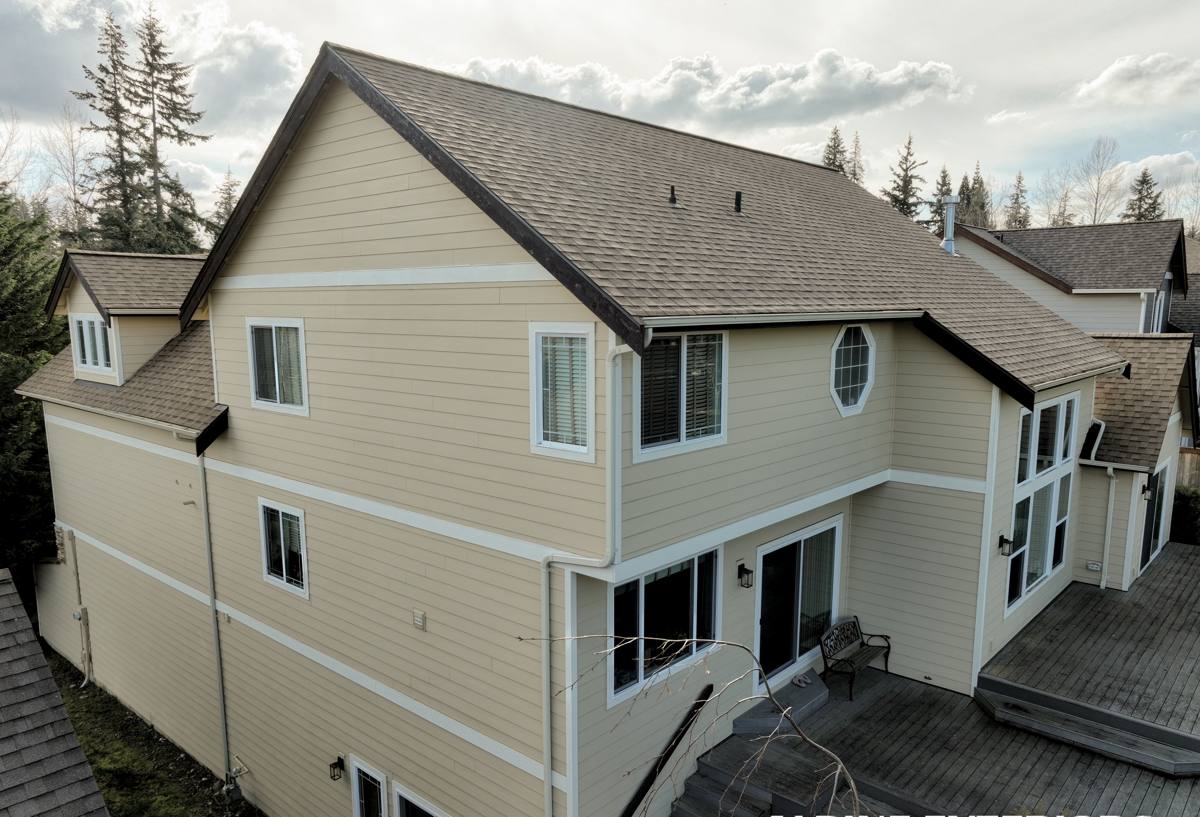
What Salt Air, Rain, and Moss Actually Do to a Deck
These aren't abstract weather notes — they translate into specific, predictable damage patterns.
- Driving rain drives water sideways into ledger connections, stair stringers, and any spot where two pieces of wood meet at an angle instead of flat.
- Shade and standing moisture slow evaporation, which means fasteners, joist hangers, and end grain stay wet longer after every rain event than they would on a sun-exposed deck.
- Moss and algae take hold on decking that doesn't get enough light or airflow, and once established they hold moisture directly against the wood surface, accelerating rot underneath a green film that looks worse than it is — until it isn't.
- Marine air moving through the broader region corrodes unprotected metal fasteners and hardware over time, which is why fastener grade matters more here than it does further inland.
None of this means a deck in Sudden Valley is doomed — it means the build has to account for these conditions from the framing up, not just at the surface finish.
Where Sudden Valley Decks Typically Fail First
Ledger Boards and House Connections
The ledger board — where the deck attaches to the house — is the single most important structural connection on any deck, and it's also the spot most exposed to wind-driven rain. Poor flashing at this joint lets water track behind the siding and into the rim joist, causing rot that's invisible until the deck starts to feel spongy or pull away from the house.
Joist Tops and Ledger Flashing
Joists that don't have proper flashing tape or a drip edge trap water on their top surface every time it rains, which rots them from the inside out long before the decking above shows any sign of trouble.
Board Gaps and Airflow Under the Deck
Decking installed too tight, or built low to the ground without enough clearance underneath, doesn't get the airflow it needs to dry out between storms. That's exactly the condition moss and algae need to establish themselves.
Fasteners and Hardware
Standard or undersized fasteners corrode faster in this climate, leaving rust streaks on decking and, eventually, connections that no longer hold their rated strength.
What a Correctly Built Deck Looks Like Here
| Component | Standard approach | What we do for Sudden Valley conditions |
|---|---|---|
| Ledger attachment | Lag bolts, basic flashing | Structural fasteners rated for wet exposure, self-adhered flashing membrane behind and over the ledger |
| Joist protection | Bare treated lumber | Flashing tape on every joist top to shed water before it reaches the wood |
| Fasteners/hardware | Standard coated screws | Corrosion-resistant, marine-rated fasteners and hangers throughout |
| Board spacing | Tight, uniform gaps | Gaps sized for the decking material and set to allow real drainage and airflow, not just appearance |
| Substructure clearance | Minimum code clearance | Extra clearance and grading where the lot allows, to keep air moving underneath |
| Surface material | Whatever's cheapest | Matched to how much sun exposure the specific deck will actually get |
Choosing Decking Material for a Shaded, Damp Lot
Material choice matters more in Sudden Valley than it does on an open, sunny lot, because shade changes how every material performs.
Pressure-Treated Wood
The most affordable option and a solid choice when it's properly maintained — sealed on a regular schedule and kept clear of debris. In heavy shade, it needs more attention than the same wood would on a sun-exposed deck, since it doesn't get the natural drying cycle that keeps rot and moss at bay.
Cedar
Naturally rot- and insect-resistant and a good match for the wooded character of the neighborhood, but it still needs periodic sealing in a climate this wet, and shaded cedar can develop a gray, weathered look faster than cedar in full sun.
Composite Decking
Often the best fit for a low-light, high-moisture lot. It won't rot, and it resists moss better than wood — though composite in deep shade can still develop surface algae and needs occasional cleaning to stay looking its best. It also costs more upfront, which is the honest trade-off.
Our Standard
We won't put a material on a deck where we know the site conditions will fight it. If a lot gets almost no direct sun for most of the day, we'll tell you that plainly and walk through which materials actually hold up versus which ones will need constant upkeep — that's a maintenance-burden conversation, not a sales pitch.
Design Choices That Work With the Site, Not Against It
- Positioning stairs and rail openings to avoid trapping wet leaves and needles in corners
- Sizing gaps between boards for real drainage, not just a clean look
- Keeping railings and structural posts clear of low branches where moss and debris collect fastest
- Planning for a walking surface that stays reasonably slip-resistant when wet — a real consideration on a shaded deck near a lake
- Where the lot allows, orienting the deck to capture whatever direct sun the property actually gets
How We Approach a Sudden Valley Deck Project
- On-site assessment. We look at sun exposure, tree cover, existing drainage, and how the current deck (if there is one) has held up, to understand what this specific lot demands.
- Honest material conversation. We walk through the real trade-offs for this site — cost, maintenance, and how each material behaves in shade and moisture — so you're choosing with full information.
- Framing and flashing first. Before a single deck board goes down, the structural connections, joist protection, and fastener grade are set to handle this climate, not a generic one.
- Build. Decking, railing, and stairs installed to code and to a standard that accounts for what this deck will face every winter.
- Maintenance guidance. We tell you what upkeep your specific material and site will actually need — cleaning schedule, sealing schedule if applicable, and what to watch for.
Maintaining a Deck Through a Long Moss Season
Whatever material you choose, a shaded lakeside deck needs a maintenance rhythm suited to its setting.
- Clear leaves, needles, and other debris from board gaps regularly — this is the single biggest thing that prevents moss and rot from getting started
- Wash the surface at least once a year, more often on heavily shaded sections, before moss has a chance to establish
- Reseal wood decking on the schedule appropriate to the product — more frequently in shade than in sun
- Check railing posts and stair stringers each season for soft spots or discoloration, since these often show trouble before the main deck surface does
- Keep gutters and downspouts near the deck clear so roof runoff isn't adding extra water on top of what the site already gets
Why Local Experience Matters for This Job
A deck built from a generic plan — the kind that works fine on a dry, open lot — often struggles within a few seasons in a spot like Sudden Valley. The failures aren't dramatic at first: a little moss here, a soft board there, a fastener starting to weep rust. By the time it's obvious, the fix is usually bigger than it needed to be. Crews that already work this community know to flash every joist, spec the right hardware, and set expectations on material choice before the first board is cut — because they've seen what skipping those steps costs a homeowner two or three years later.
Bellingham Siding has worked on homes throughout Whatcom County, including the shaded, lake-adjacent lots that make up Sudden Valley, and we build decks to hold up against the driving rain, moss, and marine air that define this region's climate — not just to look good on the day they're finished.
If you're planning a new deck or need to replace one that's showing its age, we're happy to come take a look and put together a straightforward, no-pressure estimate. Use the form below to get in touch.