 Bellingham
 Blaine's Roofs Take a Different Kind of Beating
Blaine sits right on the water at the northern edge of Whatcom County, and that location shapes what happens to a roof over time. Homes here deal with wind coming straight off the Strait of Georgia and Semiahmoo Bay, salt-laden air that accelerates corrosion on fasteners and flashing, and long stretches of driving rain that push water sideways into laps and seams that would stay dry in a calmer climate. Add in a moss season that runs longer here than in drier parts of the state, and you have a roof that ages differently than one fifty miles inland.
When a storm rolls through — and on this stretch of coast, several strong ones roll through every winter — the damage is rarely limited to one obvious spot. A wind event that lifts a few shingles on the windward side often also loosens ridge caps, stresses flashing around penetrations, and opens up small gaps that don't leak immediately but will the next time it rains hard. Storm damage repair in a coastal Whatcom County town isn't just patching what's visibly broken; it's checking everything the same storm likely stressed.
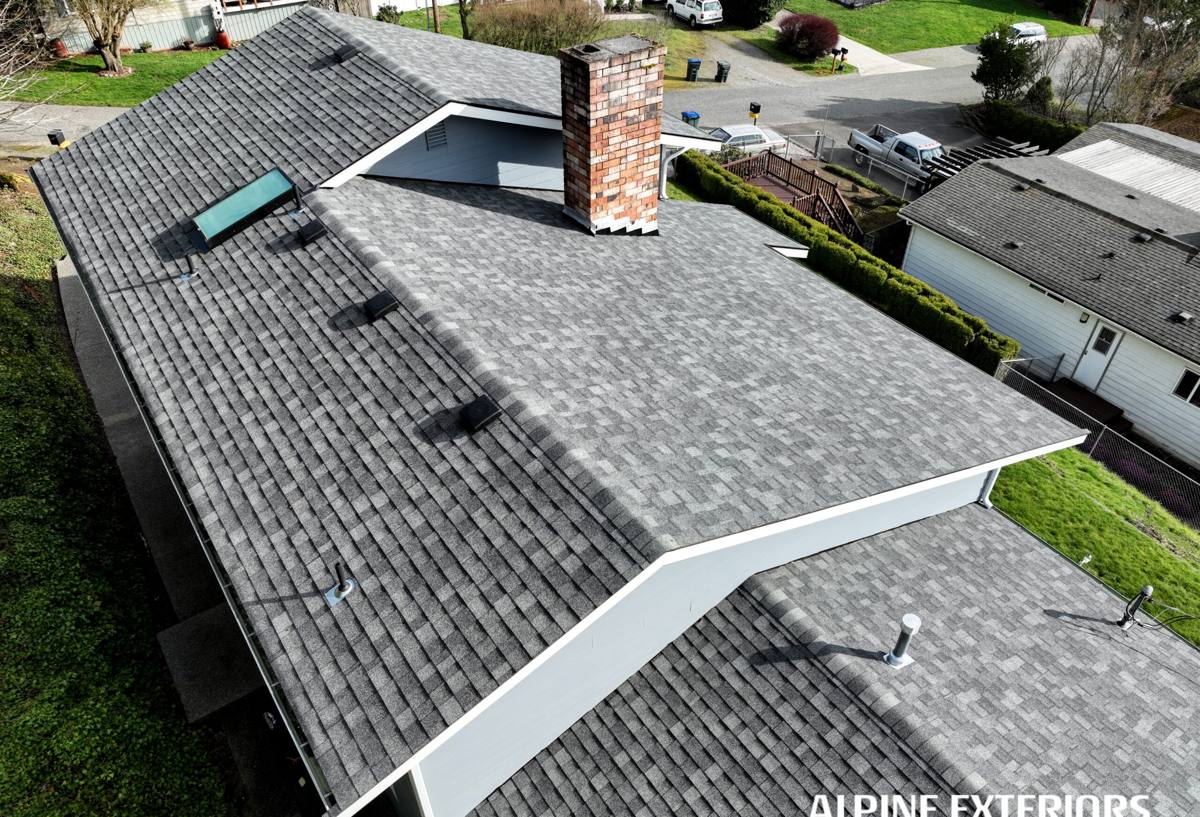
What Actually Counts as Storm Damage
Homeowners often assume storm damage means a hole you can see from the ground. In practice, most of what we find after a bad blow is less dramatic but just as important to fix:
- Shingles lifted, cracked, or torn loose along ridges, hips, and roof edges where wind uplift is strongest
- Flashing pulled away or bent around chimneys, skylights, vents, and wall-to-roof transitions
- Fasteners backed out or corroded from repeated salt exposure, leaving shingles loosely anchored
- Debris strikes from branches or wind-blown material that bruise or puncture the roofing surface
- Wind-driven rain forced up under shingle tabs or through gaps that only leak under specific wind direction
- Gutter and edge-metal damage that redirects water into fascia, soffits, or siding instead of away from the house
Some of these are visible from the ground with binoculars. Most aren't. That's why a proper post-storm inspection means getting eyes on the actual roof surface, not just looking up from the driveway.
Why Fast, Correct Repair Matters More Here
A small gap that would sit dry for weeks in a low-rain climate becomes a real problem fast in Bellingham-area weather, where the next system is usually only a few days out. Water that gets under even one compromised shingle can travel along the underlayment and show up as a stain on a ceiling several feet from where it actually entered. Left long enough, it saturates sheathing, degrades insulation, and creates conditions for mold and rot inside the attic — all from damage that started as something repairable.
There's also a cost-escalation problem specific to storm damage: insurers and contractors alike see cases where a homeowner delays a repair, a second storm hits the same weak point, and what would have been a straightforward shingle-and-flashing repair becomes a decking replacement. Addressing storm damage promptly, correctly, and completely the first time is almost always the cheaper path.
Secondary Damage We Check For
Any time we're on a roof for storm repair, we also check the areas that fail quietly:
- Attic decking and insulation directly below the damaged area, for early moisture staining
- Fascia and soffit venting, since redirected water often shows up there first
- Gutters and downspouts, which take real abuse in sustained coastal wind
- Nearby siding and trim where wind-driven rain may have found a second entry point
What a Correct Storm Repair Job Involves
A repair that actually holds up through the next Whatcom County storm season involves more than swapping out the shingles that are obviously missing. Our approach on a storm repair covers:
- Full roof-surface inspection — not just the damaged section, since wind that damaged one area usually stressed adjacent areas too
- Underlayment check — if water has reached the underlayment, that layer needs attention even if the shingles above it can be saved
- Matching materials — shingles, ridge caps, and flashing that match the existing roof in profile and, where possible, color, so the repair doesn't stand out or create a mismatched wear pattern down the line
- Flashing done right — flashing is where most repeat leaks come from when repairs are rushed; it has to be properly lapped and sealed, not just caulked over
- Fastener standards built for salt air — corrosion-resistant fasteners matter more here than in inland areas, since standard fasteners degrade faster this close to salt water
- Cleanup and haul-away — storm debris and old material removed, not left for the next windstorm to scatter
Our Process for Blaine Storm Repairs
1. Prompt Assessment
We get out to look at storm damage quickly, because the window between "minor repair" and "water got in" is often just one more rain event. We inspect the full roof, not just the spot the homeowner noticed, and document what we find.
2. Clear, Honest Scope
We tell you plainly what's storm damage versus what's pre-existing wear that the storm exposed. Both matter, but they're not the same conversation, and we won't blur the line to inflate a repair.
3. Insurance-Ready Documentation
If you're filing a claim, we provide photos and a written description of the damage that your adjuster can work from. We're not a public adjuster and we don't negotiate your claim for you, but we make sure the documentation reflects what's actually there.
4. The Repair Itself
We use materials matched to your existing roof and detailing appropriate for coastal wind and rain exposure — proper flashing laps, correctly sealed penetrations, and fasteners suited to salt-air conditions.
5. Final Walkthrough
Before we consider the job done, we walk the repair with you, explain what was done, and flag anything else worth watching so there are no surprises later.
Repair, Patch, or Replace: Weighing Your Options
Not every storm-damaged roof needs the same fix. The right call depends on the roof's age, how widespread the damage is, and how many prior repairs it's already carrying. Here's how the main options generally compare:
| Option | Best For | Typical Timeline | Key Cost Factors |
|---|---|---|---|
| Temporary tarp / emergency patch | Stopping active leaks immediately after a storm, especially if a full repair has to wait for materials or scheduling | Same day to next day | Low upfront cost, but not a permanent fix — needs a real repair to follow |
| Targeted storm repair | Roofs under roughly 12-15 years old with isolated wind or debris damage and no widespread wear | Usually 1-2 days once scheduled | Scope of flashing work, material matching, and roof pitch/access |
| Full roof replacement | Older roofs where storm damage exposed underlying wear, or where repeated repairs are no longer cost-effective | Days to about a week depending on size and weather windows | Roof size, decking condition underneath, material choice, and number of layers being removed |
We'll always give you a straight recommendation based on what we actually find on the roof — not the option that happens to be most profitable for us. If a targeted repair is the right call, that's what we'll propose.
Why a Crew That Already Works Blaine Matters
Roofing crews that mainly work drier, inland regions don't always think about salt-air corrosion, wind-driven rain angles, or how long moss season really runs on this part of the coast. That shows up later — in fasteners that corrode faster than expected, or flashing details that were fine for a different climate but not for a home a few blocks from the water.
Working regularly in Blaine and the surrounding Bellingham area also means faster response after a storm. When a windstorm moves through Whatcom County, roofs across the region get hit at once, and response time matters — a tarped roof sitting through a second storm before it gets a permanent fix is a much bigger problem than the same roof repaired within a few days. Local availability isn't a convenience; it's part of doing the job right.
Protecting Your Roof Between Storms
Storm damage is often worse on roofs that were already carrying moss buildup, clogged gutters, or aging flashing. A few habits go a long way in this climate:
- Keep gutters and downspouts clear heading into fall and winter storm season
- Have moss treated before it builds a thick mat that traps moisture against shingles
- Get a roof looked at after any named storm or sustained high-wind event, even if nothing looks obviously wrong from the ground
- Check attic insulation and decking periodically for early moisture signs, especially after a wet winter
- Don't ignore a small stain on a ceiling — trace it before it spreads
None of this prevents storm damage entirely; you can't out-maintain a strong coastal windstorm. But a well-maintained roof generally sustains less damage and is easier and cheaper to repair when a storm does find its weak point.
Get a Straight Answer on Your Roof
If a recent storm left you with missing shingles, a new leak, or just a nagging feeling that something on the roof isn't right, we're glad to come take a look. We'll give you a clear, honest assessment of what happened, what it'll take to fix it, and a free, no-pressure estimate — no obligation either way. Use the form below to get started.